
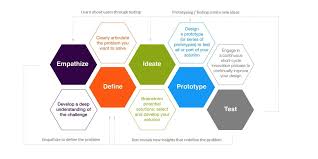
Design thinking is a human-centered, iterative approach to problem-solving that emphasizes empathy, creativity, and experimentation. It's widely used in product development, service design, and innovation across various industries.
Core Principles
The approach is built on understanding users deeply, challenging assumptions, and reframing problems to identify alternative strategies and solutions. It encourages a bias toward action—rapidly prototyping and testing ideas rather than just planning.
The Five Phases
Design thinking typically follows five stages, though they're not always linear:
Empathize - Research and understand your users' needs, experiences, and motivations through observation, interviews, and immersion in their context.
Define - Synthesize your research to articulate the core problem you're solving. This is about framing the right problem rather than jumping to solutions.
Ideate - Generate a wide range of creative solutions through brainstorming and other ideation techniques, suspending judgment to explore possibilities.
Prototype - Create quick, low-fidelity versions of potential solutions to learn what works. These can be anything from paper sketches to digital mockups.
Test - Put prototypes in front of users, gather feedback, and refine your solutions. This often leads back to earlier phases as you learn.
Why It Matters
Design thinking helps teams move beyond incremental improvements to discover innovative solutions. It's particularly valuable for tackling complex, ambiguous problems where the solution isn't obvious. By keeping users at the center and embracing experimentation, it reduces the risk of building something nobody wants.
#Physics#Learning