
Let me tell you about the most predictable conversation I have every year.
A Sec 4 student arrives for their first session, usually sometime in Term 2 or Term 3. They hand me their latest class test. There's a pattern I've seen so many times I can almost guess the score before I look: solid marks on kinematics, reasonable marks on forces, and then — a cliff edge — somewhere around the electricity and magnetism section.
"I just don't get circuits," they say. Or: "I memorised Fleming's Left-Hand Rule but I can never figure out which direction to point my fingers." Or, most commonly: "I thought I understood it, but the question was phrased differently and I just froze."
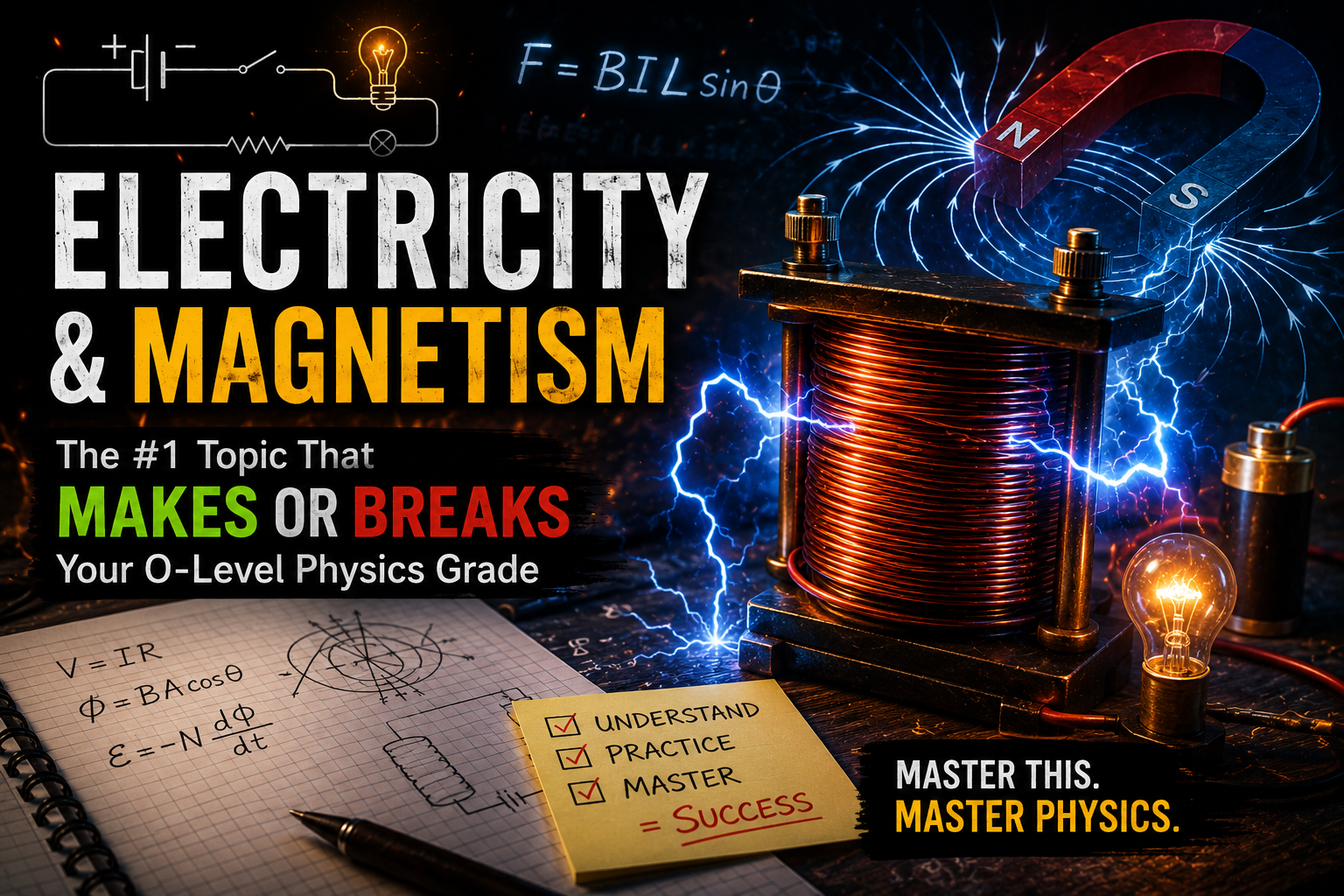
This is not a coincidence. Among all topics in the O-Level Physics syllabus (6091), Electricity and Magnetism is the heaviest in terms of exam weightage. It spans five interconnected sub-topics that together regularly account for 30 to 40 percent of total marks across Paper 1 and Paper 2.
Thirty to forty percent. From one section of the syllabus.
If your child is in Sec 3 or Sec 4, this is the single most important thing to understand about O-Level Physics: electricity and magnetism is not just another topic. It is the topic — the one that, more than any other, determines whether the final grade is an A1 or a C5.
Here is how to actually master it.
Why Electricity and Magnetism Feels Impossible to So Many Students
Before we talk about how to tackle this topic, let's be honest about why it breaks so many students.
Most physics topics have something you can observe directly. You can watch a ball fall and feel gravity. You can push a trolley and feel inertia push back. You can dip your hand in ice water and experience heat transfer in real time.
Electricity is invisible.
You cannot see current flowing through a wire. You cannot watch voltage drop across a resistor. You cannot observe magnetic field lines curling around a conductor. Every single concept in this topic requires you to build and work with a mental model of something you will never directly see — and if that mental model is wrong or absent, no amount of formula drilling will save you.
What makes this topic particularly dangerous is how interconnected it is. A student who does not understand resistance will struggle with circuits. A student who cannot handle circuits will find electromagnetism confusing. The sub-topics stack on each other, which is why students who fall behind early tend to stay behind — and why the marks keep falling right through to Paper 2.
This stacking structure is exactly why electricity and magnetism must be learned conceptually from the start — not formula-first. Let me take you through each layer.
Layer 1: Current Electricity — The Foundation Everything Else Builds On
Every electricity question in the O-Level Physics 6091 paper rests on three relationships: Ohm's Law (V = IR), electrical power (P = IV), and the rules for how current and voltage behave in series and parallel circuits.
These look simple on paper. In practice, they produce the most commonly dropped marks in the entire exam — not because students don't know the formulas, but because they carry one or more of the following misconceptions without realising it.
The "current used up" misconception. Many students believe current decreases as it passes through each component in a series circuit — as if the bulbs are consuming it. This is wrong. Current is the same at every point in a series circuit. What changes is voltage. Knowing the difference between current and voltage — not just their definitions, but their physical reality — is the foundation of everything in DC circuits.
The "parallel branches share current equally" misconception. Students often assume that if a circuit splits into two branches, each branch carries half the current. In reality, more current flows through the branch with lower resistance. Current divides inversely with resistance — which means you need to understand the relationship between resistance, current, and voltage as a dynamic system, not as isolated formulas.
The "voltage is a push" misconception. Voltage is not a push. It is a difference in electric potential — an energy difference per unit charge between two points. Current flows because of this difference, the way water flows downhill because of a height difference. Students who understand voltage as potential difference can reason through unfamiliar circuit configurations. Students who think of it as a "push" get lost the moment the question changes.
The way to build the correct mental model is through prediction exercises — not calculation drills. Before computing anything, ask: What do you expect to happen to the current through Bulb A if I add a second bulb in parallel? Why? Commit to an answer. Trace the reasoning through. Students who practise this habit develop the functional understanding of circuits that separates A1 from B3 on unfamiliar Paper 2 questions.
Layer 2: D.C. Circuits — Where the Marks Are Won and Lost
D.C. circuits is where the biggest concentration of O-Level Physics marks sits — and where mark-scheme analysis reveals the clearest pattern: students lose marks not on calculations, but on explanations.
"Explain why the reading on the ammeter increases when the variable resistor is adjusted."
"State and explain what happens to the brightness of Bulb X when switch S is closed."
"Describe how the potential divider circuit can be used to vary the output voltage."
These are not calculation questions. They are reasoning questions. And they demand that a student can trace a chain of physical causation through a circuit — not just apply V = IR to a single component in isolation.
The conceptual framework that makes these questions tractable is what I call circuit thinking: the habit of reading a circuit as a system, not as a collection of individual components. When a switch is closed, what changes? How does the total resistance change? What does that do to total current? How does that affect the voltage across each component?
This chain of reasoning — total resistance → total current → individual voltage drops — is the template for almost every DC circuits explanation question in the 6091 Paper 2. Students who have it as a habit answer these in two minutes. Students who don't stare at the question for five minutes and write the wrong formula.
Layer 3: Electromagnetism — The Most Conceptually Rich Sub-Topic
Here is where electricity and magnetism intersect in a way that students either find fascinating or completely baffling — and which direction they go depends entirely on whether they have the right mental model.
Electromagnetism covers two related phenomena.
The motor effect: a current-carrying conductor in a magnetic field experiences a force. The direction of that force depends on the directions of the current and the field — which is where Fleming's Left-Hand Rule comes in.
Electromagnetic induction: a conductor moving through a magnetic field, or a changing magnetic field passing through a conductor, generates an induced electromotive force (e.m.f.) and, if the circuit is complete, an induced current.
Most students learn both as rules to memorise: point your thumb this way, fingers that way, and the force comes out here. Then they get a question where the current is going in an unexpected direction, or the conductor is oriented differently, and the rule stops working — because they memorised the gesture, not the principle.
The underlying principle is this: whenever a current flows in a magnetic field, the field exerts a force on the moving charges. The direction of that force is always perpendicular to both the current direction and the field direction. This is a physical reality, not a mnemonic. Understanding it this way means you can reason about any orientation without needing to recall which hand to use.
For electromagnetic induction, the equivalent principle is Lenz's Law: the induced current always flows in a direction that opposes the change creating it. This is a consequence of energy conservation — not a separate rule to memorise, but something you can reason from if you understand what induction physically is.
Students who understand the why behind both of these phenomena find the exam questions straightforward. Students who memorised hand rules but not the principles freeze the moment the question is presented at an unfamiliar angle.
Layer 4: Static Electricity — The Most Underestimated Sub-Topic
Static electricity gets less revision attention than circuits or electromagnetism — which is exactly why it regularly catches students off guard on Paper 1.
The key concepts are charge (positive and negative), the behaviour of insulators and conductors, induction, and the hazards and applications of static electricity.
The most common misconception here is treating static electricity as completely separate from current electricity — when in fact it's the same phenomenon viewed differently. Static electricity is a separation of charge. Current electricity is a flow of charge. The same fundamental property of electrons underlies both.
Students who see this connection can answer static electricity questions by reasoning from first principles, rather than memorising a separate set of facts that feel disconnected from everything else they've learned.
The Study Framework That Produces A1 Results
Here is the approach that Mr. Chew's students at Physics Made Easy use — and that produces a 95% distinction rate across O-Level Physics:
StageWhat to doWhy it worksBuild the mental model firstBefore any formula, draw and explain the physical situationCreates the conceptual scaffold formulas attach toPredict before calculatingState what you expect to happen and why, before solvingExposes misconceptions before they cost exam marksTrace the causation chainFor any circuit question: resistance → current → voltageBuilds the habit that answers explanation questionsUnderstand rules, not just gesturesLearn why Fleming's Left-Hand Rule works, not just the hand positionHandles unfamiliar orientations without freezingConnect the sub-topicsSee static, current, circuits, and electromagnetism as one storyPrevents gaps when topics appear together in one questionPractise explanations lastOnce concepts are solid, practise writing mark-scheme-quality answersConverts understanding into exam marks
The Two Types of Students Who Struggle — and Why
In Mr. Chew's experience at Physics Made Easy, students who struggle most with electricity and magnetism fall into two clear groups.
Group 1 — The Formula Applicators. These students can solve V = IR with any two knowns. They can calculate equivalent resistance in series and parallel. But they cannot explain why the ammeter reading changes when a component is added. They've been taught to calculate, not to reason.
Group 2 — The Rule Memorisers. These students know Fleming's Left-Hand Rule. They can recite Lenz's Law. But they can't apply either one to a scenario that has been rotated 90° from the standard textbook diagram. They've memorised the surface, not the principle underneath.
Both groups need the same thing: a concept-first approach that builds the correct mental model before any formula or rule is introduced — and then uses that model to answer any version of any question.
This is exactly what the Multiple Intelligences framework at Physics Made Easy targets. Spatial learners build the model through diagrams and visualisations of field lines and current flow. Logical learners build it through the internal consistency of cause-and-effect chains. Kinesthetic learners build it through hands-on circuit activities and predictions. Every student gets the entry point that works for how they think — and the result is understanding that holds up under exam pressure, not just in a familiar worked example.
Frequently Asked Questions About O-Level Physics Electricity and Magnetism
How much of the O-Level Physics exam is electricity and magnetism?
Electricity and Magnetism is the single heaviest topic cluster in the 6091 syllabus, spanning five sub-topics that regularly account for 30 to 40 percent of total marks across Paper 1 and Paper 2. No other topic area comes close to this weightage. Getting electricity and magnetism right is not optional for an A1 grade — it is the central battleground of the entire exam.
What are the five sub-topics in the O-Level electricity and magnetism section?
The five sub-topics in the 6091 syllabus are: Static Electricity, Current Electricity, D.C. Circuits, Practical Electricity, and Electromagnetism (including electromagnetic induction). Each builds on the previous one, which is why a conceptual gap in Current Electricity creates compounding difficulty in D.C. Circuits and Electromagnetism. Getting Current Electricity right first is the single most important starting point.
Do I need to memorise Fleming's Right-Hand Rule for O-Level Physics?
The O-Level 6091 syllabus focuses on understanding the relationship between current direction, field direction, and force direction — the mnemonic names are less important than the physical principle. What matters in the exam is being able to determine the direction of force or induced current in any scenario, not whether you can recall a specific hand rule by name. Understanding why the rule works is more exam-proof than memorising the gesture, because it handles unfamiliar orientations without needing to recall which hand to use.
Why do I keep losing marks on electricity explanation questions even when my calculations are correct?
This is one of the most common patterns in O-Level Physics. Calculation marks and explanation marks are awarded separately — and explanation questions require a completely different skill. Getting the number right shows you can apply a formula. Explaining why the ammeter reading changes shows you understand the physics. The chain of reasoning — change in resistance → change in total current → change in voltage distribution — needs to be practised as a conscious habit, not derived from scratch under exam pressure.
How early in Sec 3 should students start taking electricity and magnetism seriously?
Immediately. The Current Electricity foundation introduced in Sec 3 directly determines how well a student handles the more complex DC Circuits and Electromagnetism content in Sec 4. The sub-topics stack on each other — students who fall behind early tend to stay behind. Students who build the correct mental model for current and voltage in Sec 3 find Sec 4 electricity manageable. Students who memorise formulas and move on find themselves overwhelmed when the questions become multi-step.
What's the fastest way to improve in electricity and magnetism before the O-Level exam?
Stop drilling calculations and start explaining. Take any past-year electricity question and, before solving it, write two sentences describing what you expect to happen physically and why. Then solve. Then compare your prediction to your answer. If they don't match, the mismatch reveals the misconception — and finding that misconception is more valuable than any number of practice calculations. This predict-first method is the fastest route from formula knowledge to genuine understanding, and it is the core of how Mr. Chew's students achieve their 95% distinction rate.
Is electricity tested in the O-Level Physics practical exam?
Yes. Electrical circuit practical work — setting up circuits, taking ammeter and voltmeter readings, plotting I-V graphs, and analysing circuit data — is a core practical skill in the 6091 syllabus. The practical paper accounts for 20% of the overall O-Level Physics grade. Students who genuinely understand Current Electricity and DC Circuits handle the practical component with confidence. Students who have only drilled calculations without conceptual understanding find the practical unfamiliar and stressful.
The Takeaway: Electricity and Magnetism Is Winnable — If You Learn It the Right Way
Electricity and magnetism regularly accounts for 30 to 40 percent of total marks in the O-Level Physics exam — which makes it the single largest opportunity in the entire 6091 syllabus. Students who master it genuinely are already halfway to an A1 before they write their first answer.
But mastering it genuinely requires more than memorising formulas and hand rules. It requires a correct mental model of invisible phenomena — current, voltage, magnetic fields, induced e.m.f. — and the reasoning habits to apply that model to any question the paper throws at you.
That is what Mr. Cornelius Chew builds at Physics Made Easy: concept-first, predict-before-formula, explanation-driven O-Level physics tuition in Singapore that turns electricity and magnetism from the topic students fear most into the topic that secures their A1.
Whether your child is just starting electricity in Sec 3 and wants to build the right foundation from day one, or in Sec 4 with Prelims approaching and a circuit misconception that has been quietly costing marks since last year — this is exactly the gap Physics Made Easy is built to close.
Book a free trial lesson at MakePhysicsEasy.com and let Mr. Chew identify — in a single session — exactly where the gap is, and exactly how to fix it before it costs another mark.
Written by Mr. Cornelius Chew, Ex-MOE, NIE-trained physics educator and FIDE-certified chess instructor, MakePhysicsEasy.com — Singapore's concept-first physics coaching centre for O-Level (6091), A-Level H2 Physics (9749/9478), IP, and IB Physics students.