High School Physics Students' Personal Epistemology: What Classroom Practice Really Reveals
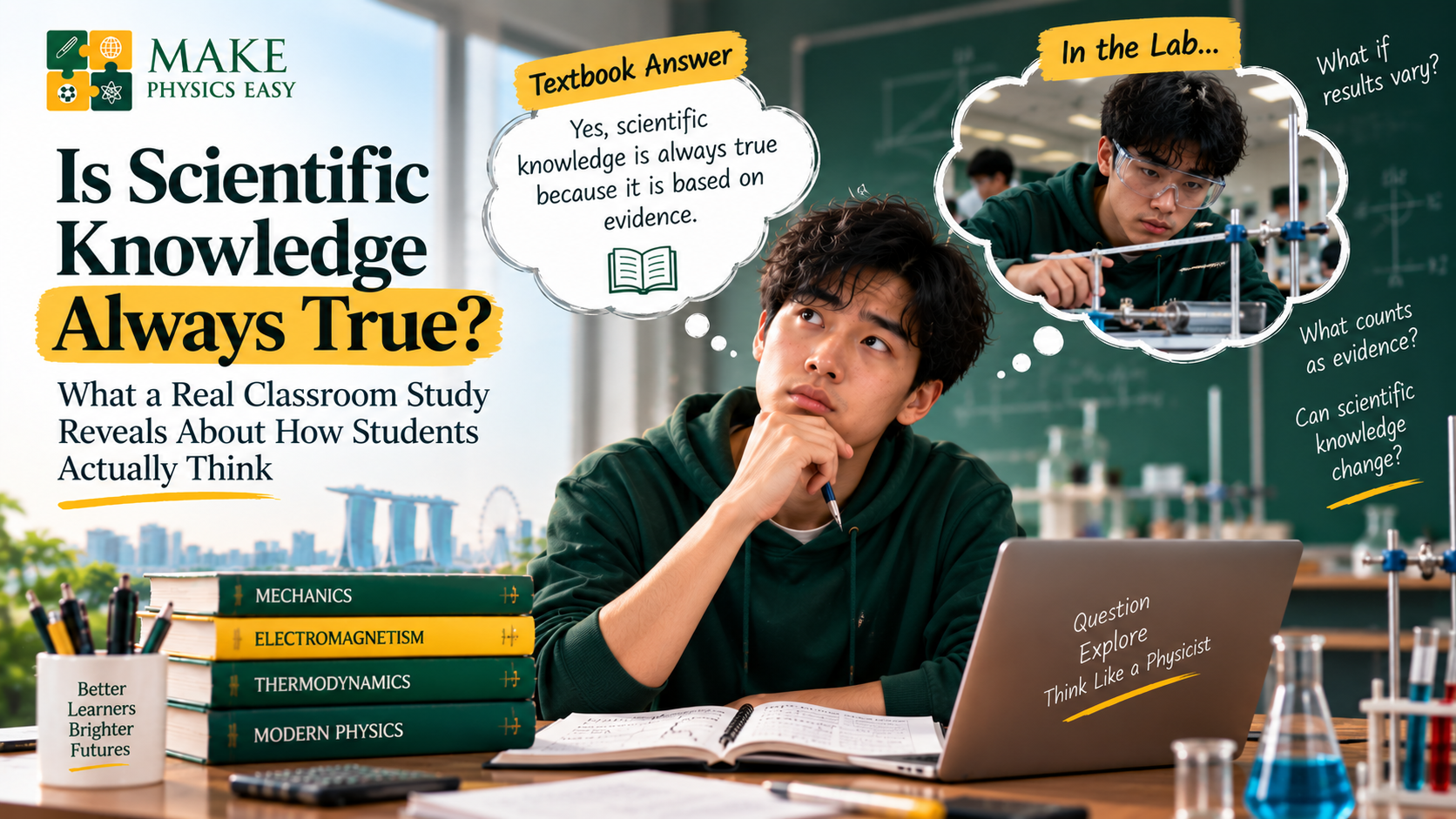
If you have ever asked a physics student "is scientific knowledge always true?" you probably got a confident, textbook-sounding answer. But here is the catch: high school physics students' personal epistemology often looks completely different once you watch what they actually do in the lab. A recent classroom-based case study followed nine eleventh-grade physics students for six weeks, and the findings say a lot about how science education practices shape the way young learners think about knowledge itself.
I spent time digging into this research because I kept running into the same question from teachers and parents: do students really understand how scientific knowledge is built, or are they just repeating phrases they were taught to say? The answer, backed by real classroom transcripts, is more nuanced than a simple yes or no — and it matters for anyone thinking about physics classroom instruction, curriculum design, or inquiry-based learning in science.
What Is Personal Epistemology in Science Education?
Personal epistemology is simply what a student believes about knowledge — where it comes from, how certain it is, and how to justify a claim as true. In science education research, this idea has been studied for decades, but most studies rely on interviews and surveys alone.
The problem with survey-only research is that students can describe scientific knowledge as "tentative" or "evidence-based" in an interview, and then behave completely differently during a real physics lab experiment. This gap between what students say and what they do is exactly what this study set out to capture, using direct classroom observation instead of decontextualized questions.
Why Classroom Observation Changes the Picture
This particular study was conducted in a traditional, formula-driven physics classroom at a charter school in the South Central United States. Over six weeks, researchers audio-recorded lessons covering Newton's laws of motion, work-energy theorem, and conservation of energy, then interviewed students after each activity.
The goal was to understand students' epistemological resources — the specific, context-dependent ideas that students activate in the moment, rather than one fixed "belief system." This framework, built on the work of Hammer and Elby, assumes that a student's thinking about knowledge is not static. It shifts depending on the activity, the teacher's guidance, and the classroom culture around them.
Experiments as the "Ultimate Proof" in Student Thinking
One of the clearest patterns in this high school physics research was that students treated hands-on experimentation as the only legitimate way to verify scientific truth. When their teacher explained Einstein's theoretical work on gravity, students pushed back, asking whether a theory even counts if nobody tested it directly.
This reveals an important gap in physics education: students were not recognizing that theoretical physics and experimental physics are two valid, complementary approaches to building scientific knowledge. Even students who could correctly define a "theory" as an idea that needs testing still leaned heavily on experimental proof as the more trustworthy path — showing how student epistemological beliefs can be inconsistent depending on the specific scientific claim being discussed.
Accuracy Via Following the Right Procedure
A second major theme in student thinking was what researchers called accuracy via following the right procedure. In practice, this meant students assumed that if they followed the exact steps their teacher gave them, their experimental data would automatically be correct.
During a pendulum bob lab, one student stopped and said, "this is not scientific," simply because her measurement technique felt inconsistent — not because she questioned the underlying physics. This shows that many students equate procedural correctness with scientific accuracy, a naive but common epistemological resource in traditional, teacher-directed physics labs.
Accuracy Via What the Others Find
The third pattern is arguably the most interesting for anyone studying peer influence in science learning. Students regularly compared their lab results with nearby groups, and if the numbers were close, they assumed their own scientific data was accurate — regardless of whether the method itself was sound.
This social validation of data works fine for simple, single-answer labs. But it becomes a problem when students apply the same logic to more complex, open-ended scientific questions, where multiple valid outcomes are normal. Interestingly, the study found that students could distinguish between "hard, multiple-answer" experiments (like what real scientists do) and their own simplified, structured classroom labs — a small but meaningful sign of more sophisticated thinking.
Practicing Formula: The Hidden Epistemology of Plug-and-Chug Physics
The final theme, practicing formula, describes how both lecture-based problem-solving and hands-on labs often reduced to the same mental process: memorize the formula, plug in the numbers, get a right or wrong answer. Students themselves noticed the overlap.
One student explained that lab work and worksheet problems were "similar" because both were really about applying the same equation correctly.
This finding is a strong signal for STEM education researchers and curriculum designers: traditional, formula-based physics instruction can quietly train students to see science as a search for the one correct number, rather than a process of building and testing explanations. That belief, repeated across labs and lectures, becomes a naive epistemological resource that limits how students engage with authentic scientific practice.
Who Should Care About This Research?
This study speaks directly to a few groups:
- Physics and science teachers designing lab activities and looking to move beyond "cookbook" experiments
- Curriculum developers working on inquiry-based or project-based science programs
- Education researchers studying personal epistemology, epistemic cognition, or science learning theory
- Parents and students who want to understand why some physics classes feel like memorization instead of discovery
If you fall into any of these groups, the takeaway is the same: student epistemological development is shaped far more by daily classroom practice than by what is written in a syllabus or told in a one-time lecture.
Traditional Instruction vs. Authentic Inquiry Practice

Frequently Asked Questions
Q1: What does "personal epistemology" mean in science education?
Personal epistemology refers to a student's beliefs about what counts as knowledge, how it is developed, and how it should be evaluated. In physics education, this shapes how a student interprets labs, data, and scientific theories.
Q2: Why do high school physics students believe experiments are the only valid proof?
Because most traditional physics instruction emphasizes hands-on labs as verification tools, students often internalize the idea that theoretical physics is less trustworthy — even though both approaches are core parts of real scientific knowledge production.
Q3: What is an "epistemological resource"?
It is a specific, situational idea a student activates about knowledge — for example, "accuracy via following the right procedure." Unlike a fixed belief, an epistemological resource can change depending on the activity or context.
Q4: How does peer comparison affect student data accuracy beliefs?
Students frequently used classmates' results to judge whether their own experimental data was correct. This accuracy via what others find resource works for simple labs but can undermine independent, critical evaluation of data in more complex investigations.
Q5: Can traditional, formula-based physics teaching limit scientific thinking?
Yes. This research suggests that heavy reliance on formula practice and highly structured labs can lead students to see physics as a search for one correct number, rather than a process of reasoning, testing, and revising explanations.
Q6: How can teachers help students build more sophisticated epistemological beliefs?
By using open-ended, project-based inquiry activities where students design their own procedures, encounter multiple valid outcomes, and discuss reasoning — not just results. This helps students move beyond naive epistemological resources toward more authentic scientific practice.
Q7: Why is classroom observation better than interviews alone for studying student epistemology?
Because students can describe scientific knowledge as tentative and evidence-based in an interview, yet act on very different assumptions during a real lab. Observing actual classroom science practice captures beliefs that surveys and interviews often miss.
Final Thoughts
Understanding high school physics students' personal epistemology is not just an academic exercise — it directly affects how students learn to think, question, and evaluate evidence for the rest of their lives. This research makes one thing clear: if we want students to develop sophisticated, flexible scientific reasoning, we need physics classrooms that go beyond formulas and cookbook labs, and instead create space for genuine, open-ended inquiry-based learning.
If you are a teacher, curriculum designer, or researcher working on science education practices, use these findings as a starting point to rethink how your physics labs are structured — because the way students practice science shapes how they believe science works.