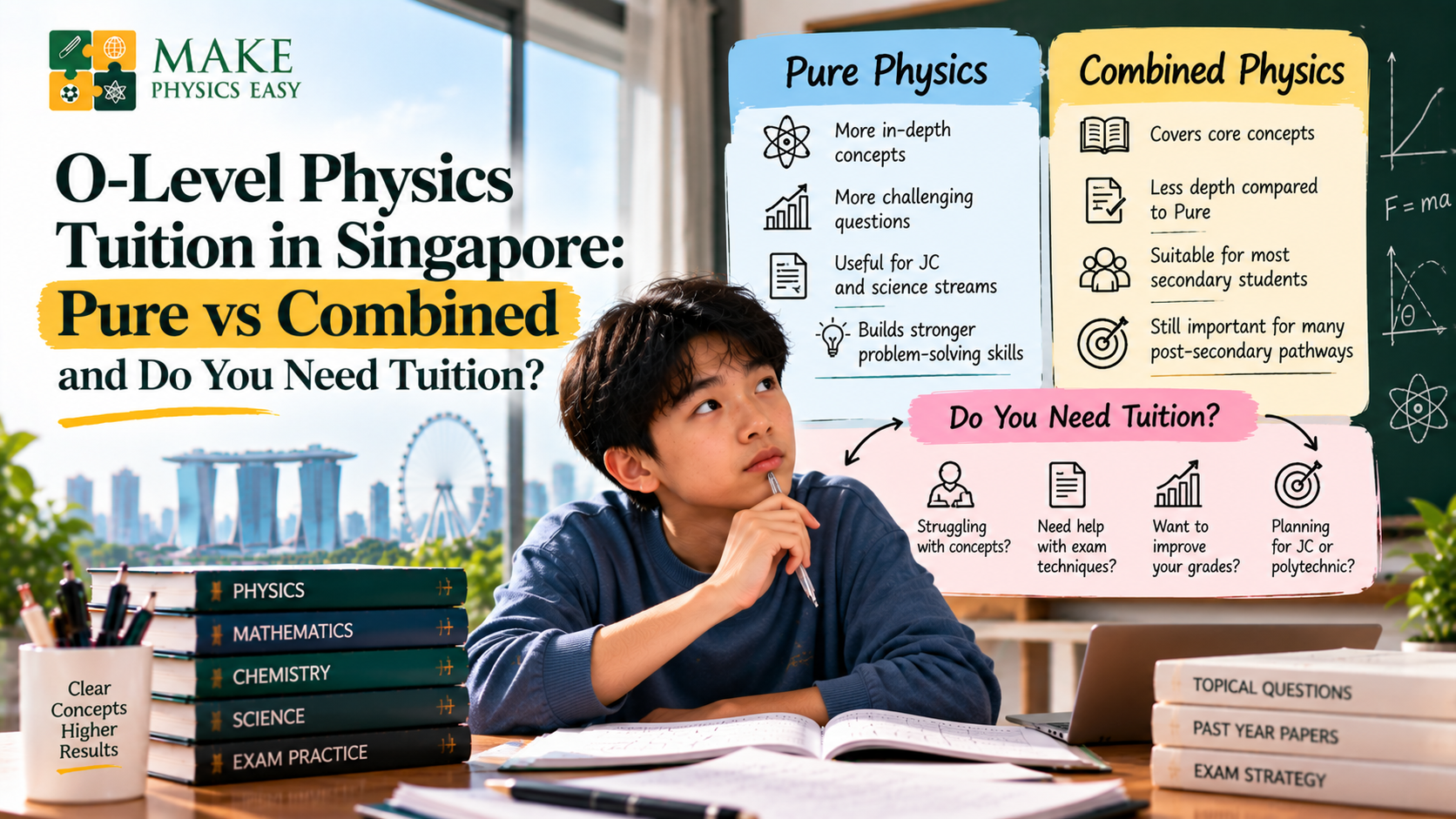
O-Level Physics Tuition in Singapore: Pure vs Combined and Do You Need Tuition?
Pure Physics or Combined Science? Do you actually need O-Level physics tuition in Singapore? This honest guide covers both syllabuses, a full Sec 3 and Sec 4 topic roadmap, warning signs to watch for, and why Physics Made Easy is Singapore's most trusted O-Level physics tuition provider.
A parent I know spent three weeks in Secondary 3 agonising over one question: does her daughter need O-Level physics tuition in Singapore immediately, or can she wait and see how the first term goes?
Her daughter had done fine in lower secondary science. She was organised, hardworking, and genuinely interested in the subject. Surely she would be okay?
By the end of Term 2, the daughter's physics grade had dropped to a D7. Not because she was not trying — she was. But Pure Physics at the O-Level level requires a depth of conceptual understanding and a precision of explanation that lower secondary science never demanded. By the time her parents searched for physics tuition in Singapore for O-Level, she had three months of compounding gaps to untangle before the year-end exam.
This guide is for every parent and student in exactly that situation — and for those smart enough to be reading it in Sec 3 before the gap appears. It covers everything you need to know: the real difference between Pure and Combined Physics, whether your child actually needs O-Level physics tuition, what each year covers topic by topic, and what to look for in a tuition programme that genuinely moves grades.
Pure Physics vs Combined Science Physics: What Is the Actual Difference?
The first confusion most families face when searching for O-Level physics tuition in Singapore is not knowing which syllabus their child is studying — and how that changes what tuition they need.
Both Pure Physics and Combined Science Physics are Singapore-Cambridge O-Level subjects. Both test physics knowledge. But they are structured very differently, and understanding the difference is the first step to finding the right secondary school physics tuition support.
The Key Differences at a Glance

The last row of that table is worth dwelling on. O-Level physics tuition in Singapore is needed by both groups — just for different reasons.
Pure Physics students often underestimate the depth Cambridge expects in explanation questions, the precision of mark-scheme language, and the conceptual leap that topics like Electromagnetic Induction and Static Electricity represent compared to what they covered in lower secondary.
Combined Science students often assume that because their physics syllabus is shorter, they can manage without physics tuition Singapore O-Level support. But Combined Science physics questions still test conceptual understanding — and students who treat the subject as a memorisation exercise tend to drop marks on the explanation questions that carry the most marks.
Do You Actually Need O-Level Physics Tuition in Singapore?
Let us be honest here — because the best physics tuition Singapore O-Level providers are honest about this too.
Not every student needs physics tuition. A Sec 3 or Sec 4 student who is genuinely understanding the physics being taught in class, scoring consistently in the B3 to A2 range, and able to articulate why a concept works (not just how to calculate with it) may not need external O-Level physics tuition support — yet.
But there are clear signs that tuition is not just helpful but necessary. Watch for these:
Sign 1 — The grade drops at a specific topic and does not recover. O-Level physics topics build on each other. A gap in Kinematics in Sec 3 Term 1 creates a gap in Dynamics in Term 2, which creates a gap in Energy in Term 3. If a test result drops and stays low, the issue is usually conceptual — not effort — and it needs a physics tutor in Singapore who can identify and close the gap at its root.
Sign 2 — Your child can do the calculations but cannot explain the physics. Cambridge O-Level physics papers are built around explanation questions — "explain why," "state and explain," "suggest a reason." Students who understand formulas but not the underlying physics almost always plateau at C5 or C6. The move from C to A in O-Level physics tuition is almost entirely about building the ability to explain in mark-scheme language.
Sign 3 — They freeze on unfamiliar question formats. Cambridge regularly presents familiar physics concepts in new scenarios. A student who has only practised past-paper questions in a single format will struggle when the same concept appears in a different context. This pattern-dependency is what Sec 3 and Sec 4 physics tuition in Singapore corrects — by building understanding, not recognition.
Sign 4 — They are in Sec 4 and the O-Level exams are less than 12 months away. For Sec 4 students with any gap at all, O-Level physics tuition Singapore is almost always the right call. There is simply not enough time in the school curriculum to close conceptual gaps, build exam technique, and drill past-year papers before October and November.
Secondary 3 O-Level Physics: Topic Roadmap and What to Build
Secondary 3 is where the O-Level physics journey truly begins — and where the most critical foundation decisions are made. Good Sec 3 physics tuition in Singapore does not just keep pace with school. It builds the conceptual understanding that makes Sec 4 topics manageable.
Secondary 3 Physics Topic Roadmap

What Sec 3 physics tuition in Singapore should achieve: At the end of Secondary 3, a student should be able to explain every topic above in correct Cambridge language — not just calculate with the formulas. The students who reach Sec 4 with both skills are the ones who achieve A1 and A2 in O-Level physics. At Physics Made Easy, Mr Chew's Sec 3 O-Level physics tuition programme uses the Multiple Intelligences methodology to build this dual competence from the very first lesson.
Secondary 4 O-Level Physics: Topic Roadmap and Exam Urgency
Secondary 4 O-Level physics introduces the most conceptually demanding topics in the entire syllabus — and delivers them under the ticking clock of approaching Cambridge examinations. Good Sec 4 physics tuition in Singapore has to do two things simultaneously: teach new content at depth and repair any Sec 3 gaps that were never properly closed.
Secondary 4 Physics Topic Roadmap

What Sec 4 physics tuition in Singapore must deliver: By Sec 4, O-Level physics tuition must shift from pure concept-building to integrated exam performance. This means writing in Cambridge mark-scheme language, managing time across Paper 1, 2, and 3, and answering multi-concept questions that combine topics from different chapters. Mr Chew's O-Level physics tuition programme at Physics Made Easy includes dedicated exam technique sessions built specifically around these skills, informed by his experience as a certified Cambridge UCLES Physics Examiner.
What Changes in Sec 4 — And Why Exam Technique Matters as Much as Content
Sec 4 O-Level physics tuition operates under a different kind of urgency from Sec 3. The Cambridge O-Level papers in October and November are a fixed, immovable deadline — and every week that passes with unresolved topic gaps is a week fewer to close them.
Three things change fundamentally in Sec 4 that O-Level physics tuition in Singapore must address:
Mark-scheme language becomes non-negotiable. A Sec 3 student who writes "the resistance increases so the current decreases" might receive partial credit. In Cambridge O-Level physics Paper 2, the mark scheme is looking for "the resistance of the filament increases, so by Ohm's Law (V = IR), for a constant voltage, the current decreases." The precision of language is the mark. Mr Chew's teaching approach trains this precision from the first session.
Time pressure becomes a real performance factor. Students who understand the physics but run out of time in Paper 2 or Paper 3 do not score what they know. Good Sec 4 physics tuition includes timed practice, deliberate time allocation strategy, and the discipline of answering in proportion to marks available.
Topic integration — questions that combine two or three concepts — become more common. The hardest questions in O-Level physics Paper 3 are not hard because of a single difficult concept. They are hard because they require a student to apply Kinematics reasoning to an Energy question inside a wave scenario. Students who know topics in isolation but cannot connect them will underperform on these high-mark questions.
What Great O-Level Physics Tuition in Singapore Looks Like
Not all physics tuition Singapore O-Level programmes deliver results. Before committing to any tuition provider, check for these non-negotiables:
The tutor has real teaching credentials. For O-Level physics, the right tutor is NIE-trained with MOE school teaching experience — and ideally, Cambridge examiner experience so they know exactly what the mark scheme rewards. A university degree in physics is the starting point, not the qualification.
The programme separates Sec 3 and Sec 4 students. These are different stages of the O-Level journey with different priorities. A tuition programme that treats both years identically is not meeting students where they actually are.
Results are audited and specific. An A1/A2 percentage across named examination levels and multiple years is meaningful. "Great results" without supporting data is not.
Class sizes allow real feedback. In a group of 25 students, a student who writes "the force increases" when Cambridge wants "the net resultant force on the object increases in the direction of motion" will not be corrected. Their error compounds across the year.
Physics Made Easy, led by Mr Chew Kok Mun — a PSC Teaching Scholar, NIE-trained educator, and certified Cambridge UCLES O-Level and A-Level Physics Examiner — meets every one of these criteria. His O-Level physics tuition programme in Singapore carries a 95% A1/A2 rate across audited results from 2001 to 2026. Read the verified case studies and named student testimonials on the results page.
Students who want to prepare for H2 Physics at JC after their O-Levels can also explore the A-Level H2 Physics programme to understand what the O-Level foundation needs to support.
Physics Made Easy vs a Typical O-Level Physics Tuition Centre in Singapore

Frequently Asked Questions About O-Level Physics Tuition in Singapore
Should my child take Pure Physics or Combined Science in Secondary school?
The choice between Pure Physics and Combined Science in Singapore depends on your child's intended post-secondary path and current aptitude for science. Students aiming for JC and considering science-heavy university programmes benefit from the depth of Pure Physics, which covers the full O-Level syllabus including Electromagnetic Induction. Students managing a broader subject load or pursuing a polytechnic pathway may find Combined Science Physics more manageable. Both syllabuses require genuine conceptual understanding — and both benefit from good O-Level physics tuition in Singapore when gaps appear.
When should a Sec 3 student start O-Level physics tuition?
The ideal time to start Sec 3 physics tuition in Singapore is in your first term of Secondary 3 — within the first six weeks. This is when Measurement, Kinematics, and Dynamics begin, and these topics underpin every chapter that follows across Sec 3 and Sec 4. Students who build strong foundations in Sec 3 Term 1 find every subsequent O-Level physics topic easier to learn, and they arrive in Sec 4 without the compounding gaps that typically drag grades down in the examination year.
Is O-Level physics tuition necessary for Combined Science students?
Yes — and more often than Combined Science students expect. Combined Science Physics still tests conceptual understanding, requires precise Cambridge mark-scheme language, and rewards students who can explain physics rather than just recall it. Many Combined Science students underestimate the subject and are caught off guard by explanation questions in their examination paper. Good O-Level physics tuition in Singapore helps Combined Science students build the same conceptual depth that Pure Physics students develop — applied to their shorter but still demanding syllabus.
What O-Level physics topics are hardest for Sec 3 students?
The most commonly misunderstood Sec 3 O-Level physics topics are Kinematics (particularly graph-based questions), Pressure and Archimedes' Principle, Thermal Physics (especially the difference between heat and temperature), and Transfer of Thermal Energy (where students confuse conduction, convection and radiation in explanation questions). All four of these topics rely on conceptual understanding rather than formula recall — which is exactly why they catch students who have been memorising equations rather than building genuine physics understanding.
What does O-Level physics tuition at Physics Made Easy include?
Mr Chew's O-Level physics tuition programme in Singapore includes concept-first teaching using the Multiple Intelligences methodology, guided worked examples using real Cambridge past-year questions, independent practice with live coaching feedback, dedicated mark-scheme language coaching, and timed exam technique sessions. All programmes cover both Pure Physics and Combined Science syllabuses, with separate lesson tracks for Sec 3 and Sec 4 students. A free resources library — including video masterclasses and concept PDFs — is available at makephysicseasy.com/resources at no cost before enrolment.
What results do O-Level students achieve at Physics Made Easy?
Physics Made Easy publishes fully audited O-Level physics results from 2001 to 2026: 95% of O-Level students achieve A1 or A2. Students arrive regularly with D and E grades and improve to A1 or A2 within one to two terms under Mr Chew's structured tuition. Named case studies and verified parent and student testimonials are available on the results and testimonials page. These are not selected highlights — they are declared across every cohort year.
How do I enrol in O-Level physics tuition at Physics Made Easy?
Visit the contact page at Physics Made Easy to book a free trial lesson — a full-length session with no commitment and no upfront fees. You can also explore the complete range of physics tuition programmes or access the free O-Level physics resources library immediately. If your child is already planning ahead for JC, the H2 Physics tuition page explains how the O-Level foundation connects to A-Level success.
The Right O-Level Physics Tuition in Singapore Changes the Trajectory
Whether your child is in Sec 3 building their foundation or in Sec 4 facing the Cambridge papers in less than a year, O-Level physics tuition in Singapore that is concept-first, examiner-informed, and genuinely personalised will always outperform generic syllabus coverage delivered to a large group.
The difference between a D7 and an A1 in O-Level physics is almost never ability. It is almost always understanding — the real, explanatory, mark-scheme-language understanding that good physics tuition Singapore O-Level builds one concept at a time.
Physics Made Easy has been building that understanding for over 20 years, for both Pure Physics and Combined Science students across Secondary 3 and Secondary 4. With a 95% A1/A2 rate, a PSC Teaching Scholar and Cambridge UCLES Examiner leading every lesson, and a free trial with no commitment required — the first step costs nothing.
Explore the O-Level physics tuition programme for Sec 3 and Sec 4 students. Start with the free physics resources library — video masterclasses, concept PDFs, and exam analysis, all free. Or book your free trial lesson today and let Mr Chew show you what the right O-Level physics tuition in Singapore actually feels like.
📍 Physics Made Easy | 186 Toa Payoh Central, Lobby H 02-430, Singapore 310186 | +65 9727 7419 | www.makephysicseasy.com