The Physics Behind Black Holes — And How Scientists Just Recreated One in a Lab
Let me start with the headline that stopped my students mid-conversation last month.
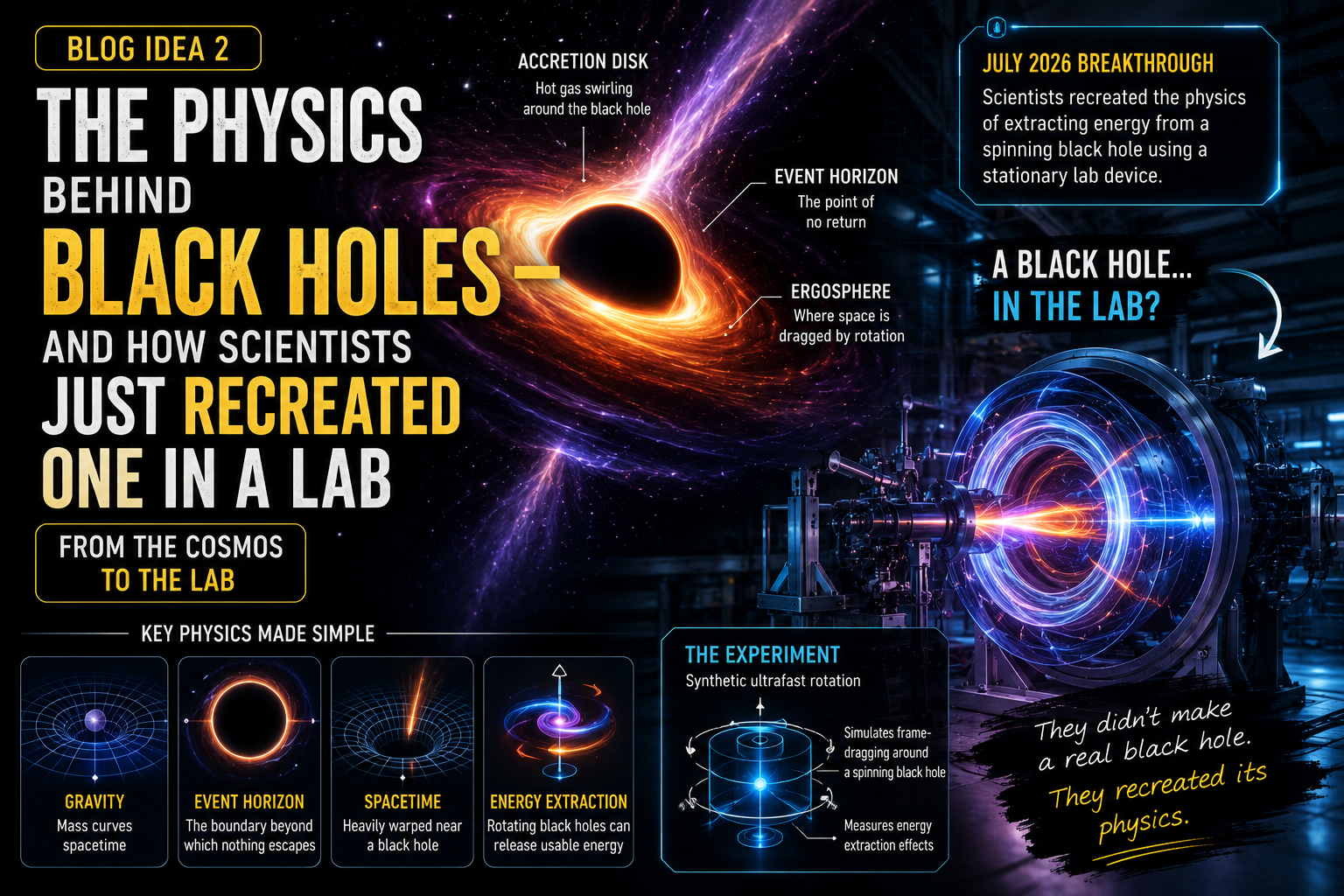
In July 2026, physicists at the CUNY Graduate Center published a paper in Nature describing something that sounds like it belongs in a science fiction film: they recreated the physics of extracting energy from a spinning black hole — inside a stationary ring of electronic components that fits on a lab bench.
No actual black hole. No rotating machinery. Just a cleverly engineered device that made electromagnetic waves think they were interacting with an object spinning faster than the speed of light.
The reaction from students was exactly what you'd expect: "Wait. They did what?"
That reaction is the right one. Because what happened in that lab is genuinely remarkable — and understanding why it's remarkable requires understanding some of the most fascinating physics in the universe. Gravity. Spacetime. Event horizons. And a 50-year-old theory from one of the most famous physicists alive.
Let's build up to it properly.
What Is a Black Hole, Really?
Most students have heard the standard line: a black hole is a region in space with gravity so strong that nothing — not even light — can escape.
That's true. But it doesn't really explain why, and the "why" is where the interesting physics lives.
To understand black holes, you need to understand gravity not as Newton described it — a force acting between masses across empty space — but the way Einstein's General Theory of Relativity describes it: as a curvature of spacetime.
In Einstein's picture, mass doesn't pull other objects toward it. Mass bends the fabric of spacetime around it, and other objects follow the curves in that fabric. The Earth orbits the Sun not because the Sun pulls it, but because the Sun's mass curves spacetime, and the Earth follows that curve.
Now imagine a mass so enormous, compressed into such a small space, that the curvature of spacetime around it becomes extreme — so extreme that all paths through spacetime, including the path light travels, curve back inward. That's a black hole. <cite index="30-1">A region of spacetime where gravity is so intense that nothing, not even light, can escape.</cite>
The boundary where this happens has a name: the event horizon.
The Event Horizon: The Universe's Most One-Way Door
<cite index="31-1">The event horizon is the point of no return — the boundary beyond which no signal, particle, or information can reach an outside observer.</cite>
Nothing dramatic happens at the event horizon. There's no wall, no explosion, no visible surface. If you fell toward a black hole, you wouldn't feel the event horizon as you crossed it. From your perspective, you'd cross it smoothly. The problem is that the moment you did, every possible path through spacetime — including the path back out — would point inward, toward the singularity at the centre.
<cite index="30-1">The radius of the event horizon — called the Schwarzschild radius — can be calculated using rs = 2GM/c², where G is the gravitational constant, M is the mass of the black hole, and c is the speed of light.</cite> This equation tells you something striking: every object in the universe has a Schwarzschild radius. For the Sun, it's about 3 kilometres. For the Earth, it's about 9 millimetres. The only reason the Earth isn't a black hole is that its actual radius (6,400 km) is vastly larger than its Schwarzschild radius. If you compressed the Earth to 9 millimetres across, it would become one.
For students studying gravitational fields in H2 Physics (9749/9478) or IB Physics Theme D, the Schwarzschild radius is a direct application of escape velocity — the speed required to break free of a gravitational field. At the event horizon, the escape velocity equals the speed of light. And since nothing travels faster than light, nothing escapes.
Spinning Black Holes and the Ergosphere
Here's where the story gets stranger — and where the July 2026 experiment comes in.
Not all black holes are the same. A non-rotating black hole (called a Schwarzschild black hole) is the simplest case. But most real black holes in the universe spin — sometimes at extraordinary speeds, close to the maximum allowed by physics. These are called Kerr black holes, after the physicist Roy Kerr who first solved Einstein's equations for a rotating mass.
A spinning black hole doesn't just bend spacetime. It drags spacetime around with it, the way a spinning ball drags the water around it in a whirlpool. This effect is called frame dragging.
Outside the event horizon of a spinning black hole, this frame dragging creates a region called the ergosphere — a zone where spacetime itself is being pulled around so fast that nothing can remain stationary relative to the distant universe. Even light, even a stationary rocket with its engines on maximum thrust, gets swept around. The name comes from the Greek word ergon, meaning energy — because the ergosphere is a region where energy can, in theory, be extracted from the black hole.
That's what the July 2026 experiment is about.
The Penrose Process: Stealing Energy From a Black Hole
<cite index="24-1">More than half a century ago, Sir Roger Penrose envisioned a scenario in which energy could be extracted from a black hole spinning at extreme speeds. He proposed that a particle entering the ergosphere could split into two. One part could fall into the black hole while the other escaped carrying more energy than the original particle.</cite>
Read that again. The escaping piece carries more energy than the original particle brought in. The extra energy comes from the rotational energy of the black hole itself — the spinning black hole slows down, ever so slightly, and that energy goes into the escaping particle.
It sounds like it breaks conservation of energy. It doesn't. The piece that falls into the black hole carries negative energy — a concept that makes sense inside the ergosphere, where spacetime itself is distorted — and the total energy balance is maintained.
<cite index="24-1">Building on this theory, physicist Yakov Zel'dovich later predicted that waves — such as electromagnetic waves — could also gain energy if they interacted with a rapidly spinning object. Instead of losing energy, the waves would become stronger, a process known as wave amplification.</cite>
This combined idea — the Penrose–Zel'dovich process — has been one of the most intriguing theoretical predictions in all of astrophysics for over 50 years. The only problem was that testing it required a black hole spinning at near-extreme speeds. Until now.
What Scientists Actually Built in July 2026
<cite index="21-1">Researchers at the Advanced Science Research Center at the CUNY Graduate Center set out to answer a fundamental question: could electromagnetic waves interacting with a completely stationary device behave as though they were encountering an object rotating at ultrafast speed and draw energy from that synthetic motion?</cite>
Their answer — published in Nature on 8 July 2026 — was yes.
<cite index="21-1">To investigate, they constructed a ring of electronic resonators whose properties were rapidly adjusted in a carefully synchronised sequence. Although the hardware itself never moved, these timed changes generated a travelling pattern around the ring. As a result, the electromagnetic waves effectively experienced the system as though it were spinning at extraordinary speed.</cite>
The device created what physicists call synthetic rotation — the appearance of ultrafast spinning, produced entirely by time-varying electronic signals, without any physical movement at all.
<cite index="22-1">When the researchers sent electromagnetic waves into the system, something remarkable happened. Certain waves were able to draw energy from the synthetic rotation and became stronger as they travelled through the device. This closely matched the behaviour predicted decades ago by Penrose and Zel'dovich.</cite>
<cite index="22-1">The researchers say this is the first successful demonstration of this type of wave amplification using synthetic rotation. It transforms an idea that once belonged only to theoretical physics into a real laboratory experiment.</cite>
And there's a detail that makes this even more striking: <cite index="26-1">according to the Nature paper, the synthetic rotation reached effective superluminal speeds — apparently faster than light — allowing researchers to access rotational regimes that cannot be achieved through conventional mechanical systems.</cite> This doesn't break physics. <cite index="22-1">Synthetic rotation can imitate apparent motion faster than the speed of light without requiring matter or information to physically travel at that speed.</cite> The pattern moves; the matter doesn't.
The Wave Physics You Already Know — Applied to Black Holes
Here's the connection that should excite every Singapore physics student reading this.
The Penrose–Zel'dovich process is fundamentally about wave behaviour. Specifically, it's about what happens when a wave interacts with a rotating system — whether that system is a real black hole or a cleverly engineered ring of electronic resonators.
The key phenomenon is superradiance: the wave extracts energy from the rotating system and is amplified. This is a direct extension of wave concepts you've already studied.
In your H2 Physics waves and superposition topic, you learned that waves can add together constructively or destructively — reinforcing or cancelling depending on phase relationships. <cite index="11-1">Understanding path difference and phase relationships is essential for later quantum physics topics</cite> — and it's also essential for understanding how the Penrose process works at a wave level. The amplified waves in the CUNY experiment are strengthened through precisely the same kind of interference physics that produces bright fringes in a double-slit experiment.
For IB Physics students studying Theme C (Wave Behaviour), the experiment is a stunning real-world demonstration of wave-energy transfer — the same principles that explain how a microwave oven heats food, how radio antennas transmit, and how acoustic resonators amplify sound, now applied to the physics of black holes.
Black hole conceptPhysics you already knowGravitational field and escape velocityH2 Physics: Gravitational fields, g = GM/r², escape velocityEvent horizon (escape velocity = c)H2 Physics: Gravitational potential, circular orbitsFrame dragging and ergosphereExtension of rotational mechanics (angular momentum)Wave amplification / superradianceH2 Physics: Wave superposition and interferenceSynthetic rotation (the 2026 experiment)Electromagnetic waves + time-modulated resonatorsEnergy extraction from rotationConservation of energy applied to rotating systems
Why This Experiment Matters Beyond Black Holes
<cite index="21-1">The achievement transforms a long-standing theoretical idea into a practical experiment and could inspire new advances in optics, wireless communications, and quantum science.</cite>
Superradiant wave amplification — if it can be engineered reliably and scaled — opens possibilities in signal processing, antenna design, and quantum information that don't currently exist. The ability to amplify specific waves by extracting energy from a controlled synthetic rotation, without any moving parts, is the kind of physics-to-technology translation that historically takes decades to arrive and then reshapes entire industries when it does.
More immediately, the experiment gives physicists an experimental platform to test ideas about rotating systems that were previously inaccessible — not just black holes, but any rotating astrophysical object whose extreme conditions can be mimicked in a lab through synthetic rotation.
Who This Connects To in Physics History
Sir Roger Penrose — whose 1969 theoretical prediction sits at the heart of this experiment — was awarded the Nobel Prize in Physics in 2020 for proving that black holes are a robust prediction of General Relativity. He shared the prize with Andrea Ghez and Reinhard Genzel, who provided the first direct observational evidence of a supermassive black hole at the centre of our galaxy.
The fact that a theory Penrose proposed in 1969, for which he received the Nobel Prize in 2020, has now been verified experimentally in 2026 is a reminder of one of the most important truths in physics: theoretical predictions made decades before they can be tested are often correct. General Relativity predicted gravitational waves in 1916. We detected them in 2015. Penrose predicted energy extraction from rotating black holes in 1969. We demonstrated it in a lab in 2026.
Physics has a long memory — and a remarkable track record.
Frequently Asked Questions About Black Holes and the 2026 Experiment
What is an event horizon and why can't anything escape from it?
An event horizon is the boundary around a black hole where the escape velocity — the speed needed to break free of the gravitational field — equals the speed of light. <cite index="30-1">Since general relativity describes gravity not as a force but as a curvature of spacetime caused by mass</cite>, the event horizon marks the point where spacetime curves so severely that all paths, including the path of light, point inward. Nothing travels faster than light, so nothing can escape. In H2 Physics, this connects directly to the gravitational field and escape velocity topics in the 9749/9478 syllabus.
What is the ergosphere and how is it different from the event horizon?
The event horizon is the point of no return — cross it and you can't come back. The ergosphere is a region outside the event horizon that only exists around spinning black holes. Inside the ergosphere, spacetime is dragged around so fast by the black hole's rotation that nothing can remain stationary — but crucially, objects can still escape. The ergosphere is where the Penrose process happens: energy can be extracted from the black hole's rotation by particles or waves that enter the ergosphere and leave again.
How did the CUNY experiment recreate black hole physics without an actual black hole?
<cite index="20-1">The researchers built a ring-shaped network of electronic resonators whose properties were rapidly modulated in a carefully timed sequence, producing a travelling pattern around the ring. Although the device itself did not move, the travelling pattern made the electromagnetic waves perceive the system to be rotating at ultrafast speed.</cite> This is "synthetic rotation" — the appearance of spinning, created by timed electronic signals. <cite index="22-1">Certain waves were then able to draw energy from this synthetic rotation and became stronger, closely matching the behaviour predicted by Penrose and Zel'dovich.</cite>
Does the "faster than light" rotation in the experiment break physics?
No — and this is an important distinction. <cite index="22-1">Synthetic rotation can imitate apparent motion faster than the speed of light without requiring matter or information to physically travel at that speed.</cite> The pattern appears to move faster than light; no actual particle or signal does. This is similar to how a laser dot swept rapidly across a distant screen can appear to move faster than light — the dot is a pattern, not a physical object, so no physical law is violated.
How does this experiment connect to what I'm studying in H2 Physics or IB Physics?
The wave amplification in the CUNY experiment relies on the same interference and superposition principles covered in the H2 Physics waves topic and IB Physics Theme C. The gravitational field and escape velocity concepts in H2 Physics (9749/9478) are the direct mathematical foundation for understanding the event horizon and Schwarzschild radius. For IB Physics students, the experiment connects to gravitational fields in Theme D and wave behaviour in Theme C. The black hole context gives every one of these topics a real, current, and genuinely exciting application.
What are the real-world applications of the Penrose–Zel'dovich process?
<cite index="21-1">The achievement could inspire new advances in optics, wireless communications, and quantum science.</cite> Superradiant wave amplification without moving parts has potential applications in signal processing, antenna technology, and quantum information systems. More broadly, the ability to use synthetic rotation to access physical regimes previously only achievable near astrophysical objects opens an entirely new class of experiments in fundamental physics.
Was Roger Penrose right about more than just black holes?
Penrose's contributions to physics span decades. His 1969 prediction about energy extraction from rotating black holes is just one example of a theoretical idea that took over 50 years to verify experimentally. He's also known for his work on the geometry of spacetime, the mathematics of quantum mechanics, and the nature of consciousness and computation. The Nobel Prize he received in 2020 recognised his proof that black hole formation is a robust prediction of General Relativity — meaning black holes aren't a mathematical quirk but a necessary consequence of Einstein's equations whenever enough mass is concentrated in a small enough space.
The Takeaway: The Universe's Most Extreme Physics, Brought Into a Lab
A ring of electronic resonators on a lab bench. No black hole. No rotation. And yet — electromagnetic waves extracted energy from synthetic spinning, amplified themselves, and reproduced the essential physics of one of the most exotic phenomena the universe contains.
<cite index="5-1">Something remarkable has been happening in physics in 2026 — theoretical ideas that lived for decades on chalkboards and in equations are making the transition into real experiments.</cite> The Penrose process is one of them. Quantum computing is another. Gravitational wave detection started the same way, with a prediction made in 1916 and an experiment completed in 2015.
This is why physics education matters beyond the exam. The concepts Singapore students are studying right now — gravitational fields, wave superposition, electromagnetic waves, conservation of energy — are the exact foundations of the experiments making international news today.
At MakePhysicsEasy.com, every topic in the O-Level Physics (6091), A-Level H2 Physics (9749/9478), and IB Physics syllabus is taught with this in mind: not as an isolated exam topic, but as a piece of understanding that connects to the real, living science happening right now.
Because the student who genuinely understands gravitational fields and wave superposition doesn't just pass the exam. They read a headline about a lab recreating black hole physics — and they understand exactly why it's remarkable.
Book a trial lesson at MakePhysicsEasy.com and start learning physics the way it was always meant to be understood.
Written by Mr. Cornelius Chew, Ex-MOE, NIE-trained physics educator and FIDE-certified chess instructor, MakePhysicsEasy.com — Singapore's concept-first physics coaching centre.
Source: "Floquet-based rotation and rotational superradiance," published in Nature, July 8, 2026. DOI: 10.1038/s41586-026-10725-y. CUNY Advanced Science Research Center.