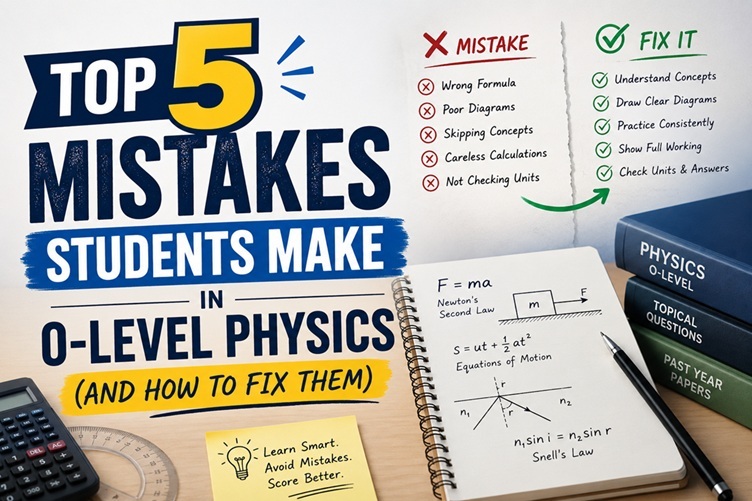
Top 5 Mistakes Students Make in O-Level Physics (And How to Fix Them)
If you've ever walked out of an O-Level Physics exam feeling like you knew the content — but still lost marks — you're not alone. I've spoken to dozens of Secondary 3 and 4 students in Singapore who said the same thing: "I studied, but I still didn't know what went wrong."
The truth is, most students don't fail O-Level Physics because they're not smart enough. They fail because they repeat the same five mistakes, paper after paper, without anyone pointing them out clearly. If you're trying to learn O-Level Physics in Singapore the right way, fixing these five mistakes will do more for your grade than three extra weeks of revision.
Let's break them down — and more importantly, let's fix them.
Mistake #1: Memorising Formulas Without Understanding What They Mean
This is the single most common mistake I see among students preparing for O-Level Physics. They copy formulas into a notebook, memorise them before the exam, and then freeze when the question is phrased differently from what they expected.
Physics is not a memorisation subject. Every formula tells a story. Take v = u + at. This isn't just symbols — it's saying that your final speed depends on where you started, how long you accelerated, and how strong that acceleration was. When you understand why the formula works, you can apply it even when the question twists the scenario.
The fix: For every formula you learn, write one sentence explaining it in plain English. Then solve at least three questions where you identify which formula applies before you even plug in numbers. This trains your brain to reason, not just recall.
Mistake #2: Skipping Units and Significant Figures
This one costs marks silently. Students solve the entire problem correctly — the physics reasoning is right, the arithmetic is right — and then they write v = 12 instead of v = 12 m/s. One mark gone. Then they round incorrectly and lose another.
In Singapore's O-Level Physics exam, examiners are trained to check units and significant figures. It's not pedantic — it's part of scientific communication. A speed without a unit is meaningless.
The fix: Make it a habit to write the unit every single time you write a numerical answer, even in your rough work. At the end of each calculation, ask yourself: "Does this answer make physical sense? Is the unit correct? Have I rounded to the right number of significant figures?" This 10-second check can recover marks you didn't even know you were losing.
Mistake #3: Not Drawing Diagrams for Kinematics and Waves Questions
When students see a kinematics or waves question, many go straight to equations. This is a mistake. A quick, labelled diagram is often the difference between a correct setup and a wrong one.
In kinematics, drawing a simple timeline or velocity-time graph forces you to identify what's given (u, v, a, s, t) and what's missing. In waves, sketching the wavefront or the ray diagram helps you see the geometry clearly — especially in reflection, refraction, and diffraction questions.
O-Level Physics exam tips from top scorers almost always include this: draw before you calculate.
The fix: Before writing any equation for kinematics, waves, or optics questions, spend 60 seconds drawing a labelled diagram. Mark all the known values on it. This alone prevents at least two or three errors that happen when students try to hold the whole scenario in their head.
Mistake #4: Confusing Concepts That Sound Similar
This is where many students drop marks on MCQ papers. O-Level Physics is full of concept pairs that sound alike but behave very differently:
- Speed vs. Velocity — one is scalar, one is vector
- Current vs. Voltage — students often mix up which is constant in a series circuit vs. a parallel circuit
- Resistance vs. Resistivity — one depends on the material, the other depends on dimensions too
- Transverse vs. Longitudinal waves — the direction of oscillation is opposite to what many expect
When a student hasn't clearly separated these pairs in their mind, they pick the wrong one under exam pressure every time.
The fix: Create a concept comparison table for every "confusable pair" in your syllabus. Write the definition, one real-life example, and one key difference. Review these weekly — not just before the exam. If you're learning O-Level Physics in Singapore, your teacher or tutor should be covering these pairs explicitly. If they're not, flag it.
Mistake #5: Losing Marks on the Last Step — Explaining the Physics
Here's a mistake that almost no one talks about: students solve a problem correctly but write their explanation wrong — and lose the method mark.
In structured questions, SEAB examiners often award one or two marks specifically for your reasoning, not just your final number. A question might ask: "Explain why the reading on the ammeter increases when the temperature of the thermistor rises."
Many students write: "Because resistance decreases." That's incomplete. The full chain is: temperature rises → resistance of thermistor decreases → for the same voltage, current increases (I = V/R) → ammeter reading increases. Each step is a mark.
This is one of the most overlooked O-Level Physics exam tips — always write the full cause-and-effect chain.
The fix: When answering "explain" or "describe" questions, use this rule: never stop at one step. Ask yourself, "And then what happens?" until you reach the observable result the question is asking about. Use physics terms and refer to equations where you can.
How These Mistakes Compare — and What to Prioritise
MistakeWhere It Costs MarksEffort to FixImpact on GradeMemorising without understandingPaper 1 MCQ, Paper 2 structuredMediumHighMissing units and sig figsEvery numerical answerLowMediumSkipping diagramsKinematics, Waves, OpticsLowHighConfusing similar conceptsPaper 1 MCQMediumHighIncomplete explanationsPaper 2 structured "explain" QsMediumVery High
If you're short on time, fix Mistake #3 and Mistake #5 first — they require the least new knowledge and give the biggest mark return.
Who Makes These Mistakes Most?
These five mistakes cut across all ability levels. I've seen them in students scoring in the 40s who are just starting to find their footing — and in students scoring in the 70s who can't figure out why they're not breaking into the A grade band.
If you're in Secondary 3 just starting to learn O-Level Physics in Singapore, fixing Mistakes 1 and 4 early will build a foundation that pays off for the next two years. If you're in Secondary 4 preparing for the actual exam, Mistakes 3 and 5 are your quickest wins right now.
The students who make it to an A1 or A2 aren't necessarily the most naturally talented — they're the ones who stopped making these five mistakes before everyone else did.
Frequently Asked Questions
Q1: What are the hardest topics in O-Level Physics Singapore?
Most students find Electricity, Kinematics, and Waves the hardest. Electricity is conceptually tricky because of the difference between series and parallel circuits. Kinematics trips students up with direction and sign conventions. Waves has a lot of terminology and diagram-based questions. These are also the three topics where the five mistakes above cost the most marks.
Q2: How many hours should I study for O-Level Physics each week?
A realistic target for most students is 6–8 hours per week for Physics alone during Secondary 4. This includes class time, topical practice, and timed paper practice. Quality matters more than quantity — 90 minutes of focused practice with immediate review is worth more than three hours of passive re-reading.
Q3: Is it possible to go from a D to a B in O-Level Physics in one semester?
Yes — and it happens regularly. The key is identifying exactly where marks are being lost. Most students who jump two or three grade bands do it by fixing systematic mistakes (like the five above) rather than learning entirely new content. A good Physics tutor in Singapore will diagnose your specific weak points quickly.
Q4: What are the best O-Level Physics exam tips for the structured paper?
The biggest tips for Paper 2 are: (1) draw diagrams before calculating, (2) write the full reasoning chain for every "explain" question, (3) check units on every numerical answer, and (4) re-read the question after you answer to make sure you addressed what was actually asked. Many marks are lost by answering a related question rather than the actual one.
Q5: How do I learn O-Level Physics in Singapore effectively if I find it boring?
Connect the concepts to real life. Kinematics is how your car accelerates. Electricity is why your phone charges faster with some cables than others. Waves explain how your earphones cancel noise. Once physics stops feeling abstract, it gets easier to engage with — and the exam questions start making more sense too. Good teachers and tutors use real-world anchors constantly.
Q6: Should I focus on understanding concepts or just drilling past-year papers?
Both — but in the right order. Understand the concept first, then drill. Students who go straight to past-year papers without conceptual clarity just practise making the same mistakes faster. Once you understand a topic well, past-year papers are extremely useful because SEAB recycles question formats and types regularly.
Q7: What is the format of the O-Level Physics exam in Singapore?
The O-Level Physics exam in Singapore has Paper 1 (40 MCQ questions, 1 hour) and Paper 2 (structured and free-response questions, 1 hour 45 minutes). There is also a School-Based Science Practical Assessment (SPA) conducted by your school. Understanding the format — and practising each paper type separately — is a basic O-Level Physics exam tip that many students skip.
Fix the Mistakes, Fix the Grade
O-Level Physics in Singapore is a demanding subject — but it's also one of the most learnable ones when you know exactly what's going wrong. The five mistakes in this post aren't random. They show up again and again because they're rooted in how students are taught to study, not how physics actually works.
Stop memorising. Start understanding. Draw the diagram. Write the full chain. Check your units.
If you want structured support to learn O-Level Physics in Singapore — with a curriculum designed to address exactly these mistakes, topic by topic — explore a Physics tuition programme that teaches reasoning, not just content. The right guidance at the right time can move a C to an A faster than most students expect.
Your next exam doesn't have to look like the last one.