A Sec 4 student asked me something recently that I didn't expect.
We had just finished a session on wave-particle duality — one of the newer additions to the H2 Physics syllabus — and she looked up from her notes and said: "Sir, this stuff about electrons behaving like waves... is this what quantum computers use?"
I told her yes, essentially. And then I watched her expression change from mild interest to something closer to genuine curiosity.
"So I'm already learning the physics behind quantum computing?" she said.
She was. And most Singapore students don't realise it.
Quantum computing has been generating extraordinary amounts of attention in 2026 — in government policy announcements, in technology investment headlines, and increasingly in the conversations parents are having about their children's future careers. Singapore has committed S$300 million through its National Quantum Strategy to build a world-class quantum ecosystem, the Centre for Quantum Technologies at NUS has grown into one of the largest quantum research facilities in Asia, and quantum-related job listings in Singapore are now numbering in the dozens with salaries for research scientists ranging from S$120,000 to S$180,000 a year.
This is not a distant future. It is happening now, in Singapore, in institutions your child could one day work at — and the foundation for all of it is the physics being taught in O-Level and A-Level classrooms today.
Here is what quantum computing actually is, why it matters, and why every Singapore physics student should care about it far more than they currently do.
Why Your Laptop Has Limits — And What That Has to Do With Physics
To understand quantum computing, you first need to understand what ordinary computers cannot do.
Every classical computer — your laptop, your phone, the servers that run Netflix and Google — processes information as bits. A bit is binary: it is either 0 or 1. Everything your computer does, from streaming a video to running a spreadsheet, is ultimately a long sequence of 0s and 1s being processed at high speed.
This works brilliantly for most tasks. But there is a class of problem where even the most powerful classical supercomputer in the world fails — not because it is too slow, but because the number of possible combinations it needs to consider grows exponentially with the size of the problem.
Simulating how a complex drug molecule folds and interacts with a protein target. Finding the shortest route through millions of interconnected logistics nodes. Factoring an enormous number into its prime components — which is, not coincidentally, the mathematical foundation of most internet encryption today.
For these problems, a faster classical computer is not the answer. The only path through is a fundamentally different kind of computation — one built not on the physics of switches and circuits, but on the physics of quantum mechanics.
The Physics You Are Already Learning — Applied to Computing
Here is the part that should excite every student sitting O-Level or A-Level Physics in Singapore right now.
Quantum computing is not built on new physics. It is built on the same quantum physics concepts that appear in the Singapore syllabus — concepts that students often find abstract and disconnected from real life, but that turn out to be the operating principles of the most consequential technology of the next decade.
Wave-particle duality is the discovery that particles like electrons and photons do not behave purely as particles or purely as waves — they behave as both, depending on how you observe them. This is not a metaphor or an approximation. It is a experimentally verified feature of reality at the quantum scale, demonstrated most famously by the double-slit experiment, where a single electron fired at a screen with two slits produces an interference pattern — as if it passed through both slits simultaneously.
For students studying H2 Physics under the new 9478 syllabus, or IB Physics under Theme E, wave-particle duality is a required topic. For quantum computing, it is a foundational operating principle.
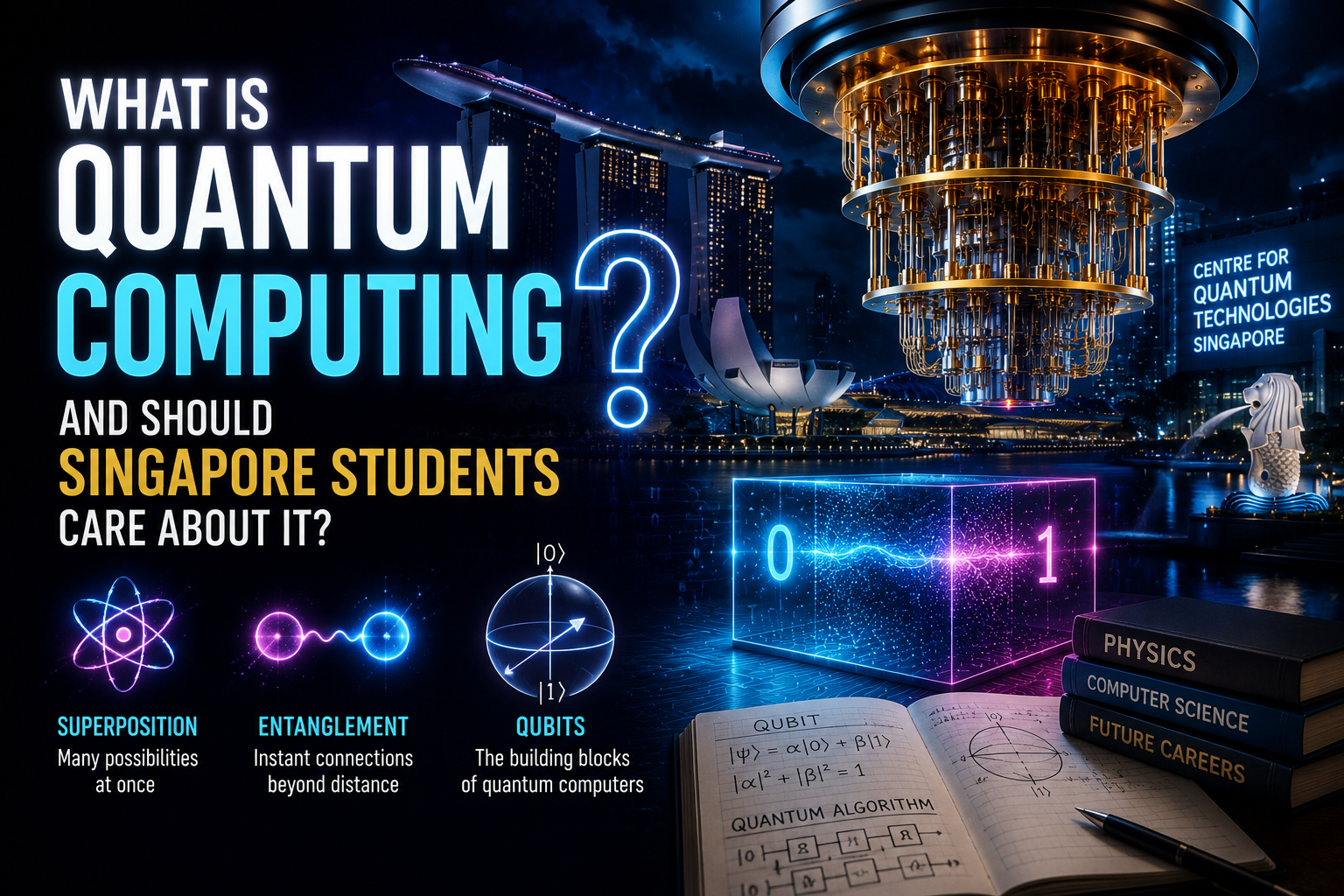
Superposition is the quantum property that a particle can exist in multiple states simultaneously until it is measured. In classical computing, a bit is always either 0 or 1. A quantum bit — called a qubit — exploits superposition to exist as 0, 1, or any combination of both at the same time. When you measure it, it resolves into a definite state. But until that measurement happens, the qubit carries information about all its possible states simultaneously.
This is the same superposition principle you encounter in wave topics — where two waves overlap and their amplitudes add together. In quantum mechanics, the states of a particle superpose in the same mathematical way, which is why the wave description and the quantum description are not separate ideas but the same physics viewed at different scales.
Quantum entanglement is the phenomenon where two particles become linked in such a way that measuring the state of one instantly determines the state of the other, regardless of the distance between them. Einstein famously called this "spooky action at a distance" and spent years arguing it could not be real. Decades of experiments confirmed it is. Entanglement is what allows quantum computers to coordinate computations across multiple qubits simultaneously — giving them capabilities that have no classical equivalent.
The student who understands these three concepts — wave-particle duality, superposition, and entanglement — understands the physics that quantum computers run on. Not as a simplified version, not as an analogy. As the actual thing.
What a Quantum Computer Actually Does Differently
A classical computer solves a problem by trying one possibility at a time, very quickly. A quantum computer, by exploiting superposition and entanglement, can explore many possibilities simultaneously — not by being faster, but by working differently at the most fundamental level of physics.
Think of it this way. Imagine you are trying to find the exit in a giant maze. A classical computer tries one path, hits a dead end, backs up, tries another. A quantum computer, in a sense, can hold the entire structure of the maze in its quantum state and identify the solution by engineering the quantum interference between paths — amplifying the correct route and cancelling the wrong ones.
This is not magic. It is wave physics applied to information. The interference between quantum states that makes certain paths cancel and others reinforce is the same interference you calculate when two waves meet in a ripple tank experiment. The physics is continuous — it just operates at a scale where its consequences become computationally extraordinary.
The global investment in quantum computing reflects exactly this: the compound annual growth rate of the quantum computing market is projected to exceed 20 percent through 2030, driven by the recognition that for certain categories of problem, quantum approaches offer advantages that no amount of classical computing investment can match.
Singapore's Position — And Why It Matters for Your Future
Singapore is not watching quantum computing from a distance. It is one of the most active quantum research hubs in the Asia-Pacific region, and it has been investing in this field for over two decades.
The Centre for Quantum Technologies at NUS was established in 2007 and has grown into one of the largest quantum research institutions in the world, bringing together more than 250 physicists, computer scientists, and engineers working on quantum computing, quantum communication, and quantum sensing. The Singapore government's S$300 million National Quantum Strategy, announced in 2024, is designed to build the full ecosystem — from fundamental research through to commercial applications and a trained quantum workforce.
Private sector activity has followed. Companies including Horizon Quantum Computing, Entropica Labs, HSBC's quantum division, Keysight Technologies, NVIDIA, and Visa's quantum research team all have a presence in Singapore. Quantum-related job listings on LinkedIn and JobStreet regularly number in the dozens, with roles spanning research scientist positions, quantum software engineering, quantum-safe cybersecurity, and AI-quantum hybrid systems.
The average salary range for quantum computing research scientists in Singapore sits between S$120,000 and S$180,000 a year. Entry-level positions start around S$84,000 — and the field is growing.
For a Singapore student choosing between university courses, specialisations, or even which A-Level subjects to take, the relevance of quantum physics to a high-growth, well-compensated career path is no longer speculative. It is demonstrably real, right now, in Singapore.
The Physics-to-Career Bridge Most Students Don't See
Here is the connection that most Singapore students — and, frankly, most Singapore parents — do not currently make.
The topics that feel most abstract in the O-Level and A-Level Physics syllabuses are the ones with the most direct relevance to quantum careers.
When a Sec 4 student studies the photoelectric effect, they are learning about energy quantisation — the discovery that light comes in discrete packets (photons) with energy proportional to frequency. This is the concept that launched quantum mechanics as a field, and it is the same concept underlying how quantum detectors and quantum sensors work.
When a JC1 student works through wave-particle duality in H2 Physics 9478, they are building the conceptual foundation for understanding how qubits exploit both the particle and wave nature of quantum systems to store and process information simultaneously.
When an IB Physics student studies interference and diffraction in Theme C, they are developing the mathematical intuition for how quantum interference — the amplification of correct computational paths and the cancellation of incorrect ones — makes quantum algorithms work.
None of this requires knowing how to build a quantum computer. But understanding the physics genuinely — not just as formulas to recall, but as descriptions of how the world actually behaves at the smallest scales — is the prerequisite for everything that comes after: university quantum physics, quantum information courses, and the research and industry careers that Singapore is actively building toward.
What This Means for How You Study Physics
The single most valuable shift a Singapore physics student can make, in light of where the technology landscape is heading, is to stop treating quantum physics topics as the strange, difficult section at the end of the syllabus and start treating them as the section that connects most directly to the real world.
Wave-particle duality is not an exam topic to memorise and move past. It is the operating principle of a technology that Singapore has invested S$300 million to develop.
Superposition is not an abstract mathematical curiosity. It is the reason a quantum computer with just a few hundred qubits can, in principle, represent more states simultaneously than there are atoms in the observable universe.
Electromagnetic waves, interference, energy quantisation, and the photoelectric effect are not historical footnotes. They are the toolkit of the quantum engineer.
This is exactly why Mr. Chew's approach at Physics Made Easy connects every topic in the Singapore physics syllabus to the larger story of how physics becomes technology. A student who genuinely understands wave-particle duality does not just answer the exam question correctly. They understand why quantum computing works — which is a far more durable and transferable kind of knowledge.
Frequently Asked Questions About Quantum Computing and Singapore Physics Students
Do I need to understand quantum computing for my O-Level or A-Level Physics exam?
Not directly — quantum computing as a technology is not an examined topic in the O-Level 6091 syllabus or the current A-Level H2 Physics 9749/9478 papers. But the physics concepts that quantum computing runs on — wave-particle duality, superposition, the photoelectric effect, and electromagnetic wave behaviour — are all examined, and they are examined more deeply and conceptually than most students realise. Understanding why those concepts matter in the real world makes them significantly easier to understand and retain for the exam.
What Singapore institutions are working on quantum computing right now?
The Centre for Quantum Technologies at NUS is the flagship institution, with over 250 researchers working across quantum computing, quantum communication, and quantum sensing. Nanyang Technological University and the Singapore Institute of Technology also have active quantum research programmes. On the commercial side, companies including Horizon Quantum Computing, Entropica Labs, Keysight Technologies, HSBC, Visa, and NVIDIA all have quantum-related operations in Singapore.
What qualifications do I need to work in quantum computing in Singapore?
Most quantum computing research and engineering roles in Singapore require at minimum a Bachelor's degree in Physics, Computer Science, Electrical Engineering, or a related quantitative field, with the most competitive positions requiring a Master's or PhD. The foundational academic pathway starts with strong O-Level Physics, then A-Level H2 Physics or IB Physics HL, followed by a physics or engineering degree at NUS, NTU, or SUTD, where quantum specialisations are increasingly available. Starting with a strong conceptual understanding of quantum physics topics at A-Level and IB level is the first practical step.
How does superposition in physics connect to what a quantum computer does?
In quantum mechanics, a particle can exist in multiple states simultaneously — described mathematically by a wavefunction — until it is measured, at which point it resolves into a definite state. A qubit exploits this property by using a physical quantum system (such as an electron's spin or a photon's polarisation) to represent 0, 1, or any superposition of both simultaneously. This allows a quantum computer to process a vast number of possible states at once, rather than one at a time, giving it an exponential advantage over classical computers for certain problem types.
Is quantum computing only relevant to physics graduates?
No — and this is an important point for Singapore students thinking about their future careers. Quantum computing draws on physics, computer science, mathematics, and engineering simultaneously. Roles in quantum software development, quantum algorithm design, quantum-safe cybersecurity, and quantum hardware engineering each require different specialisations. A student with strong A-Level H2 Physics or IB Physics HL and a subsequent computer science or engineering degree could enter the quantum workforce through the software or hardware engineering pathway, not exclusively through research physics.
Why does Singapore specifically have an advantage in quantum technology?
Singapore has been investing in quantum research since 1998 — making it one of the earliest movers in Asia — and has built sustained institutional knowledge over more than two decades that newer entrants cannot replicate quickly. The combination of the CQT's world-class research output, Singapore's open economy attracting global technology firms, a strong university pipeline through NUS and NTU, and the government's S$300 million National Quantum Strategy makes Singapore the leading quantum technology hub in Southeast Asia. This is why quantum careers in Singapore are real, growing, and increasingly well-compensated right now.
How can a Singapore student start preparing for a future in quantum technology?
The most practical starting point is building genuine conceptual understanding of quantum physics topics in O-Level and A-Level or IB Physics — not just memorising the definitions for the exam, but understanding what wave-particle duality, superposition, and energy quantisation actually mean physically. From there, platforms like IBM Quantum Experience allow students to run real quantum circuits online for free. At university level, NUS, NTU, and SUTD all offer physics and engineering programmes with quantum specialisation pathways. The foundation, however, is built in the school physics classroom.
The Takeaway: The Physics You Learn Today Is the Technology of Tomorrow
Quantum computing is not the future. In Singapore, in 2026, it is the present — funded, staffed, researched, and growing at a rate that makes the career opportunities real for students who are in school right now.
And the physics that makes it work is not separate from what Singapore students are studying. It is the same wave-particle duality, the same superposition, the same electromagnetic wave behaviour and energy quantisation that appears in the O-Level 6091 syllabus, the A-Level H2 Physics 9478 papers, and the IB Physics Theme E curriculum.
The student who genuinely understands these concepts — not just as exam answers, but as descriptions of how the physical world actually behaves — is not just prepared for their next paper. They are prepared for the most consequential technology transition of the next decade, happening right here in Singapore.
That is the kind of understanding that Physics Made Easy builds — concept-first, connect-to-reality, deeper-than-the-exam physics coaching for O-Level (6091), A-Level H2 Physics (9749/9478), IP Physics, and IB Physics students in Singapore.
Because the student who understands why wave-particle duality is true will never forget it — in the exam, in university, or in the quantum career that might one day build on it.
Book a free trial lesson at MakePhysicsEasy.com and start learning physics the way it connects to the world outside the classroom.
Written by Mr. Cornelius Chew, Ex-MOE, NIE-trained physics educator and FIDE-certified chess instructor, MakePhysicsEasy.com — Singapore's concept-first physics coaching centre for O-Level (6091), A-Level H2 Physics (9749/9478), IP, and IB Physics students.