What Is Quantum Computing - And Why Is Everyone Suddenly Talking About It?
A JC2 student I know came to class recently with a question that had nothing to do with her H2 Physics homework.
"My dad keeps saying quantum computers are going to break the internet," she said. "Is that actually true?"
It's a fair question. In 2026, quantum computing has gone from a niche physics research topic to front-page news — and the gap between what the headlines say and what students actually understand has never been wider.
In December 2024, Google unveiled a quantum chip that solved a problem in five minutes that would take a classical supercomputer longer than the age of the universe. Since then, Microsoft announced the world's first processor built on an entirely new class of quantum particles, the industry raised billions in fresh investment, governments launched national quantum strategies, and the first real-world applications began moving beyond research labs.
And yet — if you asked most students what a qubit actually is, you'd get a blank stare.
That ends here. This is quantum computing explained plainly — what it is, why it's different, and why the physics concepts you're already studying in Singapore's H2 Physics and IB Physics syllabuses are the exact foundation it's built on.
Why Your Laptop Can't Do What a Quantum Computer Can
Before we talk about quantum computers, we need to understand what they're replacing — and why ordinary computers hit a wall on certain problems.
Every classical computer — your laptop, your phone, the servers running Google — stores and processes information as bits. A bit is either 0 or 1. On or off. Every calculation your computer performs is ultimately a long series of 0s and 1s being shuffled around at enormous speed.
This works beautifully for most things. But some problems are so complex that even the fastest classical supercomputer would take longer than the age of the universe to solve them. Simulating how a complex molecule folds for drug discovery. Optimising global supply chains with millions of variables. Finding the prime factors of a very large number — which is exactly how modern internet encryption works.
These aren't problems that a faster classical computer solves. They're problems that require a fundamentally different kind of computation.
That's where quantum mechanics comes in.
What Is a Qubit — And Why Is It So Powerful?
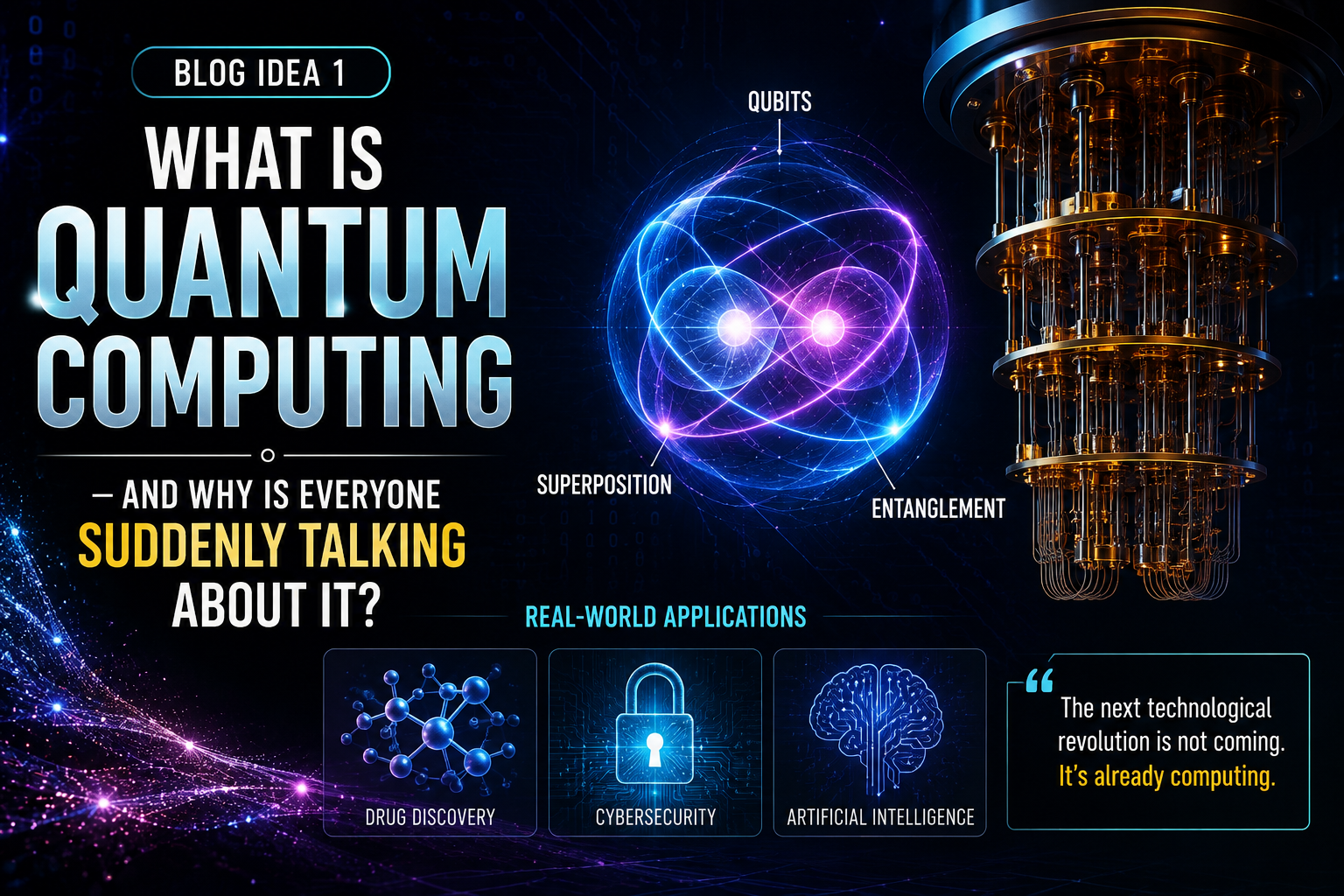
A classical bit is always either 0 or 1. A qubit — a quantum bit — can be 0, 1, or both at the same time. This isn't a trick or a metaphor. It's a direct consequence of one of the most important principles in all of physics: superposition.
You've already met superposition if you've studied waves in your H2 Physics or IB Physics syllabus. Wave motion, superposition, interference, and diffraction — understanding path difference and phase relationships is essential for later quantum physics topics. When two waves overlap, they add together — sometimes reinforcing, sometimes cancelling. Quantum particles behave the same way.
An electron, a photon, or any quantum particle doesn't have to be in one definite state until it's measured. Before measurement, it exists in a superposition of all possible states simultaneously — described mathematically by a wavefunction. The wavefunction contains the probability of finding the particle in each possible state when you look at it.
A qubit works the same way. It's a physical quantum system — usually an electron's spin, a photon's polarisation, or a superconducting circuit — that can exist in a superposition of 0 and 1 simultaneously. A quantum computer with just 300 qubits in superposition can, in principle, represent more states simultaneously than there are atoms in the observable universe.
That's the power. While a classical computer tries each possible solution one at a time, a quantum computer explores many possibilities at once — not by being faster, but by working differently at the most fundamental level of physics.
The Wavefunction Connection: What You're Already Learning
If you're studying H2 Physics under the new 9478 syllabus, this connects directly to one of the two brand-new topics added this year.
The 9478 syllabus includes Wavefunctions as a new topic — covering probability density, and the 1D infinite potential well. This is exactly the mathematical framework that quantum computing runs on. A qubit's state is described by a wavefunction. The probability of measuring 0 or 1 comes from the square of the wavefunction's amplitude — the same |Ψ|² that appears in your H2 Physics notes.
When a quantum computation finishes and the result is read out, the wavefunction collapses into a definite state — either 0 or 1. The art of quantum computing is designing the calculation so that, when the wavefunction collapses, the correct answer has the highest probability of appearing.
For IB Physics HL students, this connects to Theme E (Nuclear & Quantum Physics). The photoelectric effect, wave-particle duality, and the de Broglie wavelength are all foundational concepts that underpin how quantum computers manipulate information at the particle level.
Wave-particle duality means that quantum particles like electrons and photons behave both as particles and waves, depending on how we observe them — and this dual nature was beautifully demonstrated in the double-slit experiment, showing that reality at the quantum level cannot be neatly described by classical physics. Quantum computing is built on engineering that strange reality into something useful.
Quantum Entanglement: Spooky Action, Real Applications
The second key concept in quantum computing — after superposition — is entanglement.
When two qubits are entangled, measuring the state of one instantly tells you the state of the other, no matter how far apart they are. Einstein famously called this "spooky action at a distance" and spent years arguing it couldn't be real. Decades of experiments proved him wrong.
Entanglement is what gives quantum computers their ability to coordinate computations across multiple qubits simultaneously. When qubits are entangled, they don't behave as independent units — the entire system acts as one interconnected quantum state. This is what allows quantum algorithms to solve certain problems exponentially faster than any classical approach.
Think of it this way. A classical computer solving a maze tries one path at a time. A quantum computer with entangled qubits explores the entire maze structure simultaneously — not by being in multiple places at once, but because the entangled state of the system encodes information about all paths at the same time.
Why 2026 Is the Year Everything Changed
For years, quantum computing produced headlines but little real-world impact. Those timelines turned out to be optimistic. By 2023, enterprise customers who had invested in early quantum programs were asking hard questions — what problems had actually been solved, and what value had been delivered? The honest answer, in most cases, was: not much yet.
That started changing fast.
In 2026, multiple organisations demonstrated exponential error suppression. Logical error rates now decrease as more qubits are added, rather than amplifying. Google's Willow processor — a 105-physical-qubit superconducting chip — showed that logical error rates decrease by a factor of roughly 2.14× with each increase in surface-code lattice size.
Experts confirm that the maturity of large-scale practical quantum computing systems has been advanced by five to ten years, marking an official shift from the noisy intermediate-scale quantum era to the fault-tolerant quantum computing era.
Why does error correction matter so much? Qubits are extremely fragile and susceptible to external interference — temperature changes, electromagnetic fields, and vibrations — which leads to decoherence and calculation errors. A quantum computer that makes errors faster than it can correct them is useless. The 2026 breakthroughs mean that larger quantum computers are now more reliable, not less — which changes everything about what's commercially possible.
What Quantum Computers Will Actually Do
The applications most likely to arrive first are ones where the complexity of the problem grows exponentially — exactly the kind that breaks classical computers.
ApplicationWhat quantum computing changesDrug discoverySimulate how molecules interact at quantum level — impossible for classical computersCybersecurity (breaking)Factor large prime numbers, threatening current RSA encryptionCybersecurity (making)Quantum key distribution creates provably unbreakable communicationClimate modellingOptimise complex systems with millions of interdependent variablesMaterials scienceDesign new superconductors, batteries, and catalysts from first principlesFinancial modellingRun risk analysis across vastly more scenarios simultaneouslyLogisticsSolve routing and supply chain problems classical optimisers can't crack
The cybersecurity implications deserve special attention. Two independent analyses published in March 2026 — one from Google Quantum AI, the other from startup Oratomic — conclude that quantum computers will be capable of cracking widely used encryption schemes and cryptocurrencies before the end of the decade. Governments and banks worldwide are already moving toward post-quantum cryptography — new encryption methods designed to resist quantum attacks.
The Honest Picture: What Quantum Computers Can't Do Yet
Quantum computing deserves its excitement — but it also deserves accuracy. There are important limits that the headlines often skip.
Quantum computers are not simply faster classical computers. They're better at a specific class of problems — ones involving massive parallelism and quantum interference. For everyday tasks like browsing the internet, writing documents, or running spreadsheets, your laptop will always be faster and cheaper.
Hybrid quantum-classical workflows — where quantum processors handle specific computational bottlenecks inside larger classical pipelines — are the practical deployment model for 2026. The future isn't quantum computers replacing everything. It's quantum processors solving the hardest sub-problems inside larger classical systems.
Full, fault-tolerant quantum computing that can run any arbitrary algorithm reliably is still years away. Fault-tolerant systems are expected to unlock new applications by the 2030s. But the trajectory has genuinely shifted — and 2026 is the year the physics community stopped asking "if" and started asking "when."
How This Connects to What Singapore Students Are Already Studying
Quantum computing isn't a distant topic that appears after you finish school. It's built directly on the physics you're studying right now.
Quantum computing conceptWhere it appears in your syllabusSuperposition of statesH2 Physics 9478: Wavefunctions, probability densityWave-particle dualityH2 Physics 9478 & IB Physics Theme E: photoelectric effect, de Broglie wavelengthWavefunction collapse on measurementH2 Physics 9478: 1D infinite potential well; IB HL Quantum PhysicsQuantum interferenceH2 Physics: Superposition and wave interference; IB Physics: double-slit experimentEnergy quantisationH2 Physics: photoelectric effect, photons; IB Physics: Theme E nuclear and quantum
This is why studying quantum physics in school isn't just about passing an exam. The students who genuinely understand wavefunctions, superposition, and wave-particle duality in their H2 or IB Physics course are building the conceptual foundation for the most consequential technology of the next decade.
Frequently Asked Questions About Quantum Computing
What is the difference between a classical bit and a qubit?
A classical bit is always either 0 or 1 — like a light switch that's either on or off. A qubit exploits quantum superposition to exist as 0, 1, or any combination of both simultaneously, until it's measured. This allows a quantum computer to process a vast number of possible states at once, rather than one at a time. The qubit is described mathematically by a wavefunction — the same concept covered in H2 Physics 9478 and IB Physics Theme E.
Why can't we just build a faster classical computer instead?
Some problems are fundamentally beyond what faster classical computers can solve — not because of processing speed, but because the number of possible states grows exponentially with the problem size. Simulating how a drug molecule interacts with a protein, or finding the prime factors of a very large number, falls into this category. Quantum computers don't solve these problems by being faster — they solve them by representing and manipulating all possibilities simultaneously using superposition and entanglement.
How does quantum computing threaten internet security?
Most internet encryption today (called RSA encryption) relies on the fact that factoring a very large number into its prime components is practically impossible for classical computers — it would take millions of years. A sufficiently powerful quantum computer running an algorithm called Shor's Algorithm could do this in hours or days. Analyses published in 2026 suggest quantum computers could crack widely used encryption schemes before the end of the decade, which is why governments are already transitioning to post-quantum cryptography standards.
Is superposition in quantum computing the same superposition I study in waves?
They share the same mathematical structure. In your H2 Physics and IB Physics wave topics, superposition means two waves overlap and their amplitudes add together — producing interference patterns. In quantum mechanics, a particle's wavefunction is a superposition of all its possible states, and those states also interfere with each other mathematically. Quantum computing deliberately engineers this interference so that wrong answers cancel out and the correct answer is amplified — the same physics, applied to computation.
How does quantum entanglement actually work?
When two particles are entangled, they share a single quantum state — measuring one instantly determines the state of the other, regardless of distance. This isn't faster-than-light communication (you can't control what state you measure), but it allows quantum computers to coordinate information across multiple qubits in ways that have no classical equivalent. Entanglement is what allows quantum algorithms to solve certain problems exponentially faster than classical approaches.
Will quantum computers replace regular computers?
No — and this is one of the most common misconceptions in the news coverage. Quantum computers are better than classical computers at a specific set of problems involving massive complexity and quantum interference. For everyday tasks — writing documents, streaming video, browsing the web — classical computers are faster, cheaper, and more practical. The practical deployment model for 2026 is hybrid: quantum processors handle specific computational bottlenecks inside larger classical systems.
How can I learn more about quantum computing as a Singapore physics student?
Start with the physics you're already studying. The Wavefunctions topic in H2 Physics 9478 and the Quantum Physics content in IB Physics Theme E (wave-particle duality, the photoelectric effect, de Broglie wavelength) are the direct conceptual foundations of quantum computing. Understanding these deeply — not just for the exam, but genuinely — is the first step toward understanding how quantum computers actually work. From there, platforms like IBM Quantum Experience let you run real quantum circuits online, for free.
The Takeaway: The Physics You're Learning Is the Technology of Tomorrow
Quantum computing isn't hype. It isn't science fiction. And it isn't separate from the physics syllabus you're working through right now.
The wavefunctions in your H2 Physics 9478 notes. The superposition principles in your wave optics chapter. The photoelectric effect and wave-particle duality in IB Theme E. These aren't abstract exam topics. They're the operating principles of a technology that has been advanced by five to ten years ahead of schedule — officially shifting from laboratory research to the fault-tolerant computing era in 2026.
The student who genuinely understands why a wavefunction describes probability, why superposition allows parallel computation, and why entanglement lets qubits coordinate — that student isn't just ready for their physics exam. They're ready for a world where quantum science is reshaping drug discovery, cybersecurity, and computing itself.
That's what MakePhysicsEasy.com builds: genuine understanding that connects your Singapore physics syllabus to the world outside the exam hall. Whether you're studying O-Level Physics (6091), A-Level H2 Physics (9749 or the new 9478), or IB Physics, the concepts that power quantum computing are already in your course — you just need a physics coach in Singapore who teaches them the way they connect.
Book a trial lesson at MakePhysicsEasy.com and start building physics understanding that goes further than the paper.
Written by Mr. Cornelius Chew, Ex-MOE, NIE-trained physics educator and FIDE-certified chess instructor, MakePhysicsEasy.com — Singapore's concept-first physics coaching centre.