Why "Just Watching" Isn't Enough: What Electric Circuits Research Reveals About Physics Coaching in Singapore
Last year, I sat with a JC1 student who had just scored a D7 on his first H2 Physics class test. The topic was electric circuits. He was genuinely confused — he'd watched every YouTube video his friends recommended, copied all the notes his teacher wrote on the board, and read the same textbook chapter three times.
"I feel like I understand it when I'm watching," he said. "But then I sit the test and it just... disappears."
What he described is not laziness, and it's not a lack of effort. It's a well-documented problem in physics education — and a study published in Issues in Educational Research shows exactly why it happens, and more importantly, what actually fixes it.
The findings have direct implications for how physics coaching in Singapore should be designed, especially for electric circuits — one of the most consistently misunderstood topics across O-Level, A-Level, and IB Physics.
The Study: What Happens When Students Are Forced to Explain
Researchers Parinda Phanphech, Tanes Tanitteerapan, and Elizabeth Murphy at King Mongkut's University of Technology Thonburi studied 40 secondary students learning electric circuits — a topic notorious for producing stubborn, hard-to-shift misconceptions.
Their approach had a specific name: Predict–Explain–Enact–Observe (PEEO). Before seeing any result, students had to:
- Predict what would happen in a given circuit scenario
- Explain their reasoning in their own words
- Enact their prediction — either on a physical circuit board or a PhET virtual simulation
- Observe the actual result, then compare it to what they expected
The key word is explain. Students couldn't just tick a box or guess — they had to justify their thinking out loud before seeing whether they were right.
The researchers split students into two groups. One group used physical circuit boards. The other used an interactive PhET computer simulation. Both went through the same PEEO cycle. The results tell us something important about how physics tuition in Singapore should be structured.
Before Anyone Said Anything: Only 8% Actually Understood Circuits
Before the teaching intervention began, the researchers tested how well students understood core circuit concepts — current, voltage, resistance, how they interact.
Only 8% of students showed complete understanding.
The other 92% held at least one significant misconception. And these weren't struggling students — these were science-track secondary students who had already covered this content in class.
This is worth sitting with for a moment. Electric circuits are taught repeatedly across secondary school. Diagrams of series and parallel circuits appear in every physics textbook. Students draw them for homework. They label them on tests.
And still, 9 out of 10 had significant conceptual gaps before this intervention began.
This mirrors what Singapore's O-Level physics and H2 Physics examiners consistently report: students can reproduce a circuit diagram but cannot explain what's actually happening inside it. That's the gap that costs marks on Paper 2 structured questions and H2 Physics Paper 3 — where the answer isn't a number, it's a reasoned explanation.
The Single Change That Produced the Biggest Jump
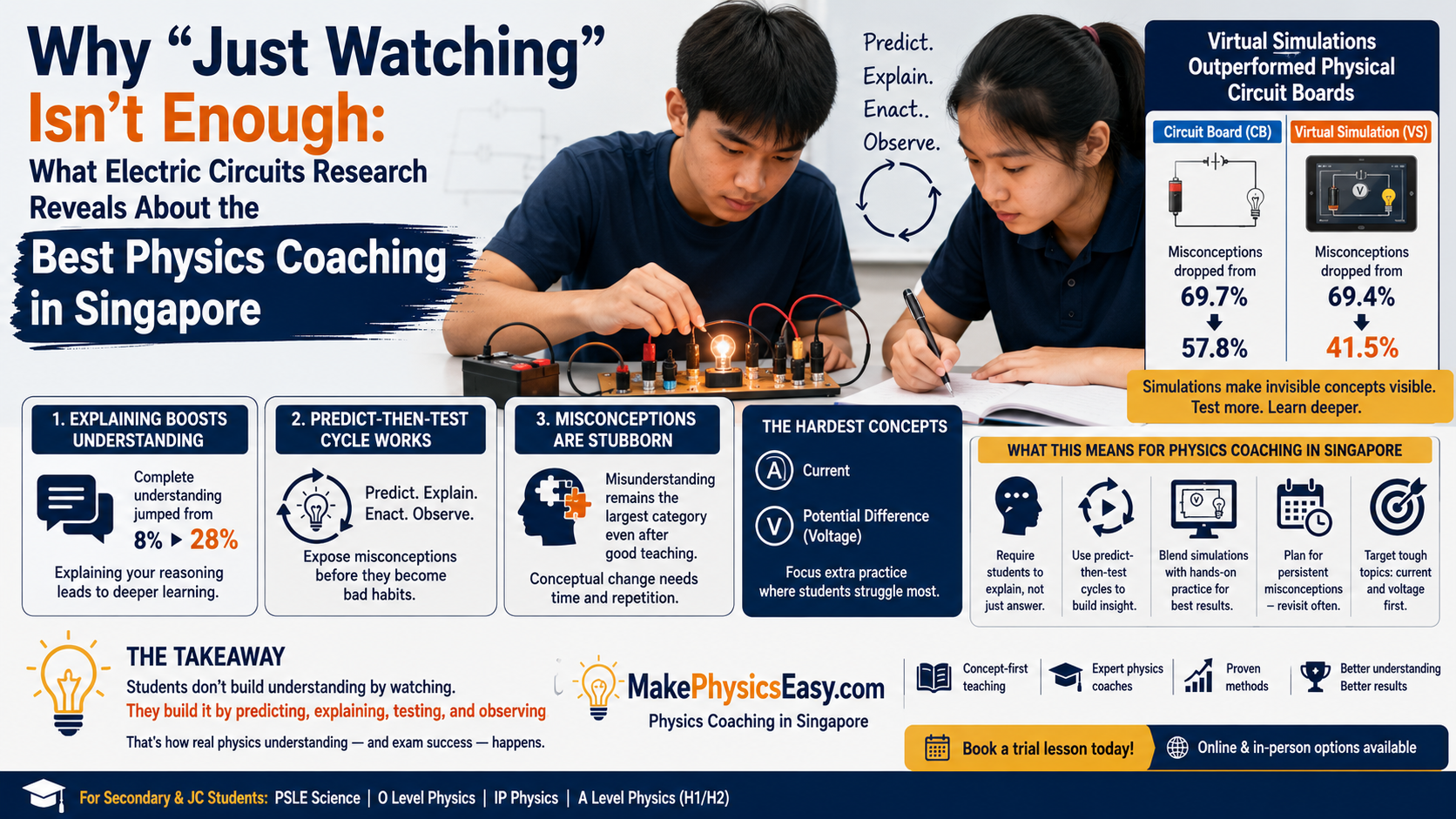
After the PEEO intervention, complete understanding across both groups jumped from 8% to 28% — a statistically significant gain from one teaching approach alone.
What drove it? The explain step.
When students had to justify their prediction before seeing the result, they were forced to examine their own reasoning. If their reasoning was wrong — if they believed, for instance, that current gets "used up" by a bulb, or that voltage is the same as current — the act of explaining it aloud made that wrong belief visible. Not to the teacher. To themselves.
This is why strong physics coaching in Singapore should never accept "I think it's B" as an answer. The moment a student says why they think it's B — and specifically why not A, C, or D — their understanding (or lack of it) becomes audible. That's when real teaching can happen.
Virtual Simulations Beat Physical Circuit Boards — Here's Why
Both groups improved, but the group using the PhET virtual simulation saw significantly greater reductions in misconceptions than the group using physical circuit boards:
GroupMisconceptions beforeMisconceptions afterPhysical circuit board69.7%57.8%Virtual PhET simulation69.4%41.5%
The simulation group reduced their misconceptions by nearly twice as much.
The reason is straightforward once you think about it. In a real circuit, you can't see current. You can't see voltage. You measure effects — a bulb lights up, an ammeter deflects — but the underlying phenomenon stays invisible. Students fill that invisible gap with whatever their intuition tells them, which is often wrong.
A well-designed simulation makes the invisible visible. Students can watch current flowing, see voltage drop across components in real time, and change one variable while everything else stays controlled. They can run the same circuit twenty different ways in five minutes without burning out a bulb or tripping a fuse.
This is a strong argument for physics coaching in Singapore that combines digital tools with hands-on practice — not as a shortcut, but because some concepts genuinely need to be seen before they can be understood. The best physics tuition doesn't choose between a circuit board and a simulation. It uses each one for what it does best.
The Finding That No Tutor Should Miss: Misconceptions Are Stubborn
Here is the finding that should matter most to every parent evaluating physics tuition Singapore options.
Even after a well-designed, research-backed teaching intervention, misunderstanding remained the single largest category of student responses. Misconceptions dropped significantly — but they did not disappear.
The researchers describe this plainly: misconceptions are "persistent difficulties." They do not evaporate after one well-taught lesson, no matter how clear the explanation or how interactive the activity.
This has a direct consequence for how physics tuition works. A single crash-course session before an O-Level or A-Level exam doesn't fix a circuit misconception that has been present since Sec 2.
A three-week intensive before Prelims is not enough time to uproot beliefs that have been reinforced — incorrectly — across years of passive note-taking.
Real conceptual change in physics requires consistent, repeated exposure across multiple sessions, with each session actively testing whether the old wrong belief has actually been replaced — or is just temporarily suppressed under exam pressure.
What This Means for Physics Coaching in Singapore Across Every Level
Whether your child is preparing for PSLE Science, O-Level Physics (6091), IP Physics, A-Level H2 Physics (9749 or the new 9478), or IB Physics, this research maps directly to five teaching principles that separate genuine physics coaching from formula-based drilling.

Who This Approach Is Built For
Predict–explain–observe style physics coaching in Singapore works especially well for students who:
- Watch videos and feel they understand, but can't reproduce the reasoning in a test
- Lose marks specifically on "explain why" and "describe what happens" questions
- Have covered circuits multiple times but still confuse current with voltage
- Are moving from O-Level into JC Physics and want to make sure Sec 3–4 foundations are genuinely solid, not just familiar-looking
- Are preparing an IB Physics Scientific Investigation (IA) and need to reason through experimental design independently
Frequently Asked Questions About Physics Coaching in Singapore
Why does my child understand circuits in class but forget everything during the test?
This is the most common circuit-learning pattern and this study explains it precisely. When a student watches a teacher work through a circuit problem, they follow the reasoning — but following someone else's reasoning is not the same as being able to generate it independently. Physics coaching in Singapore that uses predict-first teaching forces students to produce the reasoning themselves before seeing the answer, which is the only way to check whether genuine understanding exists.
How can I tell if my child actually understands voltage and current?
Ask them to explain — without a diagram in front of them — what the difference is between current and voltage, in their own words, using a real example like a torch or a phone charger. If they can't explain it without reverting to "current is measured in amps and voltage is measured in volts," they've memorised definitions but don't understand the concepts. This study found voltage and current to be the two hardest circuit concepts to correct — and the ones most worth specifically targeting in O-Level and A-Level physics tuition.
Is it worth using online simulations like PhET for physics tuition in Singapore?
This research says yes — and the margin is significant. The simulation group reduced misconceptions by nearly twice as much as the physical circuit board group. That doesn't mean hands-on work isn't valuable, but it does mean that for invisible concepts like current flow and voltage distribution, a well-designed simulation offers something a real circuit board can't: the ability to see what's physically happening, not just measure its effects. The best physics tuition Singapore programmes use both.
How many sessions does it take to fix a circuit misconception?
This study makes clear there's no quick answer. Even after a well-designed multi-session intervention, misconceptions remained the largest single category of student responses. Deep-rooted misunderstandings — especially ones formed in Sec 1 or 2 and reinforced through years of passive learning — require consistent, repeated correction over time. If your child is in Sec 4 or JC2, the goal isn't to fix everything before Prelims. It's to identify and target the specific misconceptions most likely to cost marks in the actual exam.
Does this approach work for H2 Physics 9478 as well as O-Level?
Yes, and it's arguably more important at H2 level. The new H2 Physics 9478 syllabus (first examined in 2026) places greater emphasis on multi-concept reasoning and experimental data analysis — exactly the skills that predict-explain-observe teaching builds. Students who enter JC with conceptually solid circuit understanding from O-Level are significantly better placed to handle electromagnetic induction, capacitance, and the new spreadsheet-based practical component than those who memorised the 6091 syllabus without genuine understanding.
My child is in Sec 3 starting electricity this term. Is this a good time to start concept-first tuition?
This is the ideal time. Sec 3 electricity is where most circuit misconceptions form — or get corrected. Starting O-Level physics tuition at this point with predict-explain-observe teaching means building the right mental model from the beginning, rather than spending Sec 4 trying to undo wrong ones. A student who genuinely understands circuits in Sec 3 will find the H2 electricity topics in JC1 dramatically easier — because the foundational reasoning is already in place.
What makes Mr. Chew's approach different when it comes to circuits?
Mr. Chew — Ex-MOE, NIE-trained, and a FIDE-certified chess instructor — applies the same predict-first, explain-before-revealing method this research identifies as most effective. Every circuit lesson at MakePhysicsEasy.com starts with a question, not a formula: "What do you think will happen if we add a second bulb in series — and why?" That question, and the discussion it opens, is where real understanding either surfaces or gets corrected.
The Multiple Intelligences approach means each student gets to engage with the concept through the mode that fits how they think — whether that's spatial reasoning, logical analysis, or hands-on exploration.
The Takeaway: Understanding Is Built by Explaining, Not Watching
The message from this research is clear, and it applies directly to every student working through Singapore's 6091 O-Level Physics, 9749 or 9478 H2 Physics, or IB Physics syllabus:

That's the entire philosophy behind MakePhysicsEasy.com: structured, concept-first physics coaching in Singapore where students never get to hide behind "I think I understand." Every lesson asks them to prove it — and then helps them actually build it.
If your child watches and nods but blanks out on the paper, that's the exact gap we close.
Book a trial lesson at MakePhysicsEasy.com and experience the difference between being told physics and genuinely understanding it.
Based on findings from "Explaining and enacting for conceptual understanding in secondary school physics" by Parinda Phanphech, Tanes Tanitteerapan, and Elizabeth Murphy, Issues in Educational Research, 29(1), 2019.