
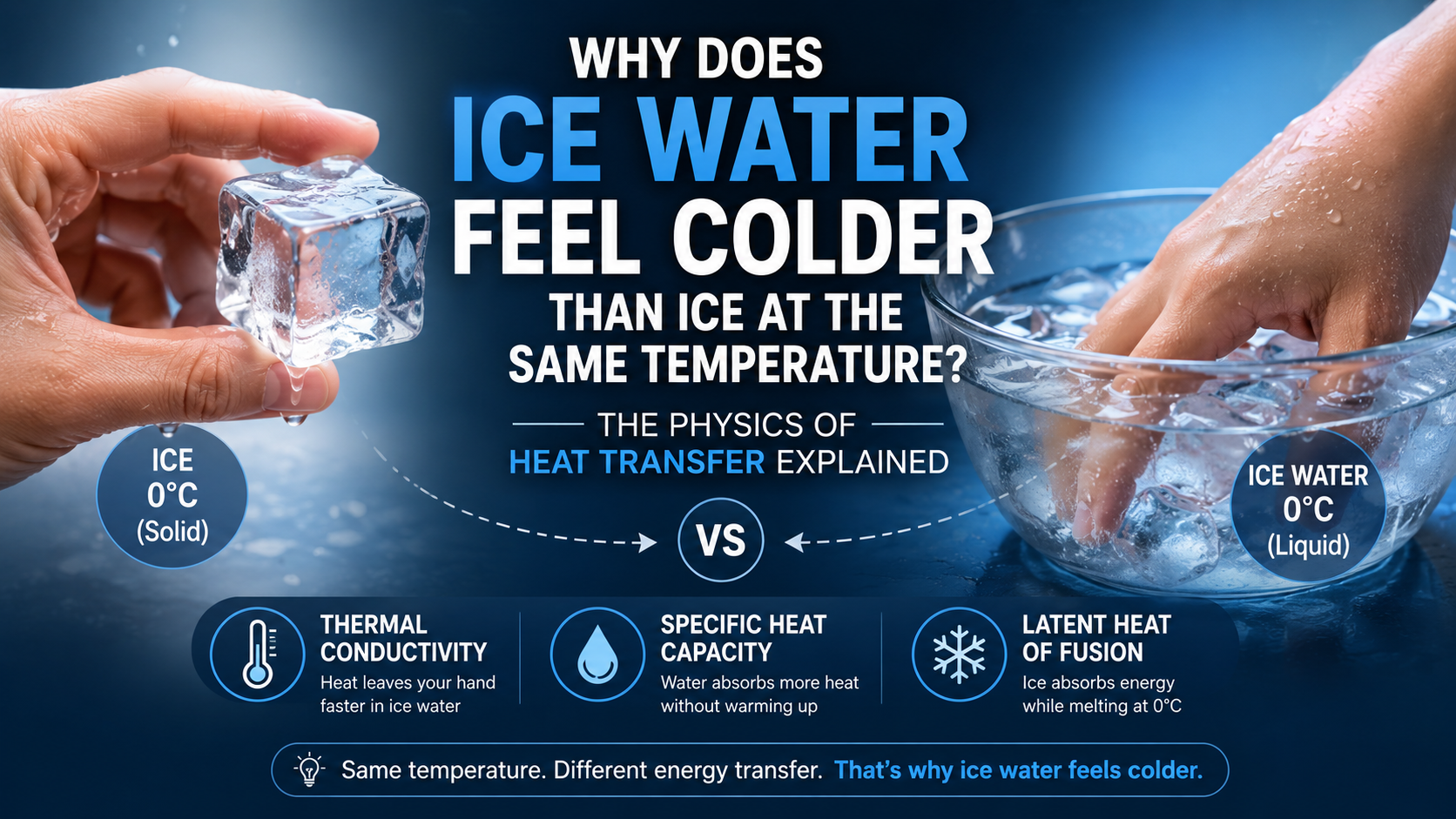
Why Does Ice Feel Colder Than Water at the Same Temperature? The Physics of Heat Transfer Explained
My younger cousin once made a bet with me at a family dinner. He put his hand in a bowl of ice water and said it felt colder than the glass of ice he'd just picked up — even though both were at 0°C.
"That's impossible," he said. "Same temperature, same cold, right?"
He lost the bet. And the explanation — once I walked him through it — made him understand more physics in five minutes than a whole chapter of his textbook had managed in a week.
The answer involves three ideas that show up in almost every heat transfer topic in the Singapore physics syllabus: specific heat capacity, latent heat, and thermal conductivity. Once you genuinely understand these three, a whole cluster of "strange" everyday observations start to make complete sense.
Let's break it down the way physics should always be taught — starting with a real thing you can touch, not a formula.
Same Temperature, Different Feeling — How Is That Possible?
Here's the key idea that most students miss when they first study thermodynamics and heat transfer: temperature and heat are not the same thing.
Temperature tells you how hot or cold something is. Heat is the energy that actually flows between objects when they're at different temperatures.
When you hold a piece of ice, your hand is at roughly 37°C. The ice is at 0°C. Heat flows from your hand into the ice — that's why your hand feels cold. Your body is losing thermal energy.
When you put your hand in ice water, the same thing happens: heat flows from your hand into the water. Your hand still feels cold.
But here's where it gets interesting. The rate at which heat leaves your hand — not just the temperature difference — determines how cold something feels. And that rate depends on thermal conductivity, specific heat capacity, and whether the substance is changing state.
Ice water wins the bet. Here's why.
Thermal Conductivity: Why Some Things Feel Colder on Contact
Thermal conductivity measures how quickly a material transfers heat. Materials with high thermal conductivity pull heat away from your hand faster — and faster heat loss feels colder, even at the same temperature.
Water has significantly higher thermal conductivity than air, which is why jumping into a 20°C swimming pool feels far colder than standing in 20°C weather. The water is pulling heat from your skin much faster than the air does.
Ice has lower thermal conductivity than liquid water — which might surprise you. But there's a catch. When you grip a piece of ice, there's direct solid contact between your warm hand and the ice surface. When you dip your hand in ice water, the water makes full, even contact with every part of your skin — fingers, palm, the gaps between them.
More surface contact + higher conductivity of water = heat leaves your body faster in ice water than when holding ice. That's why ice water feels more intensely cold, even though both are sitting at 0°C.
This is one of the most important concepts in O-Level Physics heat transfer — and one of the most commonly confused.
Specific Heat Capacity: Why Water Absorbs So Much of Your Heat
Specific heat capacity is the amount of energy needed to raise 1 kilogram of a substance by 1°C. Water has one of the highest specific heat capacities of any common substance — 4,200 J/kg°C, compared to most metals which sit below 1,000 J/kg°C.
What does this mean in practice? It means water can absorb a large amount of heat energy from your hand without its temperature rising noticeably. The water stays at 0°C while pulling energy from your skin, because it has the "capacity" to soak up that heat without warming quickly.
This is exactly why specific heat capacity shows up repeatedly in Singapore's O-Level Physics 6091 and H2 Physics 9749/9478 syllabuses — it explains real phenomena from cooling systems to why the sea heats up more slowly than the land.
When students learn specific heat capacity as just a formula (Q = mcΔT), they can calculate answers but often can't explain why a metal spoon in hot soup burns your mouth faster than the soup itself does. The spoon has lower specific heat capacity — it delivers heat to your tongue far more quickly than the liquid does. Same principle, different situation.
Latent Heat: The Hidden Energy Inside Ice
Here's where the story gets even more interesting — and where latent heat comes in.
When ice at 0°C melts into water at 0°C, the temperature doesn't change at all. But energy is still being absorbed. That energy is called latent heat of fusion — it goes into breaking the bonds between water molecules in the ice crystal structure, not into raising temperature.
For water, the latent heat of fusion is 334,000 J/kg. That's a significant amount of energy that ice absorbs from your hand before it even begins to warm up.
This is why a bag of ice in a drink keeps it cold far longer than a bag of equally cold — but solid and non-melting — material would. The ice isn't just cold. It's constantly absorbing energy to melt, which removes heat from whatever it's touching without raising its own temperature.
For students preparing for O-Level Physics thermodynamics or H2 Physics thermal physics, latent heat questions are among the most mark-rich areas in the paper — and among the most misunderstood. Students often confuse latent heat with specific heat capacity, or forget that latent heat applies only during a change of state, not during temperature change.
Putting It All Together: Why Ice Water Wins
So back to the bet. Why does ice water feel colder than an ice cube at the same temperature?
FactorIce cube (solid)Ice water (liquid)Temperature0°C0°CThermal conductivityLower — less contact areaHigher — full skin contactSpecific heat capacityLower (solid state)High — absorbs heat without warmingLatent heat effectOnly at contact surfaceActive across full immersionHeat removed from handSlowerFasterHow it feelsColdMuch colder
Same temperature. Completely different experience. Three concepts — thermal conductivity, specific heat capacity, and latent heat — explain every bit of the difference.
Why This Matters for Physics Students in Singapore
Understanding heat transfer conceptually — not just through formulas — is one of the clearest advantages a student can have in Singapore's physics exams.
In O-Level Physics 6091, thermal physics questions regularly ask students to explain why materials feel different temperatures, why evaporation cools a surface, or why a metal lid feels hotter than a wooden table in the same room. These are not calculation questions. They're explanation questions — and they reward students who understand the concepts, not just the equations.
In H2 Physics 9749 and the new 9478 syllabus, thermal physics deepens into internal energy, the first law of thermodynamics, and specific and latent heat in more rigorous mathematical contexts. But the conceptual foundation is the same — and students who built it properly at O-Level handle JC thermal physics with significantly less difficulty.
In IB Physics, the Themes include energy and thermal concepts that run through multiple papers. A student who can genuinely explain why ice water feels colder — not just what formula applies — is exactly the kind of thinker the IB rewards in its Paper 2 and Scientific Investigation.
Who This Kind of Physics Teaching Is For
The ice-and-water example works because it starts with something real — a thing you can hold, feel, and be genuinely curious about — and uses that curiosity to build understanding from the inside out.
This approach to physics coaching in Singapore works especially well for students who:
- Can apply formulas correctly but can't explain what the formula is actually describing
- Lose marks on "explain why" questions even when they get the calculation right
- Find thermodynamics abstract and disconnected from real life
- Are preparing for O-Level, A-Level H2, or IB Physics and want to build genuine understanding, not just exam technique
Frequently Asked Questions About Heat Transfer and Thermodynamics
Why does metal feel colder than wood at room temperature if they're the same temperature?
This is thermal conductivity in action. Metal conducts heat much faster than wood, so it draws heat away from your hand more quickly — and faster heat loss feels colder. The temperature is the same; the rate of heat transfer is different. This is a classic O-Level Physics heat transfer exam question, and the answer is always about conductivity, not temperature.
What is the difference between specific heat capacity and latent heat?
Specific heat capacity applies when a substance is changing temperature — it measures how much energy is needed per kilogram per degree. Latent heat applies when a substance is changing state (solid to liquid, or liquid to gas) at a constant temperature. In the ice cube example, specific heat capacity explains how water absorbs your hand's heat without warming quickly; latent heat explains the extra energy ice absorbs while melting. Both appear in Singapore's 6091 O-Level Physics and 9749/9478 H2 Physics syllabuses.
Why does sweating cool you down? Is this related to latent heat?
Yes, directly. When sweat evaporates from your skin, it absorbs latent heat of vaporisation from your skin surface. That energy comes from your body, cooling you down. This is why evaporation always produces a cooling effect — the liquid absorbs energy to change state into vapour without the vapour itself getting hotter. The same principle explains why you feel cold stepping out of a swimming pool on a windy day.
Why does ice water feel colder than ice at the same temperature?
Three reasons working together: water has higher thermal conductivity than ice (pulling heat away faster), water's high specific heat capacity means it absorbs a lot of heat without warming, and any melting ice is also absorbing latent heat from your hand. The result is that ice water removes heat from your body faster than solid ice does — even though both are at 0°C.
How does specific heat capacity explain why coastal cities have milder climates?
Water has a very high specific heat capacity — it takes a large amount of energy to raise its temperature, and it releases that energy slowly when cooling. The sea heats up slowly in summer and cools slowly in winter, keeping coastal temperatures moderate year-round. This is a real-world application of specific heat capacity that regularly appears in Singapore's O-Level Physics and H2 Physics applied questions.
Is latent heat tested in IB Physics as well as O-Level and A-Level?
Yes. Latent heat appears in IB Physics as part of the thermal energy theme, including calculations involving Q = mL and explanation questions about state changes. The IB Physics Scientific Investigation (IA) sometimes involves thermal experiments where understanding latent heat is essential for designing the method and interpreting results accurately.
How can I remember the difference between thermal conductivity, specific heat capacity, and latent heat for the exam?
Think of them as three answers to three different questions. Thermal conductivity: how fast does heat move through this material? Specific heat capacity: how much heat energy does this material absorb per degree of temperature change? Latent heat: how much energy does this material absorb while changing state, without changing temperature? Each one explains a different part of how heat behaves — and together, they explain why ice water feels colder than ice at exactly 0°C.
The Takeaway: Real Physics Starts With Real Questions
A bowl of ice water and an ice cube. Same temperature. Completely different feeling. And three physics concepts that explain every bit of the difference — specific heat capacity, latent heat, and thermal conductivity.
This is exactly the kind of question that makes physics genuinely interesting rather than just difficult. And it's the approach that MakePhysicsEasy.com takes to every topic in the Singapore syllabus: start with a real, observable, puzzling thing — and use it to build understanding that lasts beyond the exam.
If your child is studying O-Level Physics (6091), A-Level H2 Physics (9749 or 9478), or IB Physics, and you want a physics tutor in Singapore who teaches concepts this way — starting with curiosity, building to genuine understanding — book a trial lesson at MakePhysicsEasy.com and see the difference.
Written by Mr. Cornelius Chew, Ex-MOE, NIE-trained physics educator and FIDE-certified chess instructor, MakePhysicsEasy.com — Singapore's concept-first physics coaching centre.