Why Even Top Students Can't Draw a Simple Torch Circuit — And What It Reveals About Physics Coaching in Singapore
I once asked a Sec 4 student I know to explain how a torch works. Not calculate anything. Not recall a formula. Just explain it.
She paused, looked at me carefully, and said: "The battery sends electricity to the bulb?"
She was three months away from her O-Level Physics exam. She'd been drilling Ten-Year Series papers every weekend. She could solve a circuit calculation in under two minutes.
But she had no idea what was actually happening inside the torch in her hand.
Researchers at Umeå University decided to test exactly this kind of gap — and what they found should change how every parent thinks about physics coaching in Singapore.
The Study That Used No Equations on Purpose
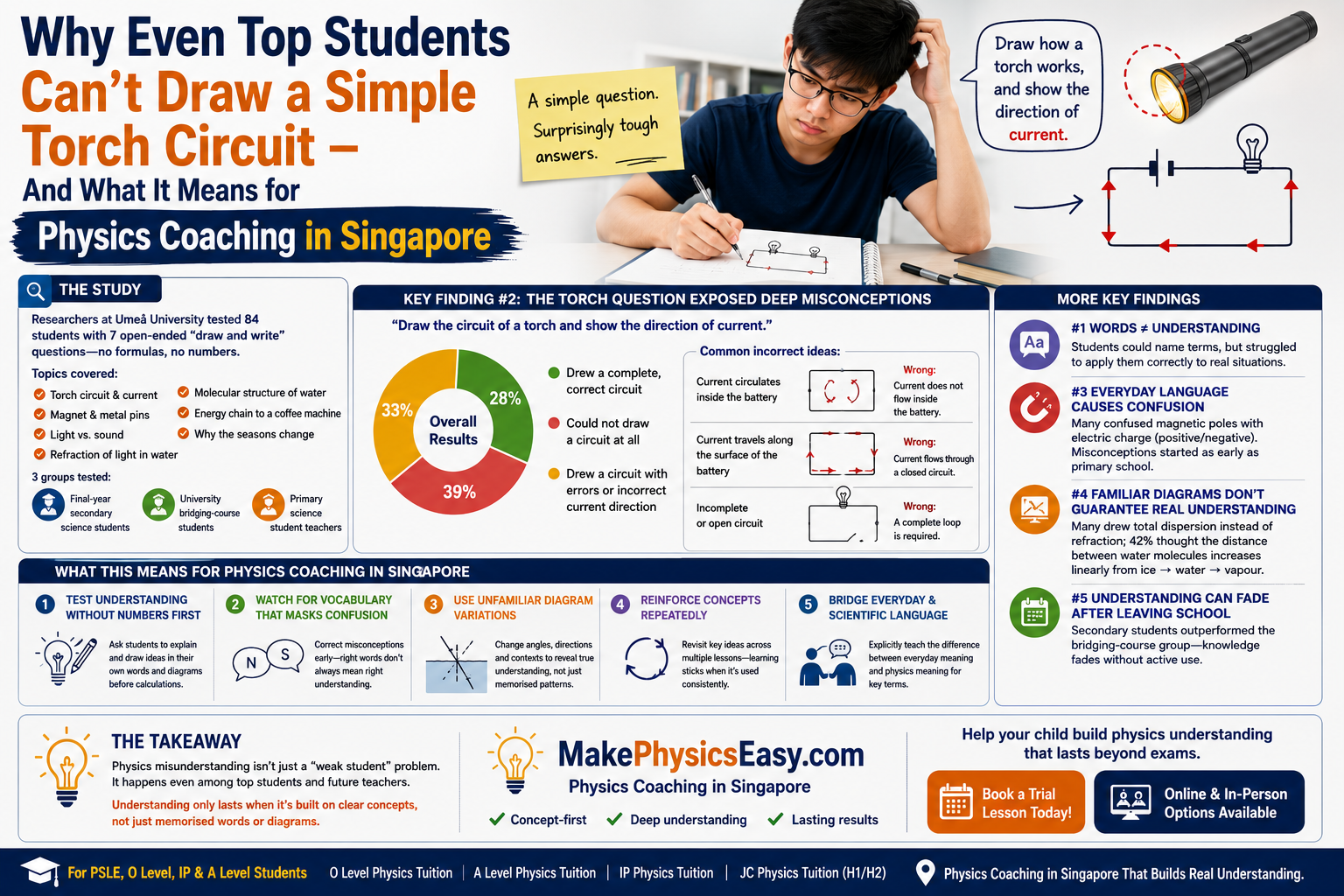
Researchers Oleg Popov, Ingegerd Zackrisson, and Karl-Uno Olofsson gave 84 students a questionnaire with zero numbers and zero formulas. No equations, no calculations — deliberately. They'd found that formulas alone triggered what they called a "brain-paralysing effect" in many students, switching them into rote-recall mode instead of genuine reasoning.
Instead, they asked students to draw and explain everyday physics situations:
- How a torch circuit works, with current direction shown
- Why a magnet attracts metal pins
- How a light ray bends when it passes through water
- What water molecules look like in ice, liquid, and vapour form
- Why the seasons change
Three groups sat the test: final-year secondary school science students, university bridging-course students, and primary science teachers-in-training. The researchers wanted to see how physics understanding holds up — or breaks down — across different stages of education.
What they found is both alarming and instructive for anyone looking at physics tuition in Singapore.
The Torch Question That Only 28% Got Right
Here's what makes this finding so striking. A torch is something virtually every student has held, used, and opened since childhood. It's not an abstract concept. It's a real object.
Yet when asked to draw a working torch circuit and show the direction of current:
- Only 28% of all students drew a complete, correct circuit
- 39% could not draw any circuit at all
- Many students who did draw something placed the current in the wrong location — believing it circulated inside the batteries, or travelled along the outside surface rather than through a closed loop
Students who could write "current flows from positive to negative terminal" in an exam answer had no mental picture of what that meant in practice.
This is the exact problem that structured physics coaching in Singapore needs to address head-on. A student who has memorised the rule can still completely misunderstand the reality. And in a Singapore Physics exam — whether O-Level 6091, H2 Physics 9749, or IB Physics — it's the explain-and-apply questions that separate A1 students from B3 students.
When Scientific Words Hide Unscientific Thinking
The magnet question produced one of the most telling findings in the whole study.
When asked to explain why a magnet attracts metal pins, about half of all students — and nearly three-quarters of the bridging-course group — used electrical concepts to explain it. They wrote about "positive and negative" rather than magnetic poles. Many said, openly, that they believed the terms were simply synonyms. A misunderstanding, they added, they'd carried since primary school.
Think about what that means. These students had studied science for years. They used the right-sounding vocabulary. But underneath it, they were working from a fundamentally wrong mental model that nobody had ever caught or corrected.
This is why the best physics tuition in Singapore never treats correct vocabulary as proof of correct understanding. When a student uses a scientific-sounding term, the right response is to ask them to explain what it means — not to assume they've understood it.
Memorised Diagrams Are Not the Same as Real Understanding
The refraction question exposed another gap that will be familiar to any O-Level physics tuition or A-Level physics tuition teacher in Singapore.
When asked to draw a light ray passing through water:
- Over 40% of students drew total dispersion instead of simple refraction
- Many couldn't work out whether the ray should bend toward or away from the normal
- Students defaulted to a memorised diagram shape — rather than reasoning through the actual physics
The same pattern appeared in the molecular structure question. Asked what water molecules look like in ice, liquid, and steam, 42% believed the distance between molecules increases in a straight, linear progression from solid to liquid to gas. They missed water's well-known anomalous expansion when it freezes — a fact that appears in both the 6091 O-Level syllabus and H2 Physics 9478.
Both errors came from the same root cause: students had memorised a standard version of a diagram and reproduced it, rather than understanding the principle well enough to reason through an unfamiliar variation.
Understanding Fades When Physics Stops
Perhaps the most sobering finding in the whole study: secondary school students — still actively studying physics — outperformed the university bridging-course students, who had studied physics a few years earlier and then stepped away from it.
The researchers describe this as weak retention. Once formal physics study ends, everyday language and common-sense intuition gradually reclaim the space that scientific reasoning once occupied. Knowledge that was never fully understood to begin with is the first to go.
This matters enormously for students planning to take A-Level H2 Physics after O-Level, or IB Physics across a two-year programme. If O-Level concepts like circuits, waves, and pressure were learned by formula rather than understood conceptually, they will erode. And H2 Physics 9478 and IB Physics both assume — and build on — genuine understanding of those foundations.
The argument for consistent, long-term physics coaching in Singapore isn't about grinding through more practice papers. It's about building understanding robust enough to survive the gap between examinations.
How This Changes What to Look for in Physics Tuition Singapore
Based on this research, here are five concrete things that separate genuine physics coaching from formula-based exam drilling — and what to look for when comparing options.
Teaching approachWhat it buildsDraw and explain before calculatingReveals real conceptual understanding, not just recallQuestion correct vocabulary, don't assume itCatches terminology confusion early — before exams doTest with unfamiliar diagram variationsSeparates reasoning from pattern memorisationRevisit core concepts across multiple sessionsPrevents the knowledge fade this study documentedExplicitly bridge everyday language and scientific meaningCloses the gap that even motivated students carry for years
Who This Research-Backed Approach Is Built For
Concept-first physics tuition in Singapore is particularly well-matched for students who:
- Score reasonably well on calculation questions but drop marks on "explain why" and "describe what happens" sections
- Say they understood the lesson but can't explain the concept the next day without their notes
- Have memorised standard diagrams but freeze when a slightly different version appears
- Are moving from O-Level into JC or IB and want to make sure their foundations will hold
- Have been told they "don't have a physics brain" — which, in almost every case, actually means they've never been taught to reason through physics, only to recall it
Frequently Asked Questions About Physics Coaching in Singapore
Why does my child understand in class but struggle on the actual paper?
This is the most common pattern in O-Level and A-Level Physics tuition. In class, students follow along with a worked example and it makes sense in the moment. But following someone else's reasoning is different from being able to reproduce reasoning independently. Strong physics coaching in Singapore builds the habit of predicting and explaining before seeing the answer — so students practise generating understanding, not just following it.
How can I tell if my child genuinely understands circuits or has just memorised the rules?
Ask them to draw a torch circuit from memory and explain what's happening at each point. Don't accept "current flows from positive to negative" as an answer — ask them to show it on a diagram and explain what that means physically. If they can't, this study's findings suggest they're in the 72% who can't draw it correctly either. A good physics tutor in Singapore will use this kind of diagnostic question at the start of any circuit topic.
Is terminology confusion really that serious at O-Level and A-Level?
Yes — and this research makes it measurable. When students confuse magnetic poles with electric charge, or conflate refraction with dispersion, they don't just lose marks on those specific questions. The confusion spreads into related topics and compounds over time. Physics tuition in Singapore that explicitly separates everyday language from scientific meaning — and tests that distinction regularly — prevents this from becoming a Sec 4 or JC2 crisis.
Will O-Level physics understanding actually be needed at A-Level?
Absolutely. H2 Physics 9478 (the new syllabus from 2025) builds directly on O-Level foundations in circuits, waves, and mechanics. IB Physics Themes A–E assume the same. If those O-Level concepts were learned by formula rather than genuine understanding, they will erode over the JC1–JC2 gap — exactly as this study showed in the bridging-course group. Starting A-Level physics tuition in Singapore with a diagnostic pass through O-Level foundations is one of the highest-value things a JC1 student can do.
How does concept-first teaching affect IB Physics IA performance?
The IB Scientific Investigation (worth 20% of the final grade) rewards students who can design and reason through an experiment independently. That requires genuine physical understanding — not the ability to recall a standard diagram. Students trained in explain-and-apply reasoning from O-Level or IP Physics produce significantly stronger IAs than those who've only drilled calculation methods. IB physics tuition in Singapore that builds this reasoning habit from the start gives students a measurable advantage in their IA.
My child is starting Sec 3 Pure Physics this year. When should they start tuition?
As early as Sec 3 Term 1. The concepts introduced at the start of Pure Physics — kinematics, forces, pressure — are the exact foundations that H2 Physics and IB Physics build on. Catching and correcting intuitive misconceptions early (the way this research recommends) is far more efficient than trying to undo three years of formula-based thinking in JC1. O-Level physics tuition that starts conceptually strong in Sec 3 removes the need for emergency revision in Sec 4.
What makes Mr. Chew's approach different from standard physics tuition?
Mr. Chew — Ex-MOE, NIE-trained, and a FIDE-certified chess instructor — teaches using the same principle this research identifies: understanding is built by reasoning, not by memorising. The Multiple Intelligences framework means each student's explanation is tested through the lens that matches how they think — whether spatial, logical, or kinesthetic. Every wrong answer is treated as diagnostic information, and every new topic begins with a predict-first question before a formula is introduced. That's the direct application of what this research recommends for lasting physics coaching in Singapore.
The Takeaway: Physics Isn't What You Can Recall — It's What You Can Explain
The Umeå University study makes one point clearer than any past-year paper ever could: understanding physics and memorising physics are two completely different things. And the gap between them shows up precisely when it matters most — in the exam hall, when a question is phrased in a way a student hasn't seen before.
A torch is the simplest possible physics object. It has a battery, a bulb, and a wire. Yet 72% of students in this study couldn't draw it correctly.
That's not a knowledge gap. That's a reasoning gap.
MakePhysicsEasy.com is built specifically to close it — through concept-first, predict-before-formula, diagnostic physics coaching in Singapore that works for O-Level Physics (6091), A-Level H2 Physics (9749/9478), IP Physics, and IB Physics.
If your child can calculate but can't explain — that's exactly who we teach.
Book a trial lesson at MakePhysicsEasy.com and find out what physics understanding that actually sticks feels like.
Based on findings from "Secondary and university students' understandings of physical and technical phenomena: informing pedagogy and practice" by Oleg Popov, Ingegerd Zackrisson, and Karl-Uno Olofsson, Umeå University, presented at the fifth Inter-Karelian Conference, 2000.