Why Foam Balls and Bedsheets Teach Physics Better Than Textbooks — And What It Means for Your Child's Physics Coaching in Singapore
My nephew scored a B3 in his O-Level Physics mock exam despite spending three weeks memorising formulas. His notes were immaculate. His formula sheet was colour-coded. He could recite the equations for Hooke's Law, Ohm's Law, and Newton's three laws without pausing.
But when I asked him to explain why a spring bounces back, or what actually happens inside a circuit when you add a second bulb — he went quiet.
That's the moment I started asking hard questions about what effective physics coaching in Singapore actually looks like. And the answers I found come from somewhere unexpected: a research unit at the University of Udine, where scientists spent decades teaching children physics using foam balls, stretched bedsheets, and cardboard boxes.
The Core Problem With How Most Students Learn Physics
Research by Marisa Michelini and her colleagues at the Physics Education Research Unit in Udine identifies something most Singapore students — and their parents — will recognise immediately.
Physics teaching has historically prioritised results over reasoning. Students are given the final formula, shown a worked example, and told to practise. What's missing is the step where they actually understand what the formula is describing.
The consequence? Students build two parallel belief systems. One is their "school answer" — the formula they've memorised for the test. The other is their private, intuitive sense of how the world works, built from years of touching, dropping, and pushing things. These two systems often point in completely opposite directions.
And outside the exam hall — or when an unfamiliar question appears — the intuitive one usually wins.
This is the real challenge for physics tuition in Singapore: not just delivering the right formula, but actively confronting and reshaping the wrong mental models students already carry around without realising it.
What Foam Balls and Bedsheets Actually Prove
The Udine research team didn't sit children down with a whiteboard. They handed them rubber foam balls, elastic sheets, and transparent boxes — and let them build their own understanding from there.
Here's what they found.
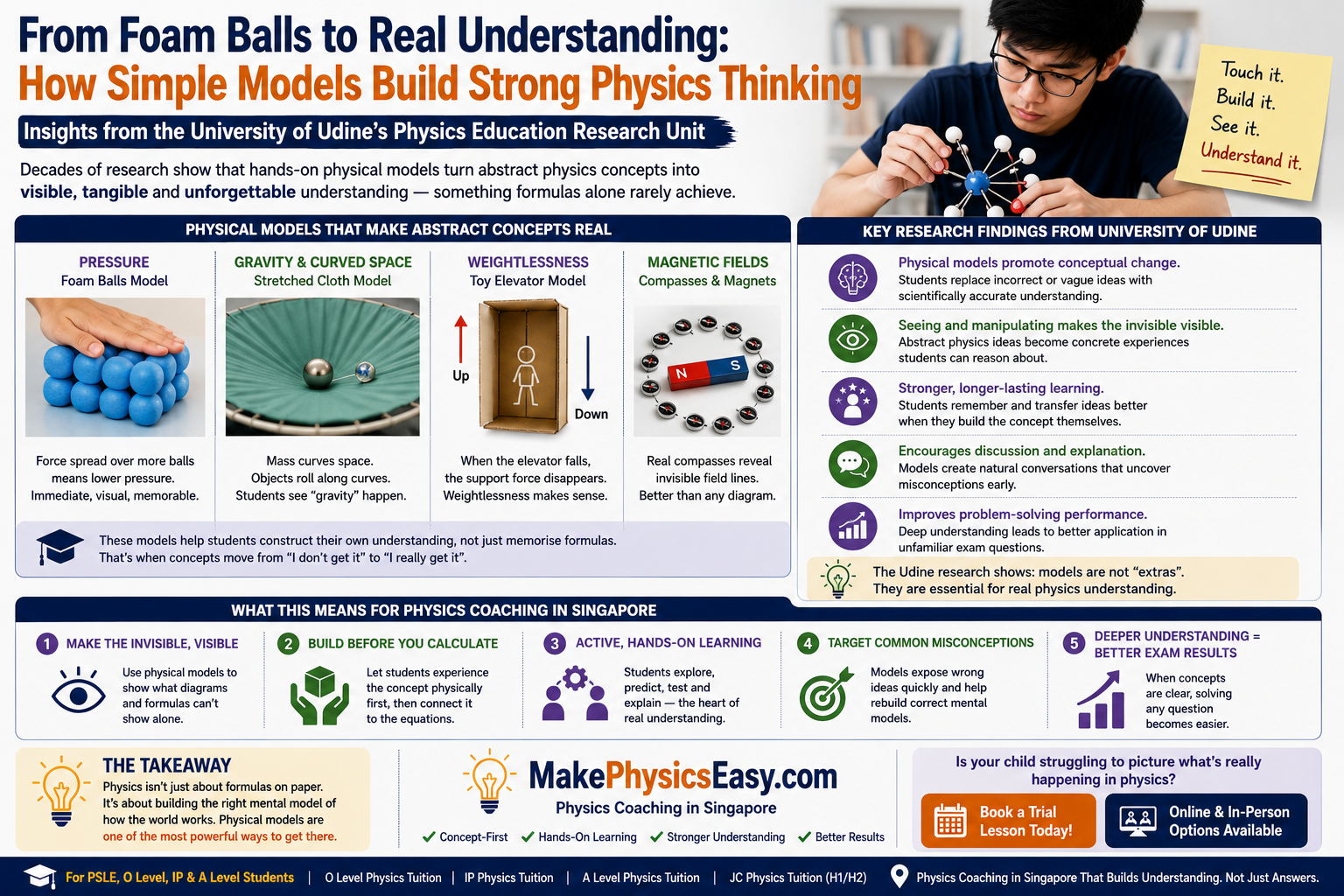
Foam balls in a container taught fluid pressure better than any diagram. Children pushed a piston against a container packed with rubber balls and watched pressure distribute and transmit through the system. They could feel Pascal's Law and Stevino's Law before a single equation was written. When the formula came later, it had something real to attach to.
A stretched elastic sheet — what the researchers called an "Eddington model" — taught gravity at both local and planetary scale. A heavy ball in the centre of a cloth lets a child see how gravity curves toward a mass. This is the conceptual leap that trips up O-Level and A-Level students: understanding gravity not just as "things fall down" but as a field that acts globally. The sheet makes it visible.
A transparent cardboard box with a spring and loose objects inside became a hands-on elevator model. Children held the box and watched the objects go weightless during free fall. After this single activity, 95% of children correctly connected free-fall weightlessness to what astronauts experience in orbit — a connection that textbook diagrams rarely produce.
The lesson for physics coaching in Singapore is direct: concepts like pressure, gravitational fields, and electric circuits resist being learned from equations alone. Give students something to physically manipulate first, and the formula becomes an explanation rather than a mystery.
Wrong Answers Are the Most Useful Thing in the Room
One of the most powerful ideas in this research is the way the team treated errors.
Rather than marking an answer wrong and moving on, they used every mistake as diagnostic information — a window into exactly where a student's private mental model diverged from the correct scientific one.
When children drew how a ball would fall at different points on Earth, their answers fell into distinct categories. Some drew a purely local picture — the ball always falls "down" on the page, ignoring the spherical shape of the Earth. Others reasoned globally. Each wrong answer told the researchers something specific about what that child actually believed.
This is a principle every physics tutor in Singapore should build into their practice. A wrong answer isn't just something to correct and move past. It's a clue. Good physics coaching digs into why a student reasoned the way they did — because the same wrong answer can come from very different underlying misconceptions, and they need different corrections.
This is part of why my nephew's formula-drilling approach left gaps his mock results couldn't hide. Nobody had ever asked him why he thought what he thought. Nobody had found the actual misconception to fix.
The "Predict First" Habit That Changes Everything
A technique that runs through all of this research is what the team calls Prevision–Experiment–Comparison (PEC): students predict what will happen and explain their reasoning, then observe the actual result, then compare.
This isn't unique to physics — it's well-established across education research. But it is especially powerful in physics, where so many results feel counterintuitive at first.
When a student commits to a prediction before seeing the answer, they're testing their own mental model against reality. When the result surprises them, it creates the exact cognitive discomfort that drives real learning. Passive demonstrations — "watch what happens when I do this" — rarely produce the same effect.
The best physics tuition in Singapore builds predict-first thinking into every new topic. Especially for notoriously tricky areas like circuits, forces, and gravitational fields, asking "what do you expect to happen, and why?" before showing the answer is one of the highest-leverage habits a student can develop.
Why Circuits Keep Tripping Up Singapore Students
Electric circuits come up repeatedly in this research as an area where students at every level struggle to reason functionally — that is, to understand how changing one part of a circuit affects the whole system, rather than just recalling isolated facts about components.
This matches what any experienced O-Level physics tuition or A-Level physics tuition teacher in Singapore will tell you. Circuits are consistently one of the highest-mark areas in both the 6091 and 9749/9478 syllabuses, and one of the most reliably misunderstood.
The Udine team developed simplified circuit "tiles" specifically to let students visualise and physically rearrange circuit structure before reasoning about current and voltage. The same logic applies here: functional understanding of circuits requires students to build, predict, and test — not just memorise which formula applies to series vs parallel.
One Strong Reasoner Can Shift a Whole Group
Here's a finding that surprised me when I first read it, but made complete sense the moment I thought about it.
The researchers observed what they called the "contamination of efficient reasoning": when one student in a group discussion offered a genuinely well-reasoned explanation, it often spread to classmates who had previously held incorrect ideas.
A single student explaining why something happens — and being heard by peers who were wrong — did more to shift thinking than a tutor delivering the same explanation from the front.
This is a strong argument for discussion-based physics coaching in Singapore, where students explain their reasoning to each other rather than only absorbing explanations from a teacher. A good physics coach creates deliberate moments for students to defend their thinking aloud — because peer explanation often corrects misconceptions more effectively than direct instruction.
How This Research Maps to Physics Coaching in Singapore
Whether your child is sitting for O-Level Physics (6091), IP Physics, A-Level H2 Physics (9749 or the new 9478), or IB Physics, this research points to five concrete things to look for in any physics tuition Singapore programme:
What to look forWhy it mattersConcepts before formulasBuilds real understanding, not just formula memoryWrong answers treated as cluesFinds and fixes the actual misconceptionPredict-first structure on every new topicForces students to test their own reasoningPeer explanation opportunitiesCorrects misconceptions through social reasoningHands-on focus on circuits and field topicsHighest-value areas; resist lecture-only teaching
Who This Approach Is Best For
This research-backed, concept-first physics coaching works particularly well for students who:
- Can recite formulas but freeze when a question is phrased in an unfamiliar way
- Consistently lose marks on "explain why" questions in Paper 2 or Section B
- Say they "understand in class" but can't reproduce the reasoning independently
- Are aiming for A1 at O-Level, A at A-Level, or Grade 7 at IB — not just a pass
It's also well-suited to students who have been told they "don't have a physics brain." That diagnosis is almost always wrong. What they actually have is a set of unchallenged intuitive beliefs that nobody has ever taken seriously enough to correct at the root.
Frequently Asked Questions About Physics Coaching in Singapore
Why does my child know all the formulas but still lose marks?
This is one of the most common patterns in O-Level and A-Level Physics. Formulas let students answer straightforward calculation questions, but physics tuition in Singapore exams increasingly reward the ability to explain physical reasoning — especially in Paper 2 and structured response questions. Knowing the formula without the concept underneath it is exactly the gap this research identifies.
What is "concept-first" physics coaching and how is it different from regular tuition?
In a concept-first approach, students explore what's physically happening before the formula is introduced — through prediction, discussion, or physical models. This is different from most physics tuition Singapore programmes, which introduce the formula first and work examples immediately. The research from Udine shows concept-first approaches produce significantly better retention and transfer to unfamiliar questions.
How does predict-first teaching help in the O-Level or A-Level exam?
When students practise predicting outcomes and justifying their reasoning before seeing the answer, they build the habit of physical reasoning that examiners reward. In both the 6091 O-Level Physics and 9749/9478 H2 Physics syllabuses, marks are frequently allocated to explanations, not just numerical answers. Predict-first training directly builds this skill.
Which topics benefit most from hands-on or concept-based physics coaching?
Based on both this research and Singapore syllabus data, the highest-value topics for concept-based teaching are electric circuits, gravitational and electric fields, pressure, and waves. These are consistently the topics where Singapore students lose the most marks — and consistently the ones that respond best to predict-experiment-compare teaching rather than formula drilling.
Is this approach suitable for IB Physics as well as O-Level and A-Level?
Yes. The IB Physics Scientific Investigation (IA) — worth 20% of the final grade — specifically rewards students who can design, predict, and analyse experiments with genuine physical understanding. IB Physics tuition programmes that build concept-first reasoning and experimental thinking directly strengthen IA performance, not just the written papers.
My child is in Sec 3 just starting Pure Physics. Is it too early to start this kind of coaching?
Sec 3 is actually the ideal time. The concepts introduced in Sec 3 — kinematics, forces, pressure, electricity — form the foundation that every later topic builds on. Starting O-Level physics tuition in Sec 3 with a concept-first approach means there are fewer wrong intuitive beliefs to undo by Sec 4, and the foundation for A-Level H2 Physics reasoning is already in place.
How can I tell if a physics tutor in Singapore is using a research-backed approach?
Ask them what they do when a student gives a wrong answer. A tutor who explores why the student answered that way — rather than simply correcting and moving on — is using diagnostic teaching. Also ask whether students ever have to predict an outcome before the tutor explains it. If the answer is yes to both, you're looking at a genuinely evidence-based approach to physics coaching in Singapore.
The Takeaway: Real Physics Understanding Is Built, Not Memorised
Foam balls, stretched bedsheets, and cardboard elevator boxes might sound like unlikely tools for physics coaching. But they work precisely because they let students construct their own accurate mental model of a phenomenon — rather than being handed someone else's formula and told to trust it.
That's the same philosophy behind MakePhysicsEasy.com: building genuine conceptual understanding through predict-first reasoning, diagnostic correction of misconceptions, and hands-on exploration — before the formula sheet ever appears.
If your child is looking for physics tuition in Singapore that fixes the "knows the formula, can't explain it" problem — whether for O-Level Physics, A-Level H2 Physics, IP Physics, or IB Physics — this is the approach the research recommends. And it's what we do in every lesson.
Ready to build physics understanding your child can actually explain, not just recall? Book a trial lesson at MakePhysicsEasy.com and experience concept-first physics coaching in Singapore.
Based on findings from "Building bridges between common sense ideas and a physics description of phenomena to develop formal thinking" by Marisa Michelini, Research Unit in Physics Education (URDF), Physics Department of the University of Udine.