Why Future Science Teachers Struggle With Everyday Physics Reasoning (And What It Means for Classroom Learning)
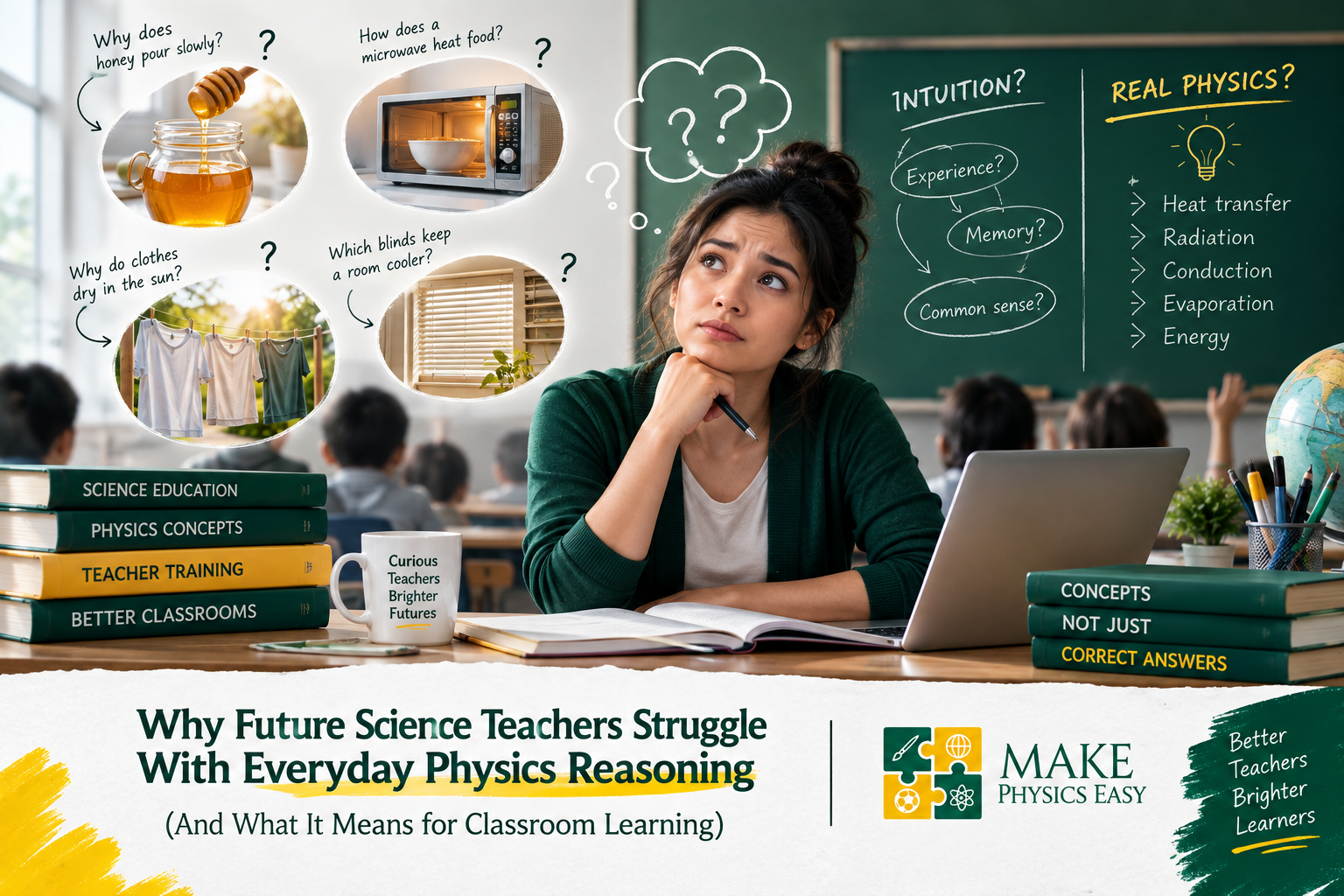
If you've ever watched a science teacher explain why honey pours slowly or how a microwave heats food — and felt something was slightly off — you're not alone. A fascinating new study on everyday physics reasoning in student teachers reveals a surprising truth: future elementary and primary science teachers often get the right answer, but for completely the wrong reasons.
This matters more than you might think. When science teacher education programs send under-prepared teachers into classrooms, the physics misconceptions they carry don't stop with them — they get passed on to the next generation of students. Let's break down what this research found, why it's alarming, and what better physics concept teaching strategies could look like.
What the Study on Science Teacher Physics Knowledge Actually Measured
Researchers tested 360 Turkish student teachers enrolled in primary and elementary science education programs. Each teacher-in-training answered 8 questions based on real-life, everyday physics situations — things like opening a stuck jar lid, choosing window blinds to keep a room cool, using a microwave, and drying clothes in the sun.
The test wasn't just looking for correct answers. It tracked:
- Everyday physics explanations — how students described real-world phenomena
- Physics-based conceptual reasoning — whether they used actual physics concepts
- Sources of physics knowledge — mother, personal experience, formal courses, media, friends, family
- Gender and department differences in physics reasoning ability
This kind of research sits at the heart of science education reform because it exposes a gap between knowing the answer and understanding the physics.
The Surprising Test Results: Correct Answers, Wrong Reasoning
The average score across all 360 student teachers was 45.8 out of 80 — just above the halfway mark. On the surface, that seems acceptable. But the internal data tells a more troubling story about physics conceptual understanding in teacher education.
Many students answered correctly but used non-scientific, context-dependent logic to get there. Their reasoning leaned on memory, cultural habit, or vague intuition rather than formal physics principles. In science education terms, this is called non-conceptual reasoning — and it's one of the biggest barriers to quality STEM teaching.
As the study concluded: "Even when student teachers gave correct answers, their reasoning may be non-conceptual."
This is a red flag for pre-service teacher training programs everywhere, not just in Turkey.
Female Student Teachers Outperformed Males — Here's Why That Makes Sense
One of the more interesting findings in this gender differences in physics reasoning data was that female student teachers scored significantly higher than their male counterparts — 47.2 vs. 39.5 on average — with a moderate effect size.
Why? The researchers point to context familiarity in physics learning. The test questions were built around everyday household situations — tasks more commonly associated with female experience in many cultural settings (cooking, laundry, kitchen tools). This gave female students a practical advantage rooted in lived experience, not necessarily deeper physics training.
This doesn't mean women are "better at physics." It means context-based physics assessments can be culturally and experientially biased — something that STEM curriculum designers and test developers need to account for.
Elementary vs. Primary Science Teachers: Why More Physics Courses Actually Help
Students in the elementary science education department — who had completed more formal physics coursework — scored noticeably higher than primary science education students: 50.2 vs. 40.2, with a large effect size.
This confirms what most science education researchers already suspect: formal physics instruction does improve conceptual reasoning, even if the effect isn't as large as we'd hope. More physics courses mean more exposure to structured scientific thinking and formal terminology.
But here's the catch — even the better-performing group still averaged only 50.2 out of 80. That means even students with more physics training are leaving gaps in their conceptual understanding of physical science. The issue isn't just course quantity — it's about how physics is being taught and whether it connects to real-world application.
Context-Sensitivity: Why Everyday Familiarity Shapes Physics Understanding
One of the most telling patterns in this research on everyday physics reasoning was how dramatically performance shifted based on context familiarity.
Students did well when asked about:
- Stirring with a wooden spoon (heat conduction — 61.9% correct concept use)
- Drying clothes in the sun (evaporation, airflow)
- Choosing window blinds (radiation and reflection)
They struggled significantly when asked about:
- Microwave heating (electromagnetic radiation — very low correct concept use)
- Honey viscosity (only 12.2% used the correct physics concept)
The microwave gap is especially telling. Many student teachers defaulted to describing how a conventional oven works because that's what they knew from experience. They'd never thought critically about electromagnetic radiation in cooking because microwaves weren't a familiar part of their daily reasoning.
This pattern is well-documented in physics education research: when students lack direct experience with a phenomenon, their reasoning becomes less reliable, more fragmented, and more likely to borrow from unrelated contexts. It's a classic case of context-dependent physics knowledge — and it's a serious problem for classroom science teaching.
Where Student Teachers Actually Learn Their Physics (The Answer May Shock You)
Here's the finding that should make every science teacher educator stop and reflect. Across 2,880 total responses about where their physics knowledge came from, student teachers cited:

Let that sink in: formal science education — the courses, teachers, and textbooks that make up an entire academic program — accounted for only 10% of the physics knowledge these future teachers were drawing on.
Meanwhile, knowledge passed down from mothers was the single largest source at 34%. Personal experience came in a close second at 33%.
This aligns directly with Hammer & Elby's epistemological framework for how people categorize knowledge:
- Propagated knowledge — information passed from others (mother, father, friends)
- Free creation — reasoning built from personal experience and observation
- Fabricated knowledge — structured knowledge from formal instruction
The dominance of propagated and experiential knowledge over formal instruction in this physics knowledge sources study reveals a critical gap in how pre-service science education is preparing teachers.
Which Knowledge Source Actually Produced Better Physics Scores?
Here's where the research gets really interesting — and counterintuitive. Despite mothers being the most frequently cited source, mother-derived knowledge did not produce the highest physics scores.
The highest scores in most question contexts came from fabricated knowledge — formal coursework, teachers, and textbooks. In some specific contexts, knowledge from friends, fathers, or media actually outperformed mother-sourced reasoning too.
This tells us something important about physics knowledge quality vs. frequency: people lean hardest on the sources that feel most familiar and emotionally accessible, not the ones that produce the best understanding. This is a known challenge in science misconceptions research — habitual, emotionally familiar sources of knowledge feel trustworthy even when they're less accurate.
For physics teacher training programs, this means the battle isn't just about adding more course hours — it's about making formal physics instruction feel as relevant and memorable as the lessons students learned at their mother's kitchen table.
The Weak Link Between Everyday Thinking and Formal Physics Concepts
The correlation between students' everyday physics answers and their ability to apply correct formal physics reasoning was r = 0.38 — a moderate relationship at best.
What this means in plain terms: student teachers can often navigate everyday physical situations adequately, but they're not strongly connecting those experiences to the formal physics frameworks they need to teach confidently. There's a bridge missing between intuitive physics understanding and scientific conceptual knowledge.
This is exactly the gap that effective physics education pedagogy must address — teaching students not just what happens, but why it happens in terms of real physics principles like thermodynamics, viscosity, electromagnetic radiation, and pressure.
What This Means for Science Teacher Education Programs
This study isn't just an academic curiosity — it has real implications for how we train and certify science teachers. Here's what the findings suggest for improving primary science teacher preparation:
Bridge the gap between everyday experience and formal physics. Teachers need explicit instruction that connects familiar phenomena (opening jars, drying laundry) to the correct physics concepts behind them — not just the right answer.
Address epistemological beliefs about where knowledge comes from. Student teachers need to critically examine why they trust certain sources of physics information and learn to prioritize evidence-based, formal knowledge over propagated or experiential reasoning alone.
Design context-diverse assessments. If every physics test only covers familiar household situations, teachers will never build the flexible reasoning they need to handle unfamiliar phenomena in the classroom.
Make physics instruction personally relevant. The fact that coursework accounts for only 10% of recalled physics knowledge suggests that formal science education isn't making a strong enough impression. Physics instructors need to actively relate physical formalism to real-world phenomena to improve retention and conceptual transfer.
As the study's authors put it: "Physics instructors… relating physical formalism to the real world are necessary for students to successfully grasp physics concepts."
Who This Research Should Concern Most
This research matters to:
- Science curriculum developers designing pre-service teacher training
- University physics instructors teaching future elementary educators
- Education policy makers setting standards for science teacher certification
- Parents and school boards who want confidently trained classroom science teachers
- STEM education researchers studying physics misconceptions and conceptual change
If the teachers training the next generation of scientists are themselves operating on incomplete, non-conceptual physics understanding — the downstream effects on student science literacy are significant.
Frequently Asked Questions About Physics Reasoning in Science Teacher Education
Why do future science teachers struggle with physics reasoning even when they answer correctly?
Many student teachers learn correct answers through memorization, cultural transmission (often from family), or personal observation — but without connecting those answers to formal physics concepts. This is called non-conceptual reasoning, and it means the correct answer is there, but the scientific understanding behind it is missing.
What is the most common source of physics knowledge for student teachers?
According to this study, 34% of physics knowledge cited by student teachers came from their mothers. Personal experience and observation came in second at 33%. Formal coursework, teachers, and textbooks accounted for only 10% — making family transmission the dominant source of everyday physics knowledge.
Does gender affect physics reasoning ability in science education?
Yes, this study found that female student teachers scored significantly higher than male student teachers on everyday physics reasoning tasks. Researchers attribute this partly to greater context familiarity — the test scenarios involved everyday household situations that female respondents interacted with more frequently.
Why did student teachers struggle most with microwave and viscosity questions?
These are less familiar everyday physics contexts for most students. Microwave use requires understanding electromagnetic radiation — a concept that doesn't map easily to conventional oven reasoning. Viscosity (why honey pours slowly) requires fluid dynamics knowledge that isn't part of most everyday conversations. Unfamiliarity with context leads to weaker, less conceptually grounded answers.
How can physics teacher education programs improve conceptual understanding?
Programs should focus on explicitly connecting everyday phenomena to formal physics concepts, designing assessments that span unfamiliar as well as familiar contexts, and addressing students' epistemological beliefs about where reliable scientific knowledge comes from. The goal is to make formal instruction feel as meaningful and accessible as life experience.
Is this problem unique to Turkish science education?
The epistemological patterns identified here — over-reliance on propagated and experiential knowledge, under-reliance on formal instruction — are consistent with science education research globally. This study's context is Turkey, but the challenges of pre-service physics teacher preparation are widely shared across education systems worldwide.
What is the link between everyday physics thinking and formal physics concepts?
The study found a moderate correlation (r = 0.38) between everyday physics reasoning and correct formal concept use. This means the connection exists but is weak — student teachers can navigate everyday situations, but they aren't strongly bridging that thinking to the formal physics frameworks needed for quality science teaching.
The Bottom Line on Physics Reasoning and Science Teacher Preparation
The core takeaway from this research is both simple and urgent: knowing the right answer isn't the same as understanding the physics. Future science teachers are graduating from teacher education programs with fragmented, context-dependent, and largely non-scientific physics knowledge — knowledge built more on what their mothers told them than on formal scientific reasoning.
Fixing this requires more than adding physics course hours. It requires a fundamental shift in how pre-service science education approaches conceptual teaching — making formal physics viscerally connected to the everyday world, so the next generation of science teachers can do the same for their students.
The physics is all around us. The job of great science education is making sure teachers can actually see it — and explain it.