Why Students Know the Right Answer But Still Fail Physics — And What the Best Physics Coaching in Singapore Does Differently
Do you know why students often know the "right" answer in physics but can't explain it scientifically — and how expert physics coaching in Singapore at MakePhysicsEasy.com bridges this gap for O Level, A Level, and IP physics students.
Have you ever watched a student confidently open a tight jar, choose the right pan for cooking, or dress warmly for a cold day — yet completely freeze up when asked to explain the physics behind it? This isn't a coincidence. It's one of the most well-documented gaps in science education, and it's the exact gap that great physics coaching in Singapore is designed to close.
A recent study of 360 pre-service science teachers in Turkey put this phenomenon under the microscope, and the results are strikingly relevant to every physics student — and every physics tuition centre — in Singapore today.
The Study: Everyday Actions vs. Everyday Understanding
Researchers Nilüfer Didiş Körhasan and Derya Kaltakçı Gürel asked participants eight simple, real-life questions covering topics like opening a jar, storing honey, drying clothes, using a microwave, and staying balanced in a braking car. For each scenario, participants had to:
- Choose the correct everyday solution
- Explain it using formal physics concepts
- State where they learned that knowledge
The results reveal something every parent searching for "physics tuition near me" or "best physics coaching in Singapore" should understand.
Key Finding #1: Knowing What to Do Isn't the Same as Knowing Why
The single biggest finding was this: students overwhelmingly picked the correct everyday action but failed to explain the underlying physics.
- Almost everyone knew to use a wooden spoon while cooking — but most couldn't correctly explain heat conduction.
- A striking 87.8% of participants failed to reference viscosity when explaining how temperature affects honey.
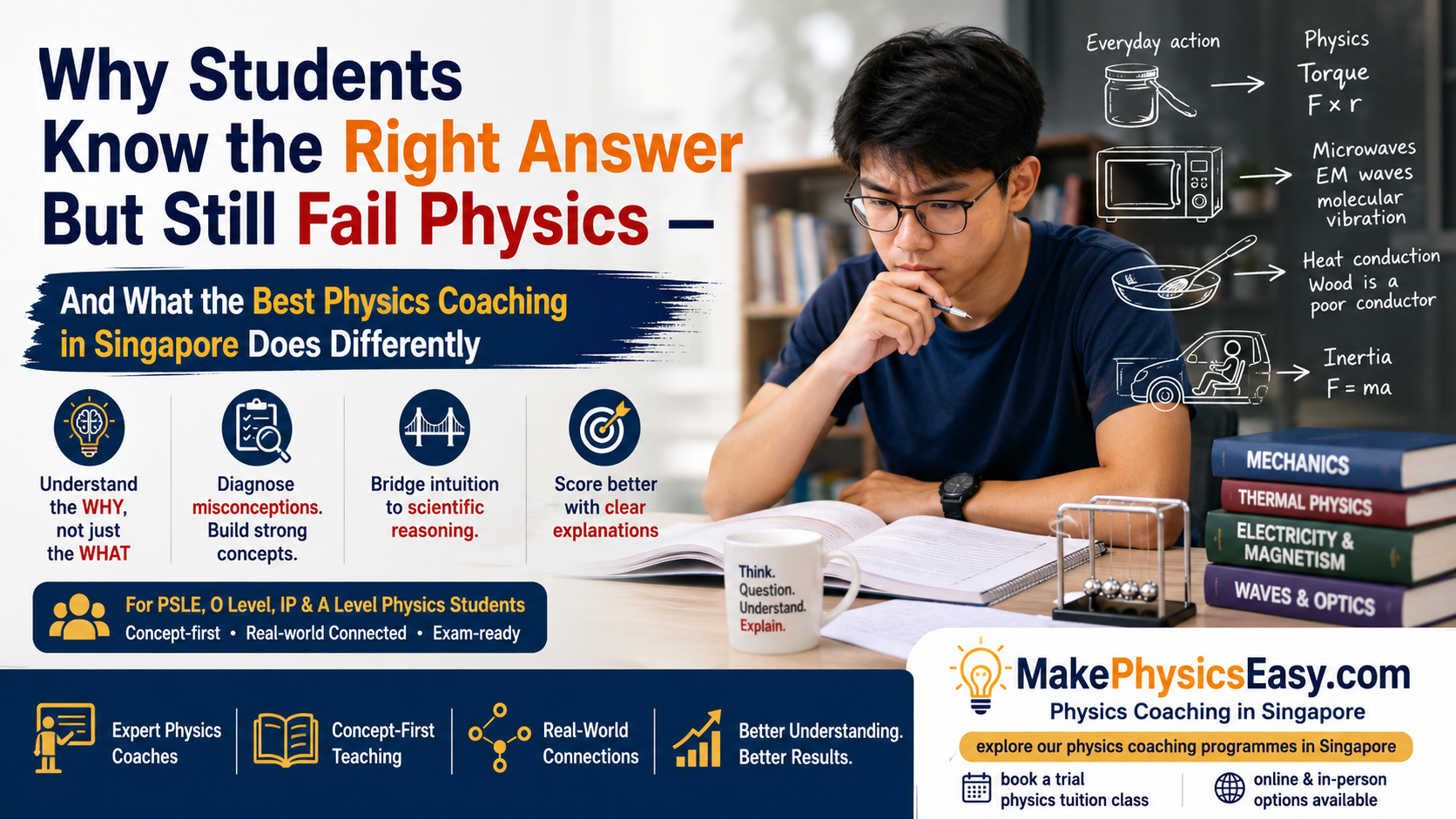
- The microwave oven question produced the most misconceptions of all, because students kept mapping the logic of a conventional oven (thermal heating) onto a microwave's actual mechanism (molecular vibration via electromagnetic waves).
This is precisely the trap that many self-taught or under-coached students fall into in Singapore's exam system: they can recall answers, but they can't derive or explain them — which is exactly what O Level, IP, and A Level physics papers are designed to test.
Key Finding #2: Context Changes Everything
Physics understanding wasn't consistent — it was highly context-dependent. Students performed far better on familiar daily situations (cooking, drying clothes) than on less familiar or more abstract contexts (microwave radiation, fluid viscosity).
This is a powerful argument for contextual, real-world teaching methods — the kind that effective physics coaching in Singapore should prioritise over rote memorisation of formulas. When physics is taught only through textbook equations and disconnected from daily life, students build fragile, situation-specific understanding instead of transferable scientific reasoning.
Key Finding #3: Where Students Actually Learn Physics
When asked where their knowledge came from, the breakdown was revealing:
- Mother / family: 34%
- Personal experience or observation: 33%
- Courses, teachers, or textbooks: only 10%
- The remainder came from media, friends, and intuition
Here's the twist: although formal coursework was cited least often, it consistently produced the highest-scoring, most scientifically accurate explanations. In other words, structured teaching works — it's just underused relative to informal, intuitive learning.
This is the strongest possible case for quality physics tuition and coaching. Left to intuition and family folklore alone, students develop some understanding — but it's the structured, expert-guided instruction that actually builds exam-ready, scientifically rigorous physics knowledge.
Key Finding #4: More Structured Physics Education = Better Results
Students who had completed more physics coursework significantly outperformed those with less formal instruction. This finding directly supports consistent, long-term physics coaching rather than last-minute cramming before exams — a principle at the heart of how MakePhysicsEasy.com structures its Singapore physics tuition programmes.
Key Finding #5: The "Hidden Barrier" Between Intuition and Formal Physics
Perhaps the most important number in the entire study: the correlation between giving the correct everyday answer and giving the correct scientific explanation was only moderate (r = 0.38).
This means intuition and formal physics reasoning are only loosely connected in most students' minds. Without deliberate teaching that bridges the two, students will keep guessing the right answers without ever truly understanding — and that gap shows up painfully in exam scripts, where markers reward explanation, not just conclusions.
What This Means for Physics Coaching in Singapore
For Singaporean students preparing for PSLE Science, O Level Physics, IP Physics, or A Level Physics, this research offers a clear blueprint for what effective coaching should look like:
1. Start With the Familiar, Then Build the Formal
Great physics tuition in Singapore should begin with relatable, everyday scenarios — a hot cup of coffee, a bicycle turning a corner, a phone charging — before introducing the equations. This activates prior intuition instead of fighting against it.
2. Always Ask "Why," Not Just "What"
Students should be trained to justify every answer using proper physics vocabulary and reasoning — exactly the skill tested (and often missing) in Singapore's exam rubrics, which award marks for correct physical reasoning, not just correct outcomes.
3. Diagnose Misconceptions Early
Open-ended questioning — not just multiple-choice drilling — is essential to catching misconceptions like the oven-vs-microwave confusion before they harden into exam-day errors.
4. Build Explicit Bridges Between Intuition and Theory
The best physics coaches in Singapore don't just teach formulas; they actively connect what a student already believes to what is scientifically correct, correcting misconceptions rather than layering new content on top of shaky foundations.
5. Make Structured Coaching Consistent, Not Occasional
Since coursework-based learning produced the strongest outcomes in the study, consistent, well-structured physics coaching — not one-off crash courses — is what actually moves the needle on results.
The Takeaway
This research confirms what experienced physics educators already know: students don't fail physics because they lack intuition — they fail because no one has taught them how to translate that intuition into rigorous scientific reasoning.
That's exactly the gap that MakePhysicsEasy.com is built to close. Through structured, concept-first, real-world-connected physics coaching in Singapore, students move beyond guessing the right answer to truly understanding — and scoring — the physics behind it.
If you're searching for physics tuition Singapore parents and students can actually trust, or comparing the best physics tuition centre in Singapore for your child's O Level, IP, A Level, or JC physics preparation, this research-backed teaching approach is exactly what to look for.
Whether you need an O Level physics tuition programme, A Level physics tuition in Singapore, secondary school physics tuition, an IP physics tuition track, or simply a reliable Singapore physics tutor who can explain concepts instead of just drilling formulas, MakePhysicsEasy.com offers structured, conceptual physics exam preparation designed around exactly this science.
Our approach is built for students at every stage — from PSLE science coaching and lower secondary physics tuition to JC physics tuition for demanding H1 and H2 syllabuses. Each lesson is designed around conceptual physics coaching, not rote memorisation, so students walk into every exam able to explain their reasoning, not just recall an answer.
So the next time you search "physics tuition near me" or "online physics tuition Singapore," remember: the goal isn't just finding a physics coach in Singapore who gives you the right answers — it's finding one who teaches you why those answers are right. That's how you move from guessing to truly understanding, and from understanding to scoring well.
Ready to close the gap between intuition and real physics understanding? Book a trial lesson with MakePhysicsEasy.com today and experience the difference that genuine physics coaching in Singapore makes.
Source: Based on findings from "Student Teachers' Physics Knowledge and Sources of Knowledge to Explain Everyday Phenomena" by Nilüfer Didiş Körhasan and Derya Kaltakçı Gürel.