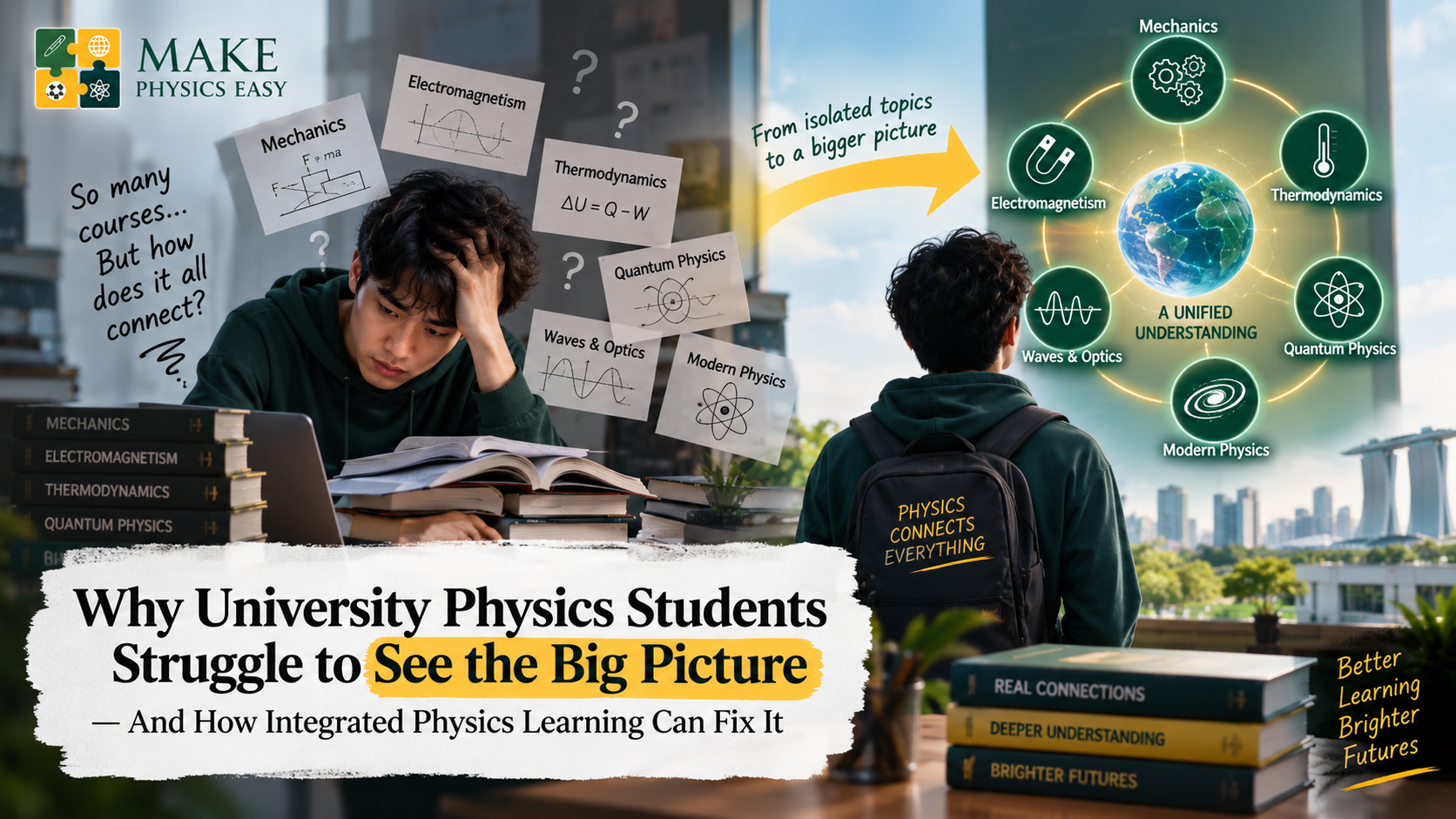
Why University Physics Students Struggle to See the Big Picture — And How Integrated Physics Learning Can Fix It
Have you ever finished a university physics course, passed the exam, and still felt like you had no idea how any of it connected to the course you took last semester? You are not alone. Millions of physics and engineering students around the world experience the same thing — and new research shows it is not their fault.
A landmark paper by Åke Ingerman, Shirley Booth, and Cedric Linder published in NordDiNa (2007) makes a compelling case: university physics learning is broken at the structural level, and the way most physics programmes are designed is actively preventing students from building a coherent understanding of the subject. The good news? The researchers also found practical, proven ways to fix it.
Whether you are a physics student feeling lost, an educator looking for better teaching strategies, or a curriculum designer trying to reduce dropout rates in STEM programmes — this research speaks directly to you.
The Real Reason Physics Students Drop Out of University Programmes
Most universities blame student dropout in physics programmes on a lack of preparation or motivation. But this research points to something deeper — a fundamental problem in how physics education is structured.
At Chalmers University of Technology in Sweden, one of Europe's most prestigious Engineering Physics programmes underwent a major curriculum reform in 1993. What followed was a sharp and unexpected rise in dropout rates. Both students and staff blamed each other, but nobody was asking the right question: Is the programme itself making it harder for students to learn?
The researchers stepped in to investigate. What they found was eye-opening. Students were not failing because they lacked intelligence or effort. They were failing because the fragmented course structure made it nearly impossible to see how different parts of physics connected to each other — or to anything beyond the exam.
This is one of the most important findings in modern physics education research: when students cannot see their studies as a coherent whole, they disengage, struggle, and ultimately leave.
What "Learning Physics as a Whole" Actually Means
Before diving into the study's findings, it helps to understand what integrated physics learning actually looks like — and why it matters so much for long-term student success.
Most university physics programmes are built around separate specialist courses — mechanics taught by one professor, electromagnetism by another, thermodynamics by a third. Each course has its own exams, its own language, and its own sense of what matters. Students move through these courses like stations on a conveyor belt, rarely stopping to ask how everything fits together.
Learning physics as a whole means the opposite of this. It means helping students build a connected, flexible understanding of physics knowledge — one where concepts from mechanics inform their understanding of electromagnetism, where mathematical tools from one course become lenses for problems in another, and where physics itself starts to feel like a living, unified field of knowledge rather than a collection of disconnected modules.
This is what researchers call the "physics knowledge object" — and building it is, according to this paper, the central goal of a quality physics education.
How the Study Was Conducted: Phenomenographic Research at Two Universities
The research was not theoretical. It drew on real student experiences at two very different institutions, making its findings both credible and broadly applicable.
At Chalmers University of Technology (Sweden), researchers conducted in-depth interviews with 20 students — both high-performing and struggling learners. Students were asked to draw diagrams showing how they saw the relationships between their courses, then explain their thinking. This phenomenographic research method produced six distinct ways students experienced their physics programme — ranging from seeing courses as completely separate units all the way to experiencing physics as one unified, adaptable body of knowledge.
At the University of the Western Cape (South Africa), the focus was on a service physics programme serving students from diverse educational backgrounds. Concerns about rote learning and shallow conceptual understanding drove the development of a new, metacognition-focused physics curriculum — one that built reflection and self-awareness directly into every lesson.
Together, these two case studies gave the researchers a powerful, cross-cultural view of what goes wrong in university physics education and what genuinely works.
Six Ways Students Experience a Physics Programme — From Fragmented to Unified
One of the most valuable contributions of this research is a clear map of how students think about their own learning. The phenomenographic analysis produced six levels of physics programme experience, moving from surface-level to deeply integrated:
Level 1 — Courses as separate units: Students see each course as a standalone requirement defined by authority, tradition, or timetabling. There is no attempt to connect them.
Level 2 — Courses as prerequisites: Students understand that Course A must come before Course B, but only in a sequential, mechanical sense — not a conceptual one.
Level 3 — Courses as useful fragments: Students begin to notice that tools from one course can be applied in another. Connections exist, but they are accidental rather than deliberate.
Level 4 — Courses as mutually illuminating: Students start to see that studying one topic actually deepens their understanding of another. This is the first real sign of integrated physics thinking.
Level 5 — Courses as parts of an adaptable whole: Students experience their physics knowledge as a flexible, evolving system they can reorganise and apply to new problems.
Level 6 — Physics as a unified knowledge object: Students have built a coherent, independent body of physics conceptual understanding that connects academic learning to real-world contexts beyond the university.
The researchers found that most students — even successful ones — stayed stuck at levels 1 to 3, focused on "study knowledge objects" like workload, teacher personalities, and course organisation rather than on physics itself. This is the core crisis in STEM university education that this paper addresses.
Three Core Problems Blocking Integrated Physics Learning
From both case studies, three recurring problems emerged that affect physics and engineering programmes worldwide:
1. Authority for learning rests entirely with teachers. Most physics students passively accept whatever structure their professors impose. They never develop the habit of taking ownership of their own physics education — asking big questions like "How does this connect to what I learned before?" or "Why does this concept matter beyond this exam?"
2. Students rarely build a coherent physics knowledge object. Without deliberate support, most physics students graduate with fragmented physics knowledge — a collection of solved problem sets rather than a living, connected understanding of physical reality.
3. Students focus on course organisation rather than physics content. When students are anxious about grades, workload, and logistics, their attention shifts away from the actual goal of deep physics learning. The structure of the programme becomes the obstacle.
These three problems feed each other in a cycle that drives disengagement, poor conceptual understanding, and ultimately high dropout rates in physics and engineering degrees.
Two Proven Strategies for Teaching Physics as a Connected Whole
The researchers did not just identify the problem — they developed and tested two concrete strategies that produced measurable improvements in student physics understanding and retention.
The Chalmers "Towards Better Learning" Course
At Chalmers, the team introduced a voluntary reflective learning course worth 3 ECTS credits, offered to first-year Engineering Physics students. The course was not about physics content directly — it was about helping students understand how they learn physics.
Students kept a study diary, conducted interviews with their teachers, and completed reflective assignments designed to help them:
- Articulate their own learning goals in relation to physics
- Evaluate how effectively they were studying
- Explore their programme from multiple perspectives — their own, their peers', and their teachers'
- Begin connecting fragments of physics and mathematics into a broader, more coherent picture
The outcome was striking. Most participants began articulating relationships between courses for the first time. They started linking their personal goals to physics as a discipline rather than just to grades and exams. A voluntary course about reflection transformed how students experienced their entire university physics programme.
The UWC Metacognitive Physics Curriculum
At the University of the Western Cape, the intervention went even further. Rather than an optional add-on, the team built metacognition directly into the compulsory physics curriculum — making self-awareness and reflection a core part of every lesson, not an afterthought.
This metacognitive physics teaching approach included:
- Explicit focus on conceptual understanding and coherence rather than memorisation
- Regular in-class reflection and written assignments on the learning process
- Connecting physics concepts to everyday life, social contexts, history, and the environment
- Group work, scientific communication, and critical thinking in physics
- Scholarly collegiality among teachers — regular team discussions about student learning, based on education research
The results were measurable and significant. Students in the metacognitive curriculum outperformed students in the traditional course on shared exams. The course grew in popularity each year. Connecting physics learning to real-world relevance and building metacognitive awareness produced better physicists, not just better exam-takers.
Traditional Physics Teaching vs. Integrated Physics Learning: A Clear Comparison

What Needs to Change: Building a College of Physics Teachers
The researchers are clear that isolated courses or individual teacher initiatives are not enough to solve this problem. What is needed is a departmental community of practice — what they call a "college of teachers" — that takes student learning seriously at every level of the programme.
This means physics departments must:
- Explore students' real experiences of the programme — through study diaries, one-to-one conversations, and genuine listening
- Build shared understanding among all physics teachers of how students experience key concepts and how those concepts are best learned
- Foster creative, ongoing dialogue with students so learners can actively help shape the programme they are studying in
The fundamental shift required is simple to state but hard to achieve: physics educators must move from viewing teaching as content delivery to viewing it as supporting students in building a coherent, personal understanding of physics — one that grows, connects, and lives beyond the exam room.
Frequently Asked Questions About Integrated Physics Learning
Why do so many university physics students struggle to connect what they learn across courses? Most university physics programmes are designed around specialist courses taught independently, with little deliberate effort to help students see connections. Students end up with isolated knowledge fragments rather than a unified understanding of physics. Research shows this structural fragmentation — not student ability — is the primary cause of confusion and dropout.
What is a "physics knowledge object" and why does it matter for university students? A physics knowledge object is a coherent, flexible, and personally owned understanding of physics as a whole — one that a student can apply to new problems, connect to real-world contexts, and continue building beyond university. Most students never develop this because their programmes do not explicitly support it. Research shows that helping students build this unified view dramatically improves both learning outcomes and long-term retention in physics.
What is metacognitive physics teaching and how does it improve student learning? Metacognitive physics teaching means making students aware of how they learn — not just what they learn. It involves reflection, self-assessment, connecting concepts to everyday life, and developing awareness of one's own thinking process. Studies at the University of the Western Cape showed that students in a metacognitive physics curriculum outperformed those in traditional courses on shared exams.
How can physics educators reduce dropout rates in university STEM programmes? The research points to three key strategies: helping students take ownership of their own learning, building a coherent and connected curriculum rather than isolated specialist courses, and fostering a departmental community of practice where teachers collaborate on student learning. Programmes that implement integrated, reflective learning approaches see measurable reductions in student dropout.
What is the difference between surface-level and deep physics learning at university? Surface-level physics learning means memorising formulas and solving exam problems without understanding how concepts connect. Deep physics learning means building a coherent understanding where ideas from different areas of physics illuminate each other, and where knowledge can be applied flexibly to unfamiliar problems. Research identifies six distinct levels of how students experience their physics programme, from completely fragmented to fully integrated.
Can a single reflective learning course really improve how students experience their entire physics degree? Yes — and the Chalmers University case study proves it. A voluntary 3-credit reflective learning course caused most participants to begin articulating connections between their courses for the first time. By shifting authority for learning from teachers to students and making the act of connecting ideas explicit, even a short intervention can transform how students experience their whole degree.
What role does real-world relevance play in helping physics students learn more effectively? Connecting physics to everyday life, history, society, and the environment gives students meaningful anchors for abstract concepts. The University of the Western Cape curriculum explicitly built these connections into every lesson — and the result was stronger conceptual understanding, higher exam scores, and greater student engagement with physics as a discipline rather than just a degree requirement.
The Bottom Line: Physics Education Needs to Change at the System Level
The research by Ingerman, Booth, and Linder is not just an academic study — it is a practical call to action for everyone involved in university physics and engineering education.
The core message is both simple and urgent: students cannot build a coherent understanding of physics on their own if the system they are studying in works against them. Fragmented programmes, passive learning environments, and isolated specialist teaching are not just inconvenient — they are actively driving talented students away from physics and engineering careers.
The solution is not a single brilliant course or one inspired teacher. It is a systemic commitment to integrated physics learning — where every teacher in a department takes shared responsibility for helping students see physics as a unified, meaningful, and personally relevant body of knowledge.
When students finally see physics as a whole, everything changes. Their motivation grows. Their dropout risk falls. Their understanding deepens. And their ability to apply physics thinking to the real world — which is, after all, the entire point of the degree — becomes something real.
That transformation is possible. This research shows us exactly how to begin.