Let me tell you about the most common question I get from students who are not in the middle of an exam panic.
It's not "how do I solve this kinematics problem?" It's not "why does my circuit calculation keep going wrong?"
It's this: "Sir, why am I even learning this?"
It's a fair question. When you're working through Newton's Laws at 11pm, or staring at a wave equation that seems to have no connection to anything real, it is genuinely hard to see why any of this matters for your future.
Here is the honest answer: a physics degree — built on exactly the foundation you're laying right now in O-Level, A-Level, or IB Physics — opens doors to some of the highest-paying, fastest-growing, and most genuinely exciting careers in Singapore in 2026. Not in the vague, motivational-poster sense. In the specific, real-salary, real-employer, real-job-listing sense.
And most students have no idea.
This post is for every Singapore student who has ever wondered whether the effort they're putting into physics is worth it. The answer is yes — and here is exactly why.
Why Physics Graduates Are So Valuable
Before we get to the five careers, it's worth understanding why physics graduates are consistently among the most employable and highest-earning STEM graduates — not just in academia, but across finance, technology, engineering, and government.
Physics trains you to do something most university courses don't: build a mathematical model of something you've never seen before, test it against data, and revise it when it's wrong. This is the core competency of a physicist. And it turns out to be the core competency of a data scientist, a quantitative analyst, a quantum engineer, a renewable energy systems designer, and a medical physicist as well.
Physics graduates don't just know content. They know how to think under uncertainty. They can translate a messy real-world problem into a clean mathematical structure, solve it, and then check whether the answer makes physical sense. That combination — quantitative rigour plus physical intuition plus comfort with uncertainty — is what employers in Singapore's most competitive sectors are paying very well for in 2026.
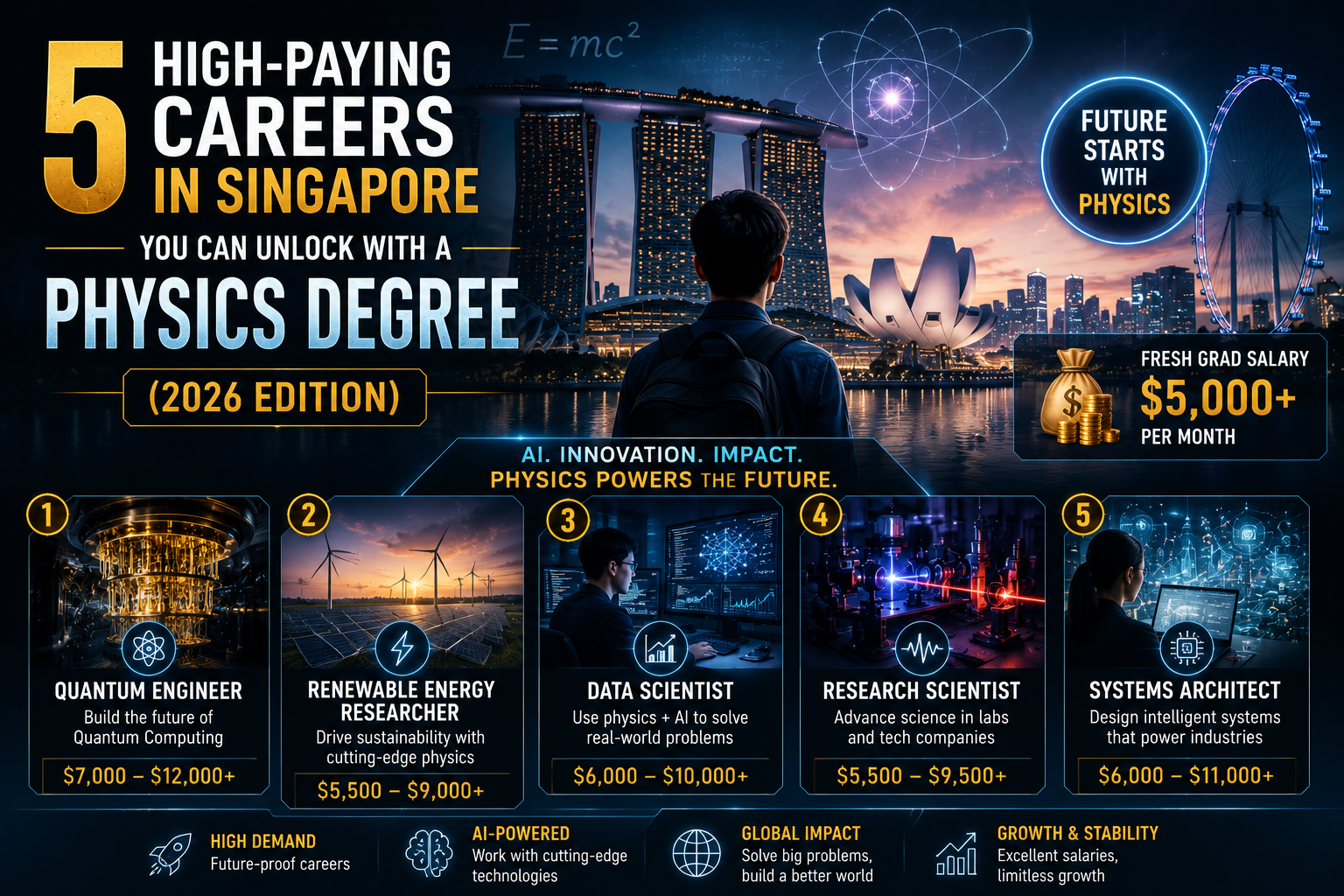
Here are five of those careers, with real salary figures and real connections to the physics you're learning today.
Career 1: Quantum Engineer / Quantum Computing Researcher
Starting salary in Singapore: S$7,000 – S$10,000/month Experienced: S$10,000 – S$15,000/month and above
If you've read anything about the future of technology in the past two years, you've seen quantum computing. In 2026 it has moved from a research curiosity to a genuinely growing industry — and Singapore is positioning itself as the leading quantum hub in Southeast Asia.
The Singapore government committed S$300 million through its National Quantum Strategy to build the full ecosystem: research, commercialisation, and a trained quantum workforce. The Centre for Quantum Technologies at NUS — one of the largest quantum research institutions in Asia — employs over 250 physicists, engineers, and computer scientists. Private companies including Horizon Quantum Computing, Entropica Labs, NVIDIA, HSBC, Visa, and Keysight Technologies all have quantum-related operations in Singapore right now.
What does a quantum engineer actually do? Depending on the role, you might be designing quantum circuits and algorithms, building and calibrating quantum hardware systems, developing quantum-safe cybersecurity infrastructure, or researching quantum sensing and quantum communication applications. The roles span from pure research at NUS and NTU to commercial engineering at private technology firms.
The physics connection: This is the most direct connection of any career on this list. The wave-particle duality you study in H2 Physics 9478 or IB Physics Theme E is not an abstract exam topic — it is the operating principle that quantum computers exploit. The superposition and interference concepts in your wave optics chapter describe exactly how qubits hold and process information. The photoelectric effect and energy quantisation topics are the foundational discoveries that launched quantum mechanics as a field.
A student who genuinely understands these concepts — not just as exam answers, but as descriptions of physical reality — is already building the foundation for a quantum career.
Career 2: Data Scientist / AI and Machine Learning Engineer
Starting salary in Singapore: S$4,500 – S$6,500/month Experienced: S$8,000 – S$15,000/month and above
Data science is one of the highest-paying professions in Singapore across almost every industry — finance, healthcare, logistics, government, retail, and technology. The median salary for a data scientist in Singapore sits around S$8,750 per month, well above the national median income, and senior roles in machine learning engineering and AI research push significantly higher.
Physics graduates are consistently among the most competitive applicants for data science roles — and this surprises people who assume data science is a computer science or statistics domain.
Here is why: data science, at its core, is about building mathematical models that explain patterns in data, testing those models against reality, and improving them iteratively. Sound familiar? It is exactly what physics trains you to do. The process of proposing a physical model, deriving its predictions, testing them against experimental data, and revising the model when the predictions fail — that is the scientific method. And it is also the professional method of every data scientist at every level.
Physics graduates also tend to arrive with stronger mathematical foundations than most — differential equations, linear algebra, probability, and computational thinking are all embedded in a rigorous physics education. These are the mathematical tools that machine learning algorithms are built on.
The additional step most physics graduates need is programming fluency: Python is the industry standard for data science, and physics students who develop Python skills alongside their physics coursework (which the new H2 Physics 9478 syllabus actively encourages, with its inclusion of data analysis and spreadsheet work in the practical component) arrive career-ready.
The physics connection: Every graph you have ever interpreted in a physics practical. Every time you've fitted a line to experimental data and asked whether the model matches reality. Every wave equation, force diagram, or circuit analysis where you had to build a mathematical model of a physical system and verify it. This is data science thinking, applied to physics. The habit of reasoning from data is exactly what your physics education has been building all along.
Career 3: Quantitative Analyst (Quant) in Finance
Starting salary in Singapore: S$6,500 – S$12,500/month Experienced: S$15,000 – S$25,000/month and above (top hedge fund roles can go much higher)
Singapore is one of the world's major financial centres and, increasingly, one of the most active locations for quantitative finance globally. Hedge funds, investment banks, and proprietary trading firms including Citadel, Two Sigma, Squarepoint Capital, Millennium Management, and Alphadyne Asset Management all have significant operations in Singapore — and they hire physicists.
A quantitative analyst — usually called a quant — uses advanced mathematics, statistical modelling, and algorithmic systems to price financial instruments, manage risk, develop trading strategies, and analyse market data. The mathematical complexity of modern quantitative finance is such that physics and mathematics graduates routinely outperform finance graduates in entry-level quant roles, because the physics background provides both stronger mathematical rigour and stronger intuition for working with noisy, complex, real-world systems.
Graduate quant roles in Singapore start at S$80,000 to S$150,000 per year — that is S$6,500 to S$12,500 per month at entry level. Senior quant researchers at leading hedge funds can earn S$500,000 or more annually. The ceiling in this career is extremely high, and the Singapore tax environment (personal income tax capped at 22%) makes the net earnings particularly attractive.
The skills that make a strong quant — mathematical modelling, probabilistic reasoning, comfort with uncertainty, ability to work with large datasets and extract signal from noise — are exactly the skills that rigorous physics training builds.
The physics connection: Statistical mechanics, probability distributions, modelling uncertainty, working with experimental error — these are all native to a physics education. The ability to build a model of a complex system (whether it is a gas of particles or a market of traders), derive predictions from it, and test those predictions against messy real-world data is the foundation of both physics research and quantitative finance. Physics graduates who add programming skills (Python, C++) and some financial domain knowledge are highly competitive for Singapore quant roles straight out of university.
Career 4: Renewable Energy Engineer / Sustainability Systems Designer
Starting salary in Singapore: S$4,500 – S$6,500/month Experienced: S$6,500 – S$10,500/month
Singapore's Green Plan 2030 has created a rapidly growing demand for engineers who understand the physical systems underlying renewable energy — solar photovoltaic systems, battery energy storage, grid modernisation, and energy efficiency optimisation. Companies including Sembcorp Industries, Keppel, PowerSeraya, and a growing ecosystem of renewable energy startups are actively hiring.
Renewable energy engineering roles in Singapore include solar system design and installation (S$5,800 – S$8,200/month), energy storage engineering (S$6,500 – S$9,200/month), grid modernisation engineering (S$7,000 – S$10,500/month), and sustainability engineering more broadly.
What does this actually involve? A solar engineer designs photovoltaic systems — specifying panel configurations, inverter sizing, cable layouts, and performance monitoring systems. This requires understanding the physics of electromagnetic radiation, energy transfer, and electrical circuits. A battery storage specialist needs to understand electrochemical energy conversion, thermal management (thermodynamics), and electrical systems integration. A grid engineer works with the physics of power transmission, electromagnetic induction, and load balancing across complex electrical networks.
Every one of these physical systems maps directly to topics in Singapore's O-Level and A-Level Physics syllabuses. Electromagnetic induction is the principle behind generators and transformers in the power grid. Circuit theory is the foundation of solar system electrical design. Thermodynamics underlies battery thermal management and energy efficiency analysis.
The physics connection: Waves and electromagnetic radiation (solar energy), circuit theory and electromagnetism (solar PV system design and grid engineering), thermodynamics (energy storage and efficiency). Students who genuinely understand these topics — not just as exam formulas but as descriptions of physical systems — are building the conceptual foundation for a career in one of Singapore's fastest-growing sectors.
Career 5: Medical Physicist / Biomedical Engineer
Starting salary in Singapore: S$4,000 – S$6,000/month Experienced: S$6,500 – S$12,000/month
This is the least talked-about career pathway for physics graduates in Singapore — and one of the most genuinely impactful.
Medical physicists work in hospitals and research institutions to ensure that radiation-based medical procedures — CT scans, MRI machines, radiation therapy for cancer, nuclear medicine imaging — are safe, accurate, and clinically effective. In Singapore, medical physicists work at institutions including Singapore General Hospital, National Cancer Centre Singapore, and the National University Hospital.
Biomedical engineers work more broadly at the intersection of physics, engineering, and medicine — designing medical devices, developing biosensors, improving diagnostic imaging systems, and applying computational physics to biological problems.
The physics underlying these careers is exactly what Singapore students study. MRI machines operate on nuclear magnetic resonance — the physics of how atomic nuclei respond to magnetic fields, directly connected to the electromagnetism and fields topics in H2 Physics and IB Physics. Radiation therapy for cancer uses the physics of ionising radiation, radioactive decay, and energy transfer to tissue — nuclear physics topics in both syllabuses. Ultrasound imaging relies on wave physics: frequency, wavelength, reflection, and the impedance mismatch between different tissue types.
This career path typically requires a Physics degree followed by specialised postgraduate training in medical physics or biomedical engineering. The pathway is longer than some others on this list, but the combination of genuine intellectual interest, social impact, and job security makes it one of the most consistently rewarding physics career paths available in Singapore.
The physics connection: Nuclear physics, electromagnetism and magnetic fields, wave physics (ultrasound), optics (endoscopic imaging), and thermodynamics (thermal therapy). Medical physics is one of the clearest demonstrations that the physics you study in school is not abstract — it is literally saving lives in hospitals every day.
The Careers at a Glance
CareerFresh Graduate Salary (SGD/month)Experienced Salary (SGD/month)Key physics you're already learningQuantum Engineer / ResearcherS$7,000 – S$10,000S$10,000 – S$15,000+Wave-particle duality, superposition, electromagnetismData Scientist / AI EngineerS$4,500 – S$6,500S$8,000 – S$15,000+Mathematical modelling, data analysis, practical skillsQuantitative Analyst (Finance)S$6,500 – S$12,500S$15,000 – S$25,000+Statistical mechanics, modelling uncertainty, complex systemsRenewable Energy EngineerS$4,500 – S$6,500S$6,500 – S$10,500Electromagnetism, circuits, thermodynamics, wavesMedical Physicist / Biomedical EngineerS$4,000 – S$6,000S$6,500 – S$12,000Nuclear physics, waves, magnetic fields, optics
What All Five Careers Have in Common
Every career on this list requires the same core ability: the capacity to take a complex, uncertain, real-world situation, build a mathematical model of it, test that model against reality, and refine it when it is wrong.
This is not a data science skill. It is not a finance skill. It is not an engineering skill. It is a physics skill — and it is the skill that every Singapore student studying O-Level, A-Level, or IB Physics is building right now, whether they realise it or not.
The students who arrive at these careers strongest are not necessarily the ones who scored A1 on every test. They are the ones who genuinely understood what they were doing — who could explain why a circuit behaves a certain way, not just calculate the current; who could describe the physical meaning of a wave equation, not just apply it. Genuine understanding transfers. Memorised formulas do not.
Frequently Asked Questions About Physics Careers in Singapore
Do I need a physics degree specifically, or will engineering or computer science work?
Many of these careers — especially data science, quant finance, and quantum computing — are accessible through physics, engineering, computer science, or mathematics degrees. The advantage of a physics degree is the depth of mathematical modelling training and the breadth of physical intuition it builds. Physics graduates are specifically sought after in quant finance and quantum computing for exactly this reason. For medical physics, a physics degree followed by specialised postgraduate training is the standard pathway.
Which university in Singapore offers the best physics degree for these careers?
NUS Physics and NTU Physics are both internationally ranked programmes with strong industry connections. NUS Physics has direct links to the Centre for Quantum Technologies and offers quantum computing specialisation pathways. Both universities have industry partnership programmes connecting physics graduates to finance, technology, and engineering employers. The academic foundation matters, but internships and research experience during your degree often determine which specific door you walk through.
How important is programming for a physics graduate in Singapore?
Extremely important across almost all of these careers. Python is the baseline skill for data science, AI, quantum software development, and quant finance. C++ is valuable for high-performance computing roles and quant development. MATLAB is used in engineering and research settings. The new H2 Physics 9478 syllabus includes data analysis and spreadsheet-based practical work — which is the first step. Students who develop genuine Python skills alongside their physics education arrive significantly more competitive for every career on this list.
Is a postgraduate degree necessary for these careers?
It depends on the role. Data science, renewable energy engineering, and many quantum engineering positions are accessible with a bachelor's degree and strong practical skills. Quantitative research roles at top hedge funds prefer or require a Master's or PhD in physics, mathematics, or computer science. Medical physics and quantum research positions at universities and research institutions almost always require postgraduate qualifications. For most careers, a bachelor's degree with strong internship experience is the most efficient entry pathway — postgraduate study is valuable if you want to specialise deeper or move into research.
What subjects should a Singapore student focus on to maximise their options for these careers?
Strong H2 Physics combined with H2 Mathematics is the most broadly applicable combination for all five careers on this list. Adding H2 Chemistry strengthens the biomedical engineering pathway. Computing as a subject (offered at many JCs) directly complements the data science and quantum computing pathways. For IB students, Physics HL combined with Mathematics AA HL is the equivalent strong foundation. Across all pathways, the single most important thing is building genuine conceptual understanding in physics — not just exam technique — because that understanding is what transfers into the career itself.
Which of these careers is the fastest growing in Singapore right now?
Quantum computing and data science are the two fastest-growing physics-adjacent fields in Singapore in 2026, driven by the S$300 million National Quantum Strategy and the ongoing digital transformation across finance, logistics, healthcare, and government. Renewable energy engineering is growing strongly under Singapore's Green Plan 2030 commitments. All five careers on this list are growing — the question is which direction your interests and skills point you.
The Takeaway: The Physics You Learn Today Is Worth More Than You Think
The next time you're working through a wave equation at 11pm and wondering why it matters — remember this.
The physics you are learning right now is the foundation of a quantum engineer's daily work in Singapore's fastest-growing technology sector. It is the mathematical intuition that makes a quant analyst valuable to a hedge fund paying S$15,000 a month. It is the modelling skill that helps a data scientist at GovTech or DBS extract meaning from millions of data points. It is the understanding of electromagnetic systems that a renewable energy engineer uses to design Singapore's solar infrastructure. It is the wave and nuclear physics that a medical physicist uses to calibrate cancer treatment equipment.
Physics is not just a school subject. It is a way of thinking that Singapore's most competitive employers are actively hiring for — and paying very well.
Physics Made Easy teaches O-Level Physics (6091), A-Level H2 Physics (9749/9478), IP Physics, and IB Physics with exactly this in mind: building the genuine conceptual understanding that transfers from the exam into the career. Because a student who truly understands physics doesn't just get a better grade. They arrive at university and the workforce with a thinking toolkit that opens every door on this list.
Book a free trial lesson at MakePhysicsEasy.com and start building physics understanding that goes somewhere.
Written by Mr. Cornelius Chew, Ex-MOE, NIE-trained physics educator and FIDE-certified chess instructor, MakePhysicsEasy.com — Singapore's concept-first physics coaching centre for O-Level (6091), A-Level H2 Physics (9749/9478), IP, and IB Physics students.
Salary figures are based on 2026 market data from Glassdoor, ERI SalaryExpert, Indeed Singapore, and industry-specific sources. Individual salaries vary based on employer, experience, specialisation, and educational background.