How to Use GenAI for Career Insights: From RIASEC Profile to Real-World Career Choices
I remember sitting with a student after his A-Level results came in. He had done well in physics. He had options. But he had absolutely no idea what to do with them.
Sound familiar?
Career confusion is not just a student problem. It is one of the most common challenges I hear from working professionals too — people who have built years of experience in one industry, only to find that AI and digital transformation are reshaping everything around them. The job they trained for may not look the same in five years. The skills that made them competitive are being automated.
What most people do not realise is that Generative AI tools — the same technology disrupting careers — can also be one of the most powerful tools for planning your next move. And when you pair AI with a structured RIASEC career assessment, you get something genuinely useful: a data-backed, personalised picture of where your strengths fit in a world being reshaped by automation.
This post walks through exactly how to do that — and why it matters more than ever in 2026.
What Is GenAI and Why Is It Changing Career Planning?
Generative AI (GenAI) refers to AI systems — like ChatGPT, Microsoft Copilot, and Google Gemini — that can produce text, images, code, and analysis in response to prompts. Unlike earlier automation tools that replaced repetitive manual tasks, GenAI can now handle semi-automated cognitive work: writing reports, analysing data, generating strategies, and even providing personalised career advice.
The result is a significant AI disruption of the workplace. Jobs that once required years of training to perform are being partially or fully automated. New roles are emerging that demand AI literacy — the ability to use AI tools strategically to improve work efficiency and decision-making.
For students and working professionals in Singapore, this is not a distant threat. It is already reshaping hiring decisions, promotion criteria, and industry demand right now.
The good news? AI for career development is not just a risk — it is also a resource. And learning to use it for your own career planning is one of the highest-leverage skills you can build today.
I write about the broader relationship between strong analytical skills — the kind physics trains you to develop — and high-value careers in our blog post on 5 High-Paying Careers in Singapore You Can Unlock with a Physics Degree. The connection between structured thinking and career advantage is a theme that runs through everything we do at Physics Made Easy.
What Is a RIASEC Profile and Why Does It Matter for Career Decisions?
Before you ask an AI agent to help you plan your career, you need the right input. That is where the RIASEC career assessment comes in.
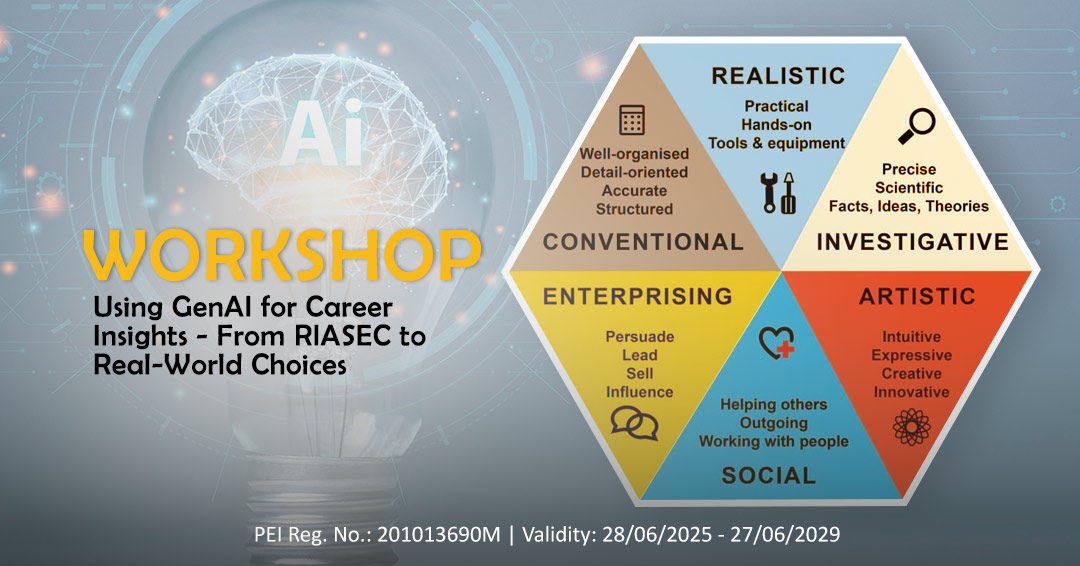
RIASEC stands for six personality and interest types identified by psychologist John Holland:
- R — Realistic: Practical, hands-on, technical
- I — Investigative: Analytical, scientific, problem-solving
- A — Artistic: Creative, expressive, design-oriented
- S — Social: People-focused, teaching, counselling
- E — Enterprising: Leadership, persuasion, business
- C — Conventional: Structured, detail-oriented, data management
Every person has a combination of these types, and your RIASEC profile helps identify which careers and work environments are likely to feel natural and motivating — rather than draining.
In Singapore, the MySkillsFuture portal offers a free RIASEC-style assessment tool that generates your career interest profile based on your responses. This profile becomes the foundation for a much richer conversation — one you can now have directly with a GenAI tool for career planning.
How to Use AI Tools Like ChatGPT for RIASEC-Based Career Planning
Here is the process I would walk a student or working professional through — step by step.
Step 1: Complete Your RIASEC Assessment
Visit the MySkillsFuture Assessment Tool at the SkillsFuture Singapore portal. Work through the career interest questionnaire and note your top two or three RIASEC types. These are your input data.
Step 2: Choose Your GenAI Tool
For career development using AI, any of the major tools will work:
- ChatGPT (OpenAI) — best for detailed written analysis and personalised advice
- Microsoft Copilot — useful if you already work in Microsoft 365 environments
- Google Gemini — strong for research-heavy prompts and real-time information
Each of these AI tools for career planning accepts natural language prompts, which means you describe your situation in plain English and the AI generates a structured response.
Step 3: Write an Effective Prompt for Career Analysis
This is where most people underuse the tool. A vague prompt produces a vague answer. A specific, structured prompt produces something genuinely useful.
A strong career planning prompt looks like this:
"My RIASEC profile is Investigative-Realistic-Conventional (IRC). I have 8 years of experience in telecommunications as a business analyst. I am concerned that AI automation may reduce demand for my current role. Based on my profile and experience, what career transitions should I consider? What new skills should I build? What roles in Singapore are likely to grow despite AI disruption?"
The more context you give, the more tailored the response. This kind of structured AI-assisted career analysis can surface options you would not have considered — and validate ones you were already thinking about.
Step 4: Use AI for Job Search and Career Development Planning
Once you have your career direction, use GenAI for job search strategy in Singapore by asking for:
- Industry-specific job titles that match your RIASEC profile
- Skills gaps between your current profile and target roles
- Recommended courses or certifications to bridge those gaps
- Resume framing advice for your target industry
- Interview preparation tailored to your specific career transition
This practical, hands-on use of AI tools to improve work efficiency is exactly the kind of skill that is now becoming a competitive differentiator in the Singapore job market.
Why AI Literacy Is Now a Career Skill, Not Just a Tech Skill
One of the most important shifts happening in Singapore workplaces right now is the reframing of AI literacy from a technical specialisation to a general professional skill.
Five years ago, knowing how to use ChatGPT would have seemed niche. Today, professionals who cannot use AI tools to augment their work are at a measurable disadvantage. This is not just in technology sectors — it affects finance, education, healthcare, logistics, and every knowledge-based industry.
The AI disruption of the workplace is not replacing all human workers. It is replacing workers who do not adapt. The professionals who thrive will be those who learn to use AI as a thinking tool — to do more complex analysis faster, generate better ideas, and make more informed decisions.
This is, in many ways, the same skill physics trains you to develop: structured reasoning, systematic analysis, and the ability to break a complex problem into manageable components. I explore this connection in our post on How Singapore Students Are Using Physics to Break Into Quantitative Finance.
The analytical mindset that makes a great physics student also makes a great AI-augmented professional.
What Prompting Skills Do You Need to Get Real Career Insights from GenAI?
The quality of your output depends almost entirely on the quality of your AI prompting skills. Here is what separates a useful response from a generic one.
Be Specific About Your Context
Do not just say "help me with my career." Say: "I am a 35-year-old market research analyst in Singapore with 10 years of experience. I hold a RIASEC profile of Investigative-Enterprising. I want to transition into a more AI-adjacent role without going back to school full-time. What are my options?"
Ask for Structured Output
Prompt the AI to organise its response:
Give me your answer as three sections:
(1) immediate skills to build in the next 6 months,
(2) career roles to target,
(3) resources available in Singapore.
Iterate on the Response
GenAI for personalised career advice works best as a conversation. If the first response is too general, ask follow-up questions: "Which of those roles has the highest demand in Singapore in 2026?" or "What does a day-in-the-life look like for a data analyst in the oil and gas industry?"
Use AI for Creative Career Planning Too
Beyond job search, you can use AI tools for career planning to map out a holiday that recharges you for the next chapter, draft a LinkedIn summary that reflects your new direction, or prepare a business case for an internal role change. The same tool that helps with physics problems can help you think through life decisions more systematically.
Who Should Be Using GenAI for Career Development in Singapore?
Based on what I have seen both in teaching and in conversations with working professionals, the following groups have the most to gain from building AI literacy for career planning:
- Mid-career professionals whose current roles face AI disruption and who need to identify adjacent opportunities
- Recent graduates exploring career options and trying to match their strengths to market demand
- Career changers who want structured analysis of how their existing skills translate to new industries
- Adult learners returning to education who want to invest their time in the most future-proof skills
- Students in STEM fields — including physics students — who are building analytical skills they want to monetise in the right career direction
At Physics Made Easy, we frequently talk with students about the career implications of the skills they are building. Physics is not just an exam subject — it is training in the kind of logical, systematic thinking that AI augments rather than replaces. Our free resources page has materials on exactly this kind of applied thinking.
Comparison: Using AI Tools vs Traditional Career Counselling

The most effective approach combines structured self-assessment (RIASEC) with AI-assisted analysis and, where possible, expert guidance — whether that is a career counsellor, a mentor, or a educator who can help you map your strengths to real-world opportunities.
Frequently Asked Questions About Using GenAI for Career Insights
What is GenAI and how is it different from regular AI?
Generative AI (GenAI) refers to AI systems that can create new content — text, images, analysis, code — based on prompts. Tools like ChatGPT, Google Gemini, and Microsoft Copilot are GenAI tools. Unlike older AI that followed fixed rules, GenAI can engage in flexible, conversational analysis, making it useful for personalised career development using AI.
Is the MySkillsFuture RIASEC assessment free?
Yes, the MySkillsFuture career assessment tool is free for Singapore residents and permanent residents. It provides a RIASEC profile that you can then use as input for GenAI career analysis. Visit the SkillsFuture Singapore portal to access it.
Can GenAI really replace a professional career counsellor?
Not entirely — but it can dramatically accelerate and enrich the self-analysis phase. AI tools for career planning are best used as a first layer: generating options, mapping skills to roles, and surfacing questions you had not thought to ask. A professional career counsellor brings emotional intelligence, contextual knowledge, and accountability that AI cannot yet replicate.
Which AI tool is best for career development — ChatGPT, Copilot, or Gemini?
All three are capable of AI-assisted career planning. ChatGPT tends to produce the most detailed written analysis. Microsoft Copilot integrates well with workplace tools. Google Gemini is strong for research-heavy queries. For a first-time user, ChatGPT with a specific, structured prompt is usually the most accessible starting point.
How does a physics background help with AI-related careers?
Physics trains you in structured problem-solving, quantitative reasoning, and systematic analysis — exactly the cognitive skills that AI augments most powerfully. Physics graduates regularly move into quantitative finance, data science, AI research, and engineering — all fields where human-AI collaboration is the new standard. We explore this in detail in our blog on careers you can unlock with a physics degree.
What should I include in my GenAI career planning prompt?
A strong AI career planning prompt includes: your current role and years of experience, your RIASEC profile, your concern or goal (e.g. career change, skill upgrade, redundancy risk), your geographic context (Singapore), and the format you want the answer in (list, analysis, step-by-step plan). Specificity is everything.
Is AI replacing jobs in education and tutoring?
AI is changing education — but it is augmenting effective teaching, not replacing it. The kind of metacognitive coaching that helps a student understand why they keep making the same physics mistake requires human insight. AI can generate practice questions; it cannot yet replicate the relationship between a trusted tutor and a struggling student. You can read more about how we think about this in our post on the latest trends in education.
The Bottom Line: GenAI Is a Career Tool — But You Need the Right Foundation
Generative AI for career planning is genuinely powerful. The combination of a structured RIASEC self-assessment and a well-prompted AI tool can surface career insights in hours that might otherwise take months of scattered research.
But here is the thing I always come back to: AI amplifies the thinking you already bring to it. The sharper your analytical skills, the more useful the AI's output becomes. The clearer your self-understanding, the more targeted your prompts will be. The stronger your foundation in logical reasoning, the better you will interpret and act on what the AI suggests.
That is why what happens in a physics classroom — or a great physics tuition session — matters beyond the exam. We are not just teaching students to solve kinematics problems. We are building the kind of systematic, evidence-based thinkers who will thrive in a world where AI handles the routine and humans are expected to provide the insight.
If you want to see what that kind of teaching looks like in practice, explore our O-Level, A-Level, and IB Physics programmes — or book a free trial lesson with Mr. Chew to experience the methodology directly.
The future belongs to people who can think clearly in a world full of AI-generated noise. That skill starts earlier than most people realise.
Related reading from the Physics Made Easy Blog:
- 5 High-Paying Careers in Singapore You Can Unlock with a Physics Degree
- How Singapore Students Are Using Physics to Break Into Quantitative Finance
- Latest Trends in Education
- What Is Quantum Computing — Physics Made Easy
- Why Physics Is the Backbone of Modern Technology