
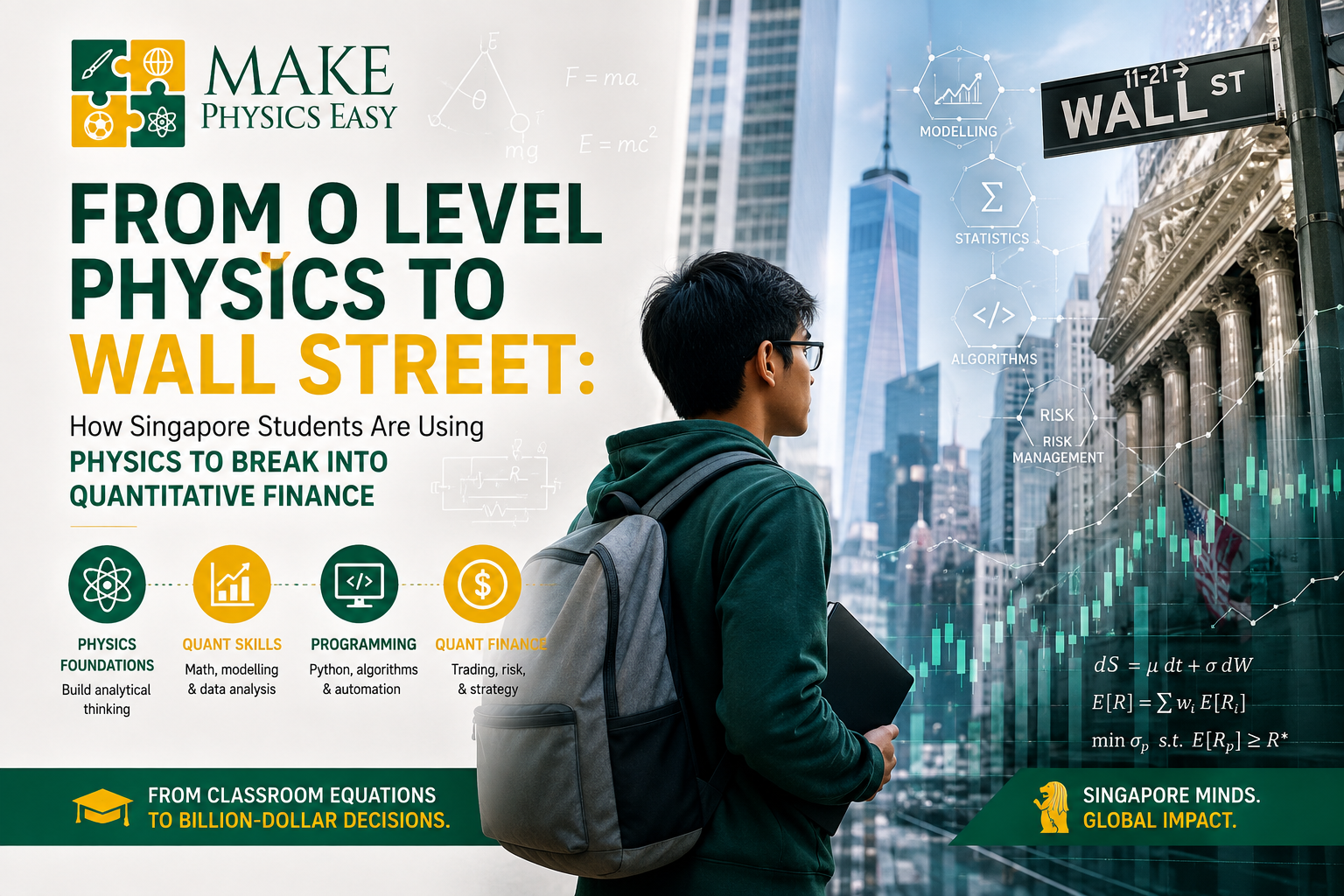
From O Level Physics to Wall Street: How Singapore Students Are Using Physics to Break Into Quantitative Finance
When I was helping my younger cousin choose her O Level subject combination, she kept asking, "What's the point of physics? I'm not going to be an engineer." I didn't have a great answer then. But a few years later, watching her land an internship at a major hedge fund after reading Physics at NUS — I finally understood what most students in Singapore still don't.
Physics is one of the most powerful launchpads into quantitative finance in the world. And Singapore students are increasingly figuring this out before their peers anywhere else.
This isn't about being a rocket scientist. It's about the way physics trains your brain — to model uncertainty, work with incomplete data, and extract signal from noise. These are exactly the skills that quant analysts, derivatives traders, and algorithmic trading firms pay top dollar for.
Here's what you need to know if you're a Singapore student sitting on an O Level or H2 Physics grade and wondering whether it could actually matter for your career.
Why Quantitative Finance Cares More About Physics Than You Think
Most students assume finance careers are for economics or accountancy majors. That assumption costs them years.
The reality on Wall Street — and in Singapore's growing financial hub — is that the most in-demand roles in finance aren't about reading balance sheets. They're about building mathematical models for pricing derivatives, managing portfolio risk, and designing algorithmic trading strategies. And those models are built by people who were trained to think like physicists.
The skills that get you through H2 Physics — dimensional analysis, working with differential equations, modelling systems with uncertainty — are the same skills that underpin stochastic calculus, Black-Scholes option pricing, and Monte Carlo simulations used every day in quantitative finance.
It's not a coincidence. Many of the pioneers of modern financial mathematics — Fischer Black, Emanuel Derman, Paul Wilmott — came from physics and engineering backgrounds. They didn't retrain from scratch. They translated what they already knew.
The O Level and H2 Physics Skills That Actually Transfer
You don't have to wait for university to start building transferable skills. Even at the O Level and A Level physics stage, Singapore students are developing mental models that map directly onto quantitative finance.
Kinematics and calculus thinking. The moment you work with velocity, acceleration, and rate-of-change problems in physics, you're already thinking in derivatives and integrals — the backbone of options pricing.
Waves and harmonic motion. The mathematics of oscillation, frequency, and damping shows up in interest rate modelling and cyclical market analysis in ways that are surprisingly direct.
Electricity and circuit analysis. The ability to model systems with resistance, capacitance, and flow maps onto cash flow modelling and network theory in finance.
Uncertainty and measurement error. Every physics student learns that measurements come with uncertainty. That mindset — quantifying what you don't know — is precisely what risk management in finance is built on.
Data interpretation and graphical analysis. Singapore's physics curriculum emphasises drawing conclusions from graphs and experimental data. In quant finance, reading and interpreting market data is a daily task.
What Singapore Students Are Doing Differently
Singapore's education system gives physics students a quiet edge: the curriculum is rigorous, calculus-heavy, and applied. Students here are solving problems that their counterparts in many Western systems don't encounter until university.
But the students who are successfully crossing over into quant finance careers are doing more than just studying the syllabus. They're making deliberate connections between what they learn in physics class and how financial markets work.
Here's what I've seen work:
Starting Python or MATLAB early. Physics teaches the thinking; programming makes it deployable. Students who pick up coding — even at a basic level — during their JC years arrive at university ready to build real quantitative models.
Reading about financial physics. Books like The Physics of Wall Street by James Weatherall or My Life as a Quant by Emanuel Derman show students exactly how physics thinking translated into financial innovation. These aren't textbooks — they're motivating stories.
Choosing the right university major. In Singapore, NUS and NTU both offer pathways — through Physics, Mathematics, or Quantitative Finance programmes — that feed directly into quant roles. Students who understand this connection pick courses more strategically.
Internship hunting in the right places. Banks like Goldman Sachs, Jane Street, Citadel, and DRW all recruit from physics and maths backgrounds. Many have Singapore offices. Students who position their physics background correctly in applications stand out immediately.
The Career Paths That Open Up
Once you understand that physics and quantitative finance overlap, the career map looks very different.
Quantitative Analyst (Quant). This is the role most people think of. Quants build the mathematical models that price complex financial instruments, assess portfolio risk, and guide trading decisions. Physics graduates are actively recruited for this role at investment banks, hedge funds, and trading firms.
Algorithmic Trader. Algo traders design and execute automated trading strategies. The job requires statistical thinking, programming skill, and the ability to model market behaviour — all things that advanced physics training develops.
Risk Manager. Every bank and asset manager employs teams to model and manage financial risk. The mathematics of uncertainty — something every physics student handles — is central to this work.
Data Scientist in Finance. As financial firms become more data-driven, they need people who can build predictive models from large datasets. Physics graduates often excel here because they've been trained to extract meaningful patterns from noisy experimental data.
Derivatives Structurer. These professionals design complex financial products. The role sits at the intersection of mathematics, client needs, and market conditions — and physics-trained thinkers are well-suited to its complexity.
Physics vs. Other Backgrounds: How They Compare in Quant Finance Recruiting
H2 Physics (Singapore) provides a high level of mathematical depth and medium coding readiness, although financial knowledge is generally low. However, with additional upskilling in programming and finance, it offers a very high fit for quantitative finance. Economics has low to medium mathematical depth and low coding readiness, but provides high financial knowledge, making it a medium fit for quantitative finance. Mathematics offers very high mathematical depth and medium coding readiness, but limited financial knowledge, resulting in a high fit for quantitative finance. Computer Science has medium mathematical depth, very high coding readiness, and low financial knowledge, also making it a high fit for quantitative finance. In comparison, Accountancy provides low mathematical depth and low coding readiness, despite having high financial knowledge, resulting in a low fit for quantitative finance.
The table above shows why physics students in Singapore are in a strong position: the gap in financial knowledge is the easiest one to close. You can learn what a bond is in a weekend. Relearning how to think mathematically takes years.
Who Is This Path Best For?
Not every physics student will love quantitative finance — and that's fine. But this career path tends to suit students who:
- Genuinely enjoy solving mathematical problems, not just memorising formulas
- Are curious about how financial markets work and why prices move
- Have an interest in programming or are willing to learn
- Want a high-earning, intellectually demanding career outside of medicine or law
- Are drawn to data, models, and logical systems rather than people management
If you got through H2 Physics and actually found the problem sets satisfying — even the hard ones — that's a strong signal you'd enjoy quant finance work.
Frequently Asked Questions
Do I need a physics degree to work in quantitative finance?
Not necessarily, but a physics background is one of the most respected entry points into quant finance. Top firms like Jane Street and Citadel actively recruit physics graduates because of their mathematical training. A physics degree from NUS or NTU, paired with programming skills, is a competitive profile for quant analyst roles.
How do O Level physics skills apply to quantitative finance?
O Level physics builds core mathematical reasoning skills — working with equations, rates of change, measurement, and uncertainty — that are directly applicable to financial modelling. While O Level alone isn't sufficient, it's the foundation that allows Singapore students to progress into the more advanced skills needed for quant roles.
What programming languages should Singapore physics students learn for quant finance?
Python is the most important language to start with — it's widely used in data analysis, backtesting trading strategies, and financial modelling. After that, learning R or MATLAB is useful. C++ is valued at high-frequency trading firms where computational speed matters. Most Singapore students can begin learning Python during their JC years or before university.
Which universities in Singapore offer the best pathway into quantitative finance?
NUS and NTU both have strong Physics and Mathematics programmes that feed into quant finance careers. NUS Business School also offers a quantitative finance specialisation. The CFA Institute's Quantitative Methods curriculum is also useful for students who want to self-study financial modelling concepts alongside their physics degree.
Is quantitative finance a realistic career path from Singapore?
Yes — and it's increasingly common. Singapore is a major financial hub with offices of global banks, hedge funds, and proprietary trading firms. Many of these firms actively recruit from Singapore's universities. Students who combine a strong physics or maths background with coding skills and financial knowledge are competitive candidates both locally and for international roles.
How much do quant analysts earn in Singapore?
Entry-level quant analyst roles at investment banks in Singapore typically start between SGD 6,000–9,000 per month. At proprietary trading firms and hedge funds, compensation — including bonuses — can be significantly higher. Senior quant roles can command total packages well into six figures annually.
Can I switch into quantitative finance from physics mid-career?
Yes. Many working physicists and engineers have successfully transitioned into quant finance in their 30s. A strong mathematical background, combined with targeted study of financial mathematics (such as a part-time Master's in Financial Engineering or Mathematical Finance), is a well-established route. Several Singapore universities and institutions offer such programmes.
The Bottom Line
If you're a Singapore student with a strong physics background, you're sitting on something more valuable than you realise. The skills that let you work through a difficult H2 Physics problem — mathematical rigour, comfort with uncertainty, the ability to model a complex system — are exactly what the most competitive employers in global finance are looking for.
The students who are breaking into Wall Street and top hedge funds from Singapore aren't always the ones who studied finance. They're often the ones who studied physics, learned to code, and made the connection that most of their peers missed.
Physics isn't a detour from finance. For the most in-demand roles, it's the fastest route in.
If you want to explore how to build on a physics background toward a career in quantitative finance — from choosing the right university major to positioning yourself for internships at top trading firms — the journey starts with understanding that the skills you already have are more relevant than you think.