O-Level Combined Science (Physics) Tuition in Singapore
Focused help for the Physics component of Combined Science, so the Physics grade stops holding your overall result back.
Who This Class Is For
In Combined Science, Physics constitutes exactly 50% of your total score. Fixing Physics is the fastest way to turn a failing grade into an L1R4/L1R5 scoring asset.
Students Pulled Down by the Physics Half
Your Chemistry or Biology marks are decent, but your overall Combined Science grade is stuck at B4, C5 or lower because Physics drags down the 50% aggregate.
Students Needing Core Basics Rebuilt
Struggling with fundamental concepts like resultant forces, series/parallel circuit current splitting, or ray diagrams. You need patient, step-by-step explanations.
Students Aiming for a Definite Distinction (A1 / A2)
Combined Science questions follow predictable patterns. With disciplined exam technique and formula mastery, Physics can become your guaranteed scoring paper.
Combined Science Physics vs Pure Physics
What is the difference between Pure Physics and Combined Science (Physics) in Singapore? Here is an objective comparison to help you choose the best study path:
| Feature | Combined Science (Physics 5076) | Pure Physics (6091) |
|---|---|---|
| Total Subject Weight | Counts as 50% of one Science grade (e.g., Science Physics/Chem). | Counts as 1 full standalone O-Level subject grade. |
| Depth of Content | Streamlined syllabus. Focuses on straightforward conceptual definitions and standard single-equation calculations. | Deeper conceptual and mathematical rigor, multi-step problem solving, and complex graphical derivations. |
| Excluded Topics | No Radioactivity, no Specific Heat Capacity / Latent Heat equations, no complex Electromagnetic Induction circuits. | Includes all 22 full chapters including Radioactivity, Nuclear Physics, and advanced induction. |
| Practical Exam | Combined Science Paper 5 practical is shared between two sciences (shorter 1h 30m total). | Paper 3 Practical is an intensive 1h 50m lab exam carrying 20% weightage. |
| Who This Suits | Students aiming for Polytechnic diplomas, arts/commerce JC streams, or students wanting a lower-stress science subject. | Students planning to take JC H2 Physics and pursue engineering, computing, architecture, or science degrees. |
How We Teach Combined Physics
Combined Science students do not need overwhelming theory. They need simplicity, high-frequency question mastery, and immediate exam confidence.
Start from Fundamentals
We strip away confusing textbook jargon and explain concepts using visual everyday examples so students truly understand why things happen.
High-Frequency Questions
Cambridge Combined Science repeats core question patterns. We drill the top 20 question styles that consistently appear year after year.
Formula & Unit Confidence
A one-page Formula Sheet and our Given → Formula → Calculation checklist eliminate careless calculation and conversion mistakes.
Fix Common Traps
Topic-by-topic traps (like confusing mass and weight, or forgetting that total resistance in parallel decreases) are mastered upfront.
Topics Covered in Combined Science Physics
Full coverage of all SEAB syllabus topics across Sec 3 and Sec 4.
Section I: Measurement & Mechanics
Section II: Thermal Physics
Section III: Waves, Light & Sound
Section IV: Electricity & Magnetism
Schedule, Location & Fees
No hidden material fees, no registration deposit, and small groups capped at 4 to 8 students.
| Course | Class Size | Duration | Monthly Fee | Venues |
|---|---|---|---|---|
| Sec 3 Combined Science (Physics) | 4 – 8 students | 2.0 Hours / week | $320 / 4 sessions | Toa Payoh Central / Online |
| Sec 4 Combined Science (Physics) | 4 – 8 students | 2.0 Hours / week | $320 / 4 sessions | Toa Payoh Central / Online |
| 1-on-1 Fast-Track Booster | 1-on-1 custom | 1.5 – 2.0 Hours | Enquire for slots | Physical Studio / Online |
185 Toa Payoh Central, #02-342 (Lift E), Singapore 310185. (Wednesday classes held at 186 Toa Payoh Central #02-430).
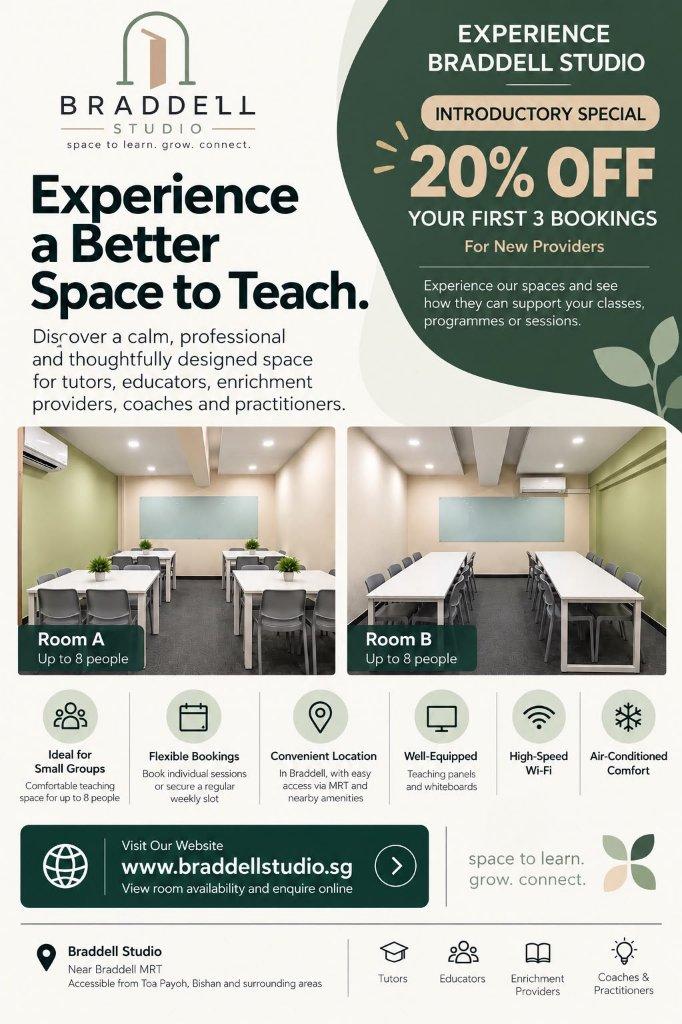
Braddell Studio (near Braddell MRT), providing calm overflow small-group capacity when existing venues are full.
Real-time online lessons with digital whiteboard and mailed physical notes for students who cannot travel.
Combined Science Grade Breakthroughs
Real stories of students who transformed Physics from their worst subject into their highest-scoring asset.
“Physics was always dragging my Combined Science down to D7. Mr Chew made circuits and turning effects so simple with his analogies. For O-Levels, my science jumped all the way to A1!”
“I was very stressed before Prelims because my Physics marks were always below 50%. The targeted topical drilling and formula cheat sheets gave me immediate confidence.”
“Mr. Chew never makes you feel bad for asking basic questions. His patient explanation of light refraction and moments helped my son finally enjoy science.”
Frequently Asked Questions
Everything you need to know about our Combined Science Physics coaching.
Turn Physics Into Your Scoring Advantage
Experience Mr. Chew's clear, patient teaching in a free trial lesson. WhatsApp us today to check current class times and seat availability.