O-Level Pure Physics Tuition in Singapore for Sec 3 & Sec 4 Students
Physics makes sense when it is explained step by step. Join small-group classes built to take your child from confused to confident before O-Levels.
Does Your Child Face Any of These Problems?
Most secondary students find Pure Physics jarring because Lower Sec Science was about memorisation. Pure Physics requires real logical deduction.
Understands notes but cannot answer unfamiliar questions
Your child follows classroom explanations and memorizes formulas, but freezes when Cambridge twists the question scenario or presents a novel everyday context.
Loses heavy marks on explanation answers
Calculations might be passable, but structured 3–4 mark qualitative questions get penalised repeatedly for missing Cambridge keywords and incomplete cause-and-effect reasoning.
Weak in formulas, units or graphical analysis
Mixing up prefixes (micro, milli, mega), careless unit conversions, or failing to interpret the physical meaning of gradients and areas under velocity-time or I-V curves.
Unsure whether to stay in Pure Physics or drop to Combined
After a disappointing Sec 3 Mid-Year or End-of-Year exam, confidence takes a hit. Students question if they should give up Pure Physics even when their foundation just needs targeted fixing.
Why O-Level Physics Feels So Hard
The transition from Lower Secondary Science to O-Level Pure Physics (Syllabus 6091) represents one of the steepest jumps in Singapore’s secondary curriculum. Students who scored distinctions in Sec 2 suddenly find themselves getting C5 or F9 on their first Sec 3 Physics test. Here is why:
1. The Heavy Concept-to-Application Jump
In Lower Sec, remembering facts was enough. In O-Level Pure Physics, questions are contextualized in real-world scenarios—rollercoasters, hydraulic lifts, optical fibers, or domestic AC mains. Students must diagnose which underlying law applies without being directly told.
2. Precise Keywords and Cause-and-Effect Phrasing
Cambridge examiners do not award marks for vague impressions. Explanation answers must link cause and effect using mandatory scientific keywords (e.g. “rate of change of momentum”, “constant velocity implies net force is zero”, “internal energy equals sum of kinetic and potential energy”).
3. Careless Calculation and Mathematical Pitfalls
Students frequently lose 8 to 15 marks across Papers 1 and 2 purely due to unit mismatches (forgetting to convert grams to kilograms, or cm³ to m³), misreading graph axes, or dropping significant figures in final answers.
How We Help Students Score Better
Instead of giving students endless past-school exam papers to drown in, we build mastery systematically through 5 deliberate steps.
1. Concept Clarity via Real Analogies
We use intuitive mental models and real-life physical props so abstract concepts (like electric potential difference or electromagnetic induction) become tangible before mathematical formulas are introduced.
2. Topic-by-Topic Mistake Bank
Every topic has a curated 'Cambridge Trap List' highlighting the exact careless blunders, misleading distractors, and incomplete explanations that cost students marks year after year.
3. 3-Part Answering Protocol
Structured frameworks for definition questions, calculation workflows (Given → Equation → Working → Units), and qualitative explanation templates that guarantee all keyword marks.
4. Past-Year Topical Drilling
Students practice questions clustered by subtopic difficulty rather than year-by-year, allowing them to spot recurring Cambridge patterns and master variations of every core question type.
5. Practical Paper 3 Skills
Dedicated guidance on laboratory exam technique: experimental planning, avoiding parallax error, tabulating data with correct d.p./s.f., and writing airtight sources of error.
6. Direct WhatsApp Diagnostic Help
Students can snapshot tricky school tutorial problems and send them directly to Mr. Chew for step-by-step voice-note explanations and prompt clarification between weekly lessons.
Topics We Cover in Pure Physics
Every chapter in the Singapore-Cambridge GCE O-Level Pure Physics (6091) syllabus is covered thoroughly with concise notes and targeted worksheets.
Physical Quantities, Units & Measurement
Base vs derived units, standard prefixes, precision with vernier calipers and micrometer screw gauge.
Kinematics
Interpreting distance-time and velocity-time graphs, calculating acceleration, free fall and terminal velocity.
Dynamics & Newton's Laws of Motion
Free-body force diagrams, resultant force F = ma, balanced vs unbalanced forces, and friction.
Mass, Weight & Density
Gravitational field strength, inertia, density calculations and sink/float principles.
Turning Effects of Forces (Moments)
Principle of moments, clockwise vs anticlockwise balance, center of gravity and stability conditions.
Pressure & Hydrostatics
Solid pressure P = F/A, liquid pressure P = hρg, hydraulic systems, U-tube manometers and mercury barometers.
Work, Energy & Power
Kinetic energy, gravitational potential energy, conservation of energy law, and mechanical power calculations.
Thermal Properties & Kinetic Model
States of matter, Brownian motion, conduction, convection, radiation, specific heat capacity and latent heat.
General Wave Properties
Transverse vs longitudinal waves, wave equation v = fλ, wavefronts, reflection and refraction mechanics.
Light & Optics
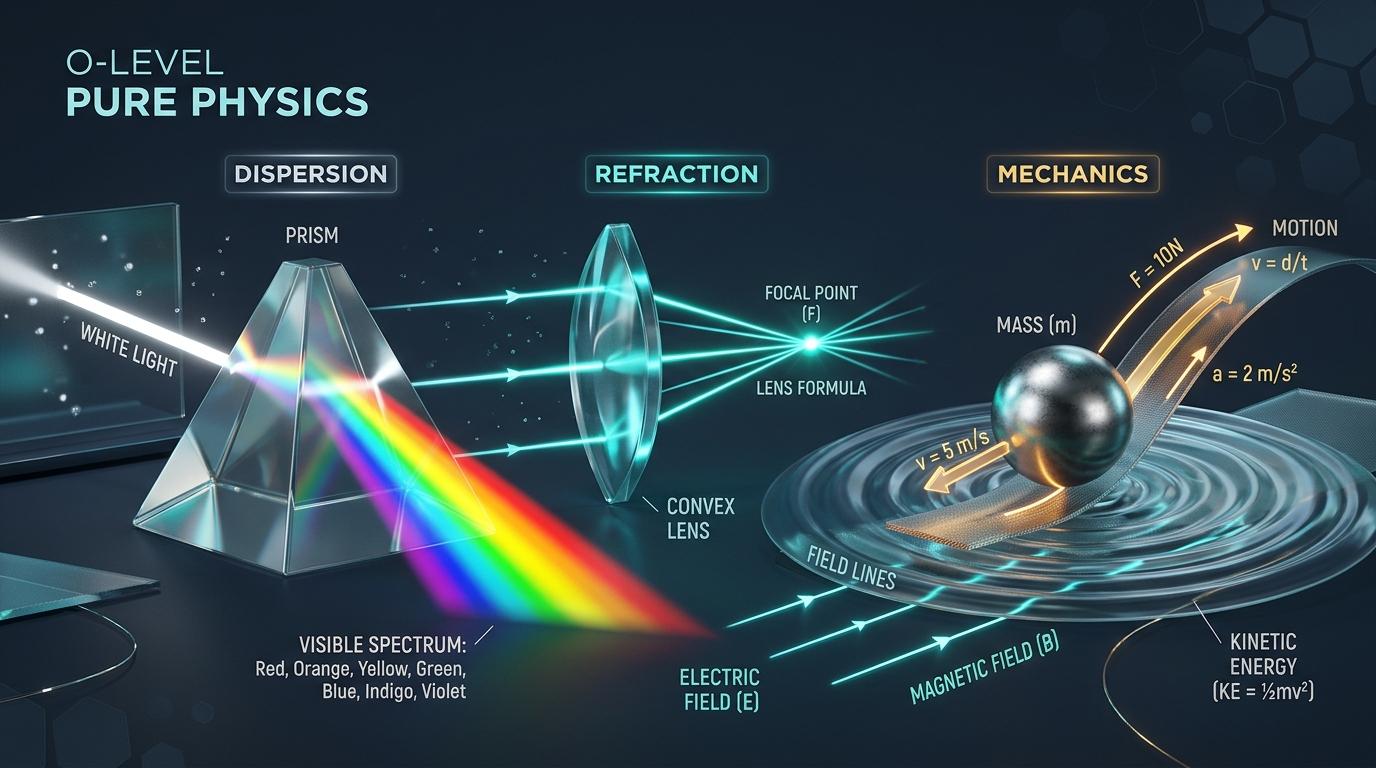
Reflection laws, Snell's law of refraction, total internal reflection (TIR), critical angle, and thin converging lenses.
Electromagnetic Spectrum & Sound
EM wave properties and applications, longitudinal sound waves, pitch, loudness, speed of sound and echo reflections.
Static & Current Electricity
Electric charges, Coulomb forces, electric current, potential difference (V = W/Q), resistance and Ohm's law.
D.C. Circuits & Practical Electricity
Series and parallel circuits, potential dividers, electrical power (P = IV), safe domestic wiring, circuit breakers, and plugs.
Magnetism & Electromagnetism
Magnetic fields, right-hand grip rule, Fleming's left-hand motor rule, d.c. electric motor principles.
Electromagnetic Induction
Faraday's and Lenz's laws, Fleming's right-hand dynamo rule, a.c. generators and step-up/down transformers.
Radioactivity & Nuclear Physics
Alpha, beta, and gamma radiation, nuclear decay equations, half-life decay curves, and biological hazards.
Pure Physics or Combined Science: Which Is Right for Your Child?
Many students struggle in early Sec 3 and wonder if they should drop to Combined Science (Physics/Chemistry). Before deciding, consider:
- Essential if aiming for JC H2 Physics and Engineering/Computing at university.
- Includes dedicated Practical Paper 3 (20% weightage).
- Covers deeper topics: Radioactivity, advanced wave optics and magnetic fields.
- Physics accounts for 50% of one overall Science subject grade.
- Shorter syllabus with simpler calculation questions.
- Suited for students prioritizing Poly diplomas or non-STEM JC paths.
Lesson Format, Schedule & Fees
Small group classes ensuring close individual attention, high-quality printing of proprietary notes, and dedicated WhatsApp consultation.
| Level | Class Size | Duration | Monthly Fee | Venues & Options |
|---|---|---|---|---|
| Sec 3 Pure Physics | 4 – 8 students | 2.0 Hours / week | $320 / 4 sessions | Toa Payoh Central / Online |
| Sec 4 Pure Physics (O-Level Prep) | 4 – 8 students | 2.0 Hours / week | $340 / 4 sessions | Toa Payoh Central / Online |
| 1-on-1 Intensive Diagnostic | 1-on-1 custom | 1.5 – 2.0 Hours | Enquire for rates | Physical Studio / Online |
185 Toa Payoh Central, #02-342 (Lift E), Singapore 310185. (Wednesday sessions held at 186 Toa Payoh Central, #02-430).

Braddell Studio (near Braddell MRT), providing calm, comfortable small-group capacity when main classes fill up.
Live broadcast with digital tablet work, real-time step reviews, and hardcopy materials delivered directly to your home.

Taught Personally by Mr. Chew Kok Mun
Former MOE PSC Scholar, ex-Physics lecturer at NTU National Institute of Education, and holder of a Master of Education (M.Ed.). With over 20 years of experience deconstructing the Cambridge syllabus, Mr. Chew knows precisely where students lose marks and how to systematically rebuild their confidence.
“I was failing Pure Physics consistently in Sec 3. Mr. Chew broke down turning effects and light refraction so clearly that I stopped memorizing formulas blindly. Scored A1 for O-Levels!”
“I was about to drop Pure Physics after Sec 3. The small group attention and the step-by-step answering method completely changed my approach. Thank you Mr Chew!”
“Mr. Chew’s notes are far superior to my school’s lecture pack. He connects pure physics concepts to real engineering applications, which made Sec 4 IP physics enjoyable and easy to score.”
Frequently Asked Questions
Clear answers to help you decide on the right physics support for your child.
Give Your Child the Clarity to Master Pure Physics
Book a no-obligation trial lesson or message Mr. Chew directly on WhatsApp to discuss your child's current syllabus progress and diagnostic needs.