Scientific Theory vs Scientific Law: The Physics Myth Students in Singapore Still Believe
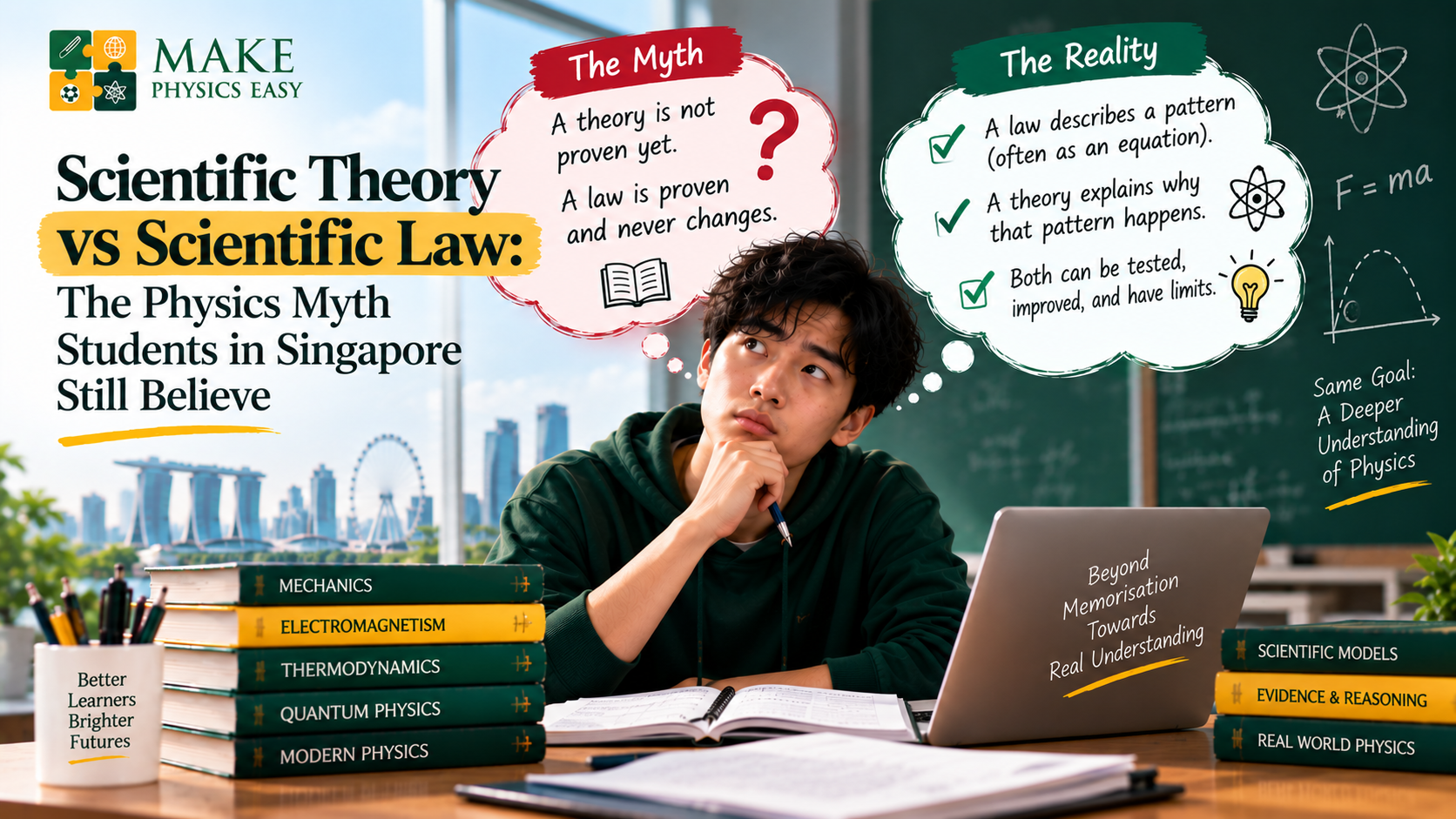
Ask a Sec 4 student, "What is the difference between a scientific theory and a scientific law?" and you will hear a very familiar answer: "A theory is not proven yet. A law is proven and never changes." It sounds sensible, and it is repeated in many notes and textbooks. But it is a common physics misconception, and it quietly hurts marks in O-Level Physics, H2 Physics, and IB Physics every year.
A research paper on the nature of science tested this exact belief on 89 university freshmen and 7 chemistry teachers in Venezuela. The results were striking, and they matter for every parent and student searching for physics tuition in Singapore that teaches real understanding. Here is what the study found, why the "theory vs law" idea is misleading, and how to fix it.
What Is the "Theory vs Law" Myth in Physics?
The myth says science moves in a straight line: you collect observations, they become a scientific law, and a scientific theory is just a "not yet proven" idea waiting to graduate into a law. Philosophers call this the positivist view of science.
The researchers linked it to what the philosopher Imre Lakatos called a "Baconian inductive ascent." In simple words, it means "facts first, then laws, then theories." It looks neat. But the real history of science is messier, and this misunderstanding of scientific laws can make physics concepts harder to learn.
What the Study Found: Students and Teachers Thought Alike
The researchers gave a short four-question test on how scientific knowledge works. Students and teachers explained their thinking in writing, and the answers were sorted into three groups: positivist, transitional, and Lakatosian (the most developed view, where science moves through competing explanations).
The main results were clear:
- 78% of students gave a positivist answer on whether theories change.
- 65% of students gave a positivist answer when describing what an atom looks like and how we know.
- 65% of students gave a positivist answer on the difference between a theory and a law.
- All seven teachers gave a positivist answer on the theory-versus-law question.
- Only about 1 to 2% of students gave a fully Lakatosian answer on the first three questions.
The most common belief, shared by students and teachers, was this: a theory has not been fully proved, while a law has been proved and is universal. That pattern shows how deeply this idea sits inside science education, not only inside student minds.
Why "Laws Never Change" Is Not the Full Story
Many students in the study named Newton's laws of motion as the perfect example of an unchanging, universal law. That sounds convincing, but it hides an important point that strong physics teachers know well.
Scientific laws are built using idealisation. We imagine frictionless surfaces, point masses, and perfect gases so that the maths becomes clean. Real objects, like a charged and heavy ball, are affected by several forces at once, so no single law describes them perfectly. Newton's laws are extremely powerful for everyday speeds and sizes, but they are models with limits, not final truths.
This is why A-Level H2 Physics students who understand assumptions, limits, and conditions score better than students who only memorise formulas. If you want examples of how this affects your child, read our article on why students know physics terms but cannot use them.
Theories Explain, Laws Summarise (And Both Matter)
Here is a simple way to see the real relationship for physics exam preparation:
- A law usually describes a pattern, often as an equation.
- A theory explains why that pattern happens.
- Both can be tested, improved, and limited by new evidence.
The gas laws and the kinetic theory of gases are a good example. The gas laws describe how pressure, volume, and temperature relate. The kinetic theory explains why, using moving particles and collisions. The study points out that the big theoretical explanation was the real breakthrough, and the earlier experimental law was less central to how the theory developed.
The same lesson applies to the history of the atom model. Many textbooks say Bohr's main goal was to explain the hydrogen spectrum. According to the historians cited in the paper, his real puzzle was why the Rutherford atom did not collapse. Knowing the true story helps students see that physics grows through competing models and problem-solving, not through a simple ladder from fact to law.
The "Atom Looks Like the Solar System" Problem
When asked what an atom looks like, the most common student answer was the planetary model, with electrons circling the nucleus like planets. Most students who gave this answer treated it as a picture of reality, not as a model that was improved over time.
A small number of students showed better thinking. They said scientists build models step by step, and each model tries to improve on the last. That is the kind of answer we want in O-Level Chemistry and Physics and in IB Physics essays on models and evidence.
Discussion Changes Thinking: The "Testing Effect"
Here is the most hopeful finding. The fourth question asked students to explain how two groups of scientists could look at the same data and reach different conclusions about the universe. On this question, positivist answers fell to 40%, and transitional answers rose to 38%.
The authors suggest this happened because the question made students think and discuss how science progresses, which many courses never do. That is useful news for physics tuition in Singapore: when students talk through ideas, compare explanations, and ask "how do we know?", their thinking grows.
Why Textbooks Can Make the Myth Stronger
The paper argues that textbooks influence teachers, and teachers influence students. It points to a chemistry textbook that describes theories as ideas "dignified" after enough testing, and to a separate study showing that many high school chemistry textbooks give little attention to science as a way of thinking.
This does not mean textbooks are bad or that teachers are careless. It means students need a tutor who explains the ideas behind the formulas, and who is willing to say, "Here is where this law works, and here is where it stops working."
Theory vs Law: What Students Believe and What Science Shows

How Our Physics Tuition in Singapore Helps You Think Like a Physicist
At Physics Made Easy, Mr. Chew, an ex-MOE scholar and NIE-trained educator with over 20 years of experience, teaches O-Level, A-Level H2, IB, and IGCSE Physics with one goal: help students understand why physics works, not only how to calculate.
Here is how that supports the ideas in this research:
- Concepts before calculations. Students first explain a law in plain words, then use the formula. This builds strong conceptual understanding in physics.
- Assumptions and limits. We ask, "When does this law work, and when does it not?" That habit helps in H2 Physics data questions and IB internal assessments.
- Compare competing models. Students learn to weigh two explanations against evidence, a skill that lifts scores on explanation questions. Our article on why the best physics coaching in Singapore focuses on explaining shows how.
- Learn from common mistakes. See our guide to the top 5 mistakes in O-Level Physics and how to avoid them.
- Build big-picture thinking. Struggling to connect topics? Read why students struggle to see the big picture in physics.
You can explore the full approach on our methodology page and our Multiple Intelligences page. Parents who want to know why students trust our classes can also read why Mr. Chew is a trusted physics tutor in Toa Payoh.
Find the Right Physics Class for Your Child
- O-Level Physics Tuition: clear explanations, exam drills, and help with tough topics such as electricity and magnetism.
- A-Level H2 Physics Tuition: strong problem solving, models, and long-answer technique for JC1 and JC2.
- IB Physics Tutor Singapore: Paper 1, 2, and 3 strategy plus IA mentoring.
- All courses: including IGCSE, IP, and AEIS Mathematics preparation.
You can also start free with our physics study resources, or see real student results first.
Frequently Asked Questions
Q1: What is the difference between a scientific theory and a scientific law?
A scientific law usually describes a pattern in nature, often with an equation. A scientific theory explains why the pattern happens. Both are tested against evidence, and neither is simply a "proven" version of the other.
Q2: Can a scientific theory become a scientific law?
No. They do different jobs, so one does not "graduate" into the other. This is one of the most common physics misconceptions, and good physics tuition in Singapore should correct it early.
Q3: Do scientific laws ever change or have limits?
Yes. Laws work under certain conditions. Newton's laws, for example, are excellent for everyday motion but rely on idealised assumptions, so students should always ask when a law applies.
Q4: Why does this matter for O-Level and H2 Physics exams?
Exam questions often ask you to explain, suggest, or evaluate. Students who see physics as a set of connected models write stronger answers than students who only memorise laws and formulas.
Q5: Is the atom really a tiny solar system?
No. The planetary picture is a helpful early atomic model, but modern physics uses more advanced models. Seeing models as improving tools helps students in both physics and chemistry.
Q6: How can I help my child think more like a scientist?
Encourage "How do we know?" questions, discuss rival explanations, and practise explaining ideas in simple words. A skilled physics tutor in Singapore can guide these habits during lessons.
Q7: Does this study apply to Singapore students?
The study used university freshmen and teachers in Venezuela, was small, and was not an experiment, so we should treat it as a useful signal, not a final answer. Still, its patterns match what many physics tutors see in classrooms everywhere.
Final Thoughts: From "Proven Laws" to Real Physics Understanding
The research shows that students and teachers can share the same tidy but misleading picture of science, where theories are weak guesses and laws are final truths. Real physics is more exciting: models compete, evidence tests them, and every law has a place where it works best.
If you want physics tuition in Singapore that helps your child understand physics deeply, not just memorise it, learn more about Mr. Chew and book a free trial lesson today. Your child can move from memorising laws to thinking like a physicist.