Why Student Teachers Struggle to Explain Everyday Physics Phenomena (And What It Means for Physics Education in Singapore)
I have been teaching physics in Singapore for over two decades, and one pattern still catches me off guard.
A teacher — someone who will one day stand in front of a classroom of 30 kids — can recite Newton's Laws from memory. They can write out the formula for pressure. They can tell you that heat conduction is responsible for why a metal spoon gets hot when you stir soup. But ask them why they chose a wooden spoon this morning, and the explanation suddenly falls apart.
That gap between knowing a physics concept and using it to explain something real is not just a curiosity. It is a crisis in physics education that a major research study has now quantified — and the findings should concern every educator, tutor, and parent in Singapore.
What the Research Reveals About Everyday Physics Reasoning in Student Teachers
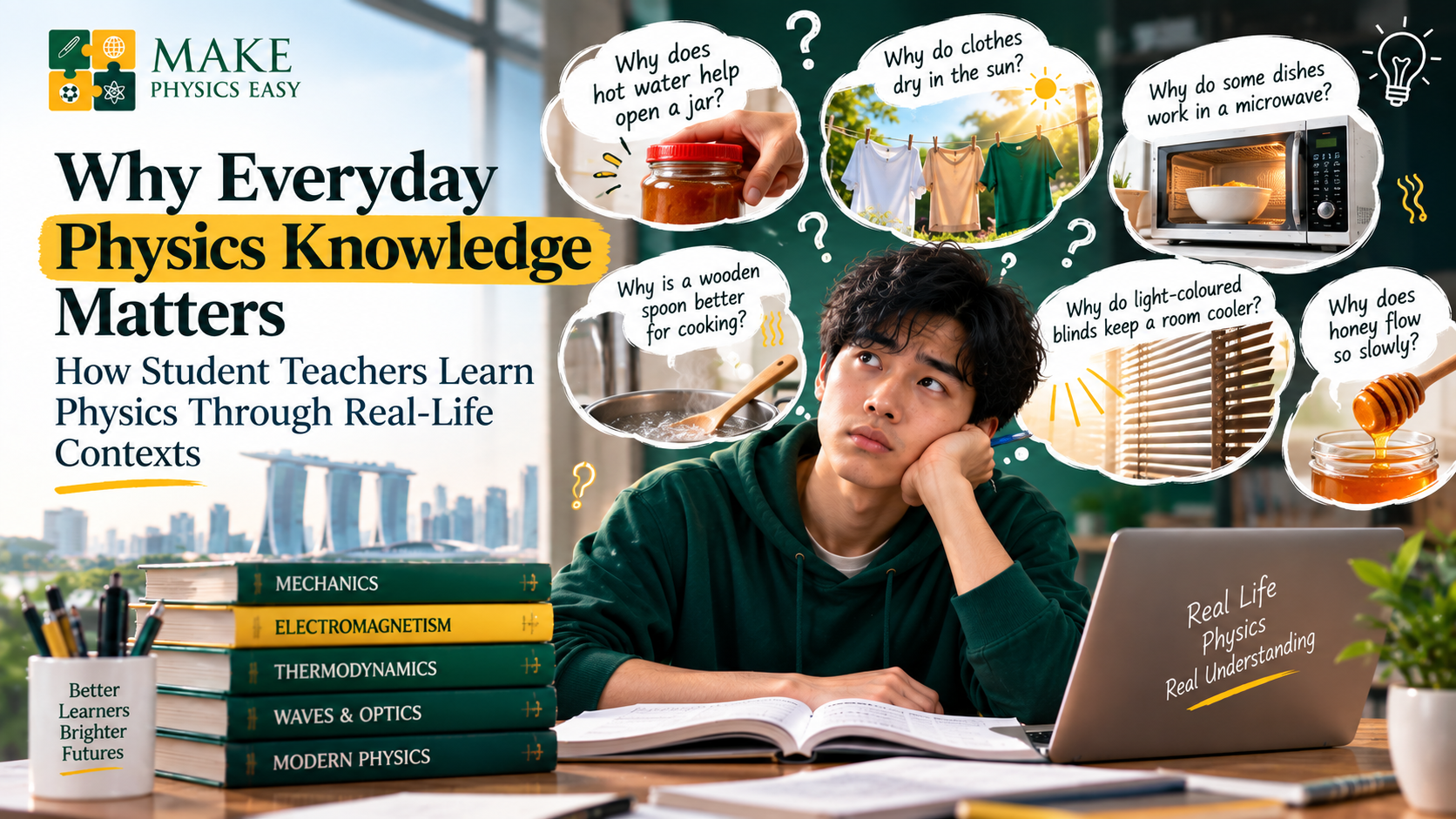
A published study in Science Education International tested 360 student teachers in Turkey on their ability to explain eight common everyday physics phenomena. These were things like opening a stuck jar lid, choosing the right spoon for cooking, picking shoes for a snowy day, and understanding how a microwave heats food.
Each of these everyday scenarios has a clear physics concept behind it — pressure, heat conduction, friction, electromagnetic radiation, force and inertia. These are topics every science teacher will need to explain to students one day.
The results were both revealing and troubling.
While most student teachers gave correct answers (telling you what to do), their physical reasoning was frequently wrong, non-conceptual, or missing entirely. In other words, they got the answer right for the wrong reason. And that matters enormously for everyday physics understanding.
Why Getting the Right Answer the Wrong Way Is a Physics Education Problem
When I work with students in O-Level Physics tuition here in Singapore, this is one of the first things I look for. Can you get the answer? Great. But why is it the right answer?
The study found that student teachers explained everyday physics contexts they were familiar with — like choosing a spoon for cooking or drying clothes — in conceptually correct ways. Their physics reasoning held up because they had encountered these situations repeatedly in daily life.
But for the microwave oven context (selecting the right dish), the same teachers performed poorly. They confused microwave heating — which works by vibrating water molecules using electromagnetic waves — with regular oven heating, which uses convection. Because they were less familiar with the microwave as a physics context, their everyday physics reasoning broke down.
This is called context-sensitivity, and it is one of the most important findings in physics education research today. It confirms that a student's ability to reason through a physics problem does not just depend on whether they "know" the concept — it depends on whether the context feels familiar enough to activate that knowledge.
The Epistemology Problem: Where Student Teachers Learn Physics From
The study also asked student teachers: where did you learn this information?
The answers reveal a significant gap in how future physics educators are building their everyday physics knowledge.
- 34% said they learned from their mother
- 33% said it came from personal experience or observation
- Only 10% said it came from a course, teacher, or textbook
Think about that. Nearly two-thirds of student teachers are explaining physics phenomena based on what their mother told them or what they personally observed — not from formal physics education.
In Hammer and Elby's epistemological framework, which the research uses, this maps onto two types of knowledge:
- Propagated knowledge — "My mother told me this is how it works"
- Free creation knowledge — "I saw this happen and invented my own explanation"
The third type — fabricated knowledge (from formal study, textbooks, or courses) — is the one most likely to produce scientifically accurate explanations. And yet it was the rarest source stated by student teachers.
Here at Physics Made Easy, this aligns exactly with what I see in students arriving for the first time. They carry confident explanations built from years of everyday life — but those explanations often contain invisible physics misconceptions that formal study has never corrected.
If you want to understand why students believe what they believe about physics, our page on Science Understanding explores this in depth.
How Source of Physics Knowledge Affects Physics Scores
The research went a step further: it compared physics scores against the source of knowledge students claimed to use. The findings challenge the assumption that lived experience is enough.
For most contexts, students who said their knowledge came from a course or teacher scored the highest — despite this being the least commonly cited source. Meanwhile, students who cited "mother" as their source — the most common answer — scored among the lowest in conceptual physics explanations.
The implication for everyday physics reasoning is clear: informal knowledge propagated through family and daily experience produces confident answers, but rarely produces scientifically accurate ones.
This is why I emphasize to every student I teach that physics is a refinement of everyday thinking — not a replacement for it, but a structured upgrade. As Einstein himself noted, science builds on everyday observation. But without formal scaffolding, those everyday observations remain stuck at the level of intuition.
If you are interested in how we structure that learning upgrade, our Multiple Intelligences methodology explains the approach in full.
The Gender Surprise in Everyday Physics Understanding
One of the more counterintuitive findings of the study involves gender. Across most of the eight everyday physics contexts, female student teachers significantly outperformed male student teachers.
This ran against the common assumption in physics education that males tend to perform better in physics assessments. The researchers suggest the explanation may be the contexts chosen — jar opening, cooking spoons, drying clothes, window blinds — which are settings that female students may engage with more frequently in daily life.
This connects back to context-sensitivity. When everyday physics phenomena are embedded in familiar contexts, students activate better reasoning. And familiarity with a context is shaped by life experience, not just formal study.
For educators and parents thinking about how to improve physics reasoning skills, this finding is important: the pathway into better physics thinking often runs through the familiar. Start with what students already engage with, then build the formal framework on top.
The Epistemological Barrier Between Everyday and Formal Physics
Perhaps the most significant finding in the study is something researchers call the epistemological barrier between everyday reasoning and formal physics thinking.
The study found a moderate positive correlation between student teachers' everyday explanations and their physics reasoning — but only moderate. That gap represents students who can describe what happens in the world but cannot connect it to a physics concept.
This is the same barrier described in research by Lising and Elby (2005), which found that this disconnection actively limits students' ability to search for explanations or use formal reasoning to answer problems.
I wrote about a closely related issue in our blog on why physics students in Singapore know physics terms but cannot use them. The pattern is consistent: knowledge of terminology does not equal ability to use it in context.
And in our earlier post on why future science teachers struggle with everyday physics reasoning, I explored how this same research finding plays out in teacher education — with direct consequences for the students they will one day teach.
What This Means for Physics Tuition in Singapore
This research has concrete implications for how physics should be taught — both at the student teacher level and for students preparing for O-Level, A-Level, and IB Physics exams in Singapore.
1. Everyday Physics Contexts Should Be Entry Points, Not Afterthoughts
The most powerful way to teach a physics concept like heat conduction or pressure is not to start with the formula. It is to start with the everyday context — why does a metal spoon get hot faster than a wooden one? — and then build the formal framework from there. This is exactly how our O-Level Physics classes are structured.
2. Correct Answers Are Not Enough — Reasoning Must Be Tested
A student who picks "wooden spoon" correctly but cannot explain why in physics terms has not actually learned heat conduction. They have learned a habit. Exams — and great tutors — test the reasoning, not just the answer.
3. Misconceptions Built from Everyday Experience Must Be Actively Replaced
Students arrive with confident explanations for how the world works. Many of those explanations are physically incorrect. Addressing physics misconceptions built from years of informal experience is one of the most important jobs a physics educator can do. We discuss how we approach this in our methodology page.
4. Physics Courses Need to Bridge the Gap Between Informal and Formal Knowledge
The study found that student teachers who cited formal courses as their source of knowledge scored highest — but only 10% of them used this source. That underrepresentation points to a gap in physics teacher preparation that needs to be addressed urgently.
Who Is Most at Risk of This Physics Reasoning Gap?
Based on the study and my own experience with students in Singapore, the following groups tend to carry the largest gap between everyday explanations and conceptual physics reasoning:
- Students who have relied on rote memorization rather than concept-building
- Students from programs with fewer physics courses in the curriculum
- Students who have not been explicitly taught to explain their answers using physics terms
- Future teachers who will pass their informal knowledge on to the next generation
If you recognize yourself or your child in this list, the good news is that the gap is bridgeable. It requires the right kind of teaching — one that explicitly connects everyday physics phenomena to formal concepts, and tests reasoning rather than just recall.
You can see the kind of results this produces in our verified student testimonials, including students who moved from failing grades to distinctions after learning to reason through physics rather than memorize it.
Comparison: What Different Approaches to Physics Learning Produce

The MI-Based approach used at Physics Made Easy targets the reasoning layer that most tuition centers miss entirely. We do not just teach you what the answer is. We teach you why the physics works that way — in a context you already understand — and then formalize it into exam-ready thinking.
Frequently Asked Questions About Everyday Physics Reasoning and Learning
Why do students get physics answers right but score poorly in exams?
Students often know what to do in a familiar everyday context without understanding the physics behind it. Exams test physical reasoning and conceptual explanation — not just the correct choice. A student who picks "wooden spoon" but cannot explain heat conduction in physics terms will lose marks in structured-answer and essay questions.
What is context-sensitivity in physics learning?
Context-sensitivity means that a student's ability to reason through a physics problem changes depending on how familiar the everyday setting is. Students may explain pressure correctly when talking about snow shoes but fail to apply the same concept to a hydraulic system because the context is unfamiliar. Good physics tuition builds reasoning that transfers across contexts.
How does epistemology affect a student's physics understanding?
A student's beliefs about where knowledge comes from — their epistemology — shape how they learn and retain physics. Students who believe physics is just a collection of formulas to memorize approach learning very differently from students who see it as a coherent system of ideas that explains the real world. The second group consistently outperforms the first.
Why do female students sometimes outperform males in everyday physics contexts?
Research suggests it is not about ability — it is about context familiarity. When everyday physics phenomena are embedded in contexts that students regularly engage with, they activate better reasoning. This supports the case for using a wide variety of real-life contexts in physics teaching, rather than relying on abstract or single-domain examples.
What is the difference between propagated, fabricated, and invented physics knowledge?
These three types come from Hammer and Elby's (2002) epistemological framework. Propagated knowledge is passed from another person (like a parent). Invented knowledge comes from personal experience and observation. Fabricated knowledge is constructed from formal study — textbooks, teachers, and structured courses. Research consistently shows that fabricated knowledge produces the most accurate physics understanding, yet it is the rarest source students report using.
How can I tell if my child has physics misconceptions from everyday experience?
Ask them to explain why — not just what. If they can answer a multiple-choice question but struggle to give a coherent, concept-based explanation, they are likely working from informal knowledge rather than formal physics understanding. A good physics tutor will spot this immediately and target the gap directly.
Does more physics coursework actually improve everyday physics reasoning?
Yes. The study found that student teachers from programs with more physics courses significantly outperformed those with fewer — and the effect was large. This confirms that formal, structured learning in physics concepts builds the kind of reasoning that holds up across different everyday contexts.
The Bottom Line for Physics Students and Parents in Singapore
The research is clear: getting the right answer is not the same as understanding physics. The gap between everyday intuition and formal physics reasoning is real, measurable, and consequential — for students taking O-Level and A-Level exams, and for teachers who will shape the next generation of science learners.
At Physics Made Easy, bridging that gap is the core of everything we do. Mr. Chew's approach — built on Multiple Intelligences theory and decades of experience as an MOE-trained educator — is specifically designed to connect the everyday context a student already lives in with the formal physics framework they need to succeed in exams and in life.
If your child can give answers but cannot explain the reasoning behind them, it is time to address the epistemological gap before it costs them in the exam hall.
Book a free trial lesson with Mr. Chew and find out exactly where the gaps are — and how to close them.
Related reading from the Physics Made Easy Blog:
- Why Physics Students in Singapore Know Physics Terms But Cannot Use Them
- Why Future Science Teachers Struggle With Everyday Physics Reasoning
- Why Students Know the Right Answer But Still Fail Physics
- Newton's Laws in Your Smartphone: The Physics You Use Every Day
- Top 5 Mistakes Students Make in O-Level Physics