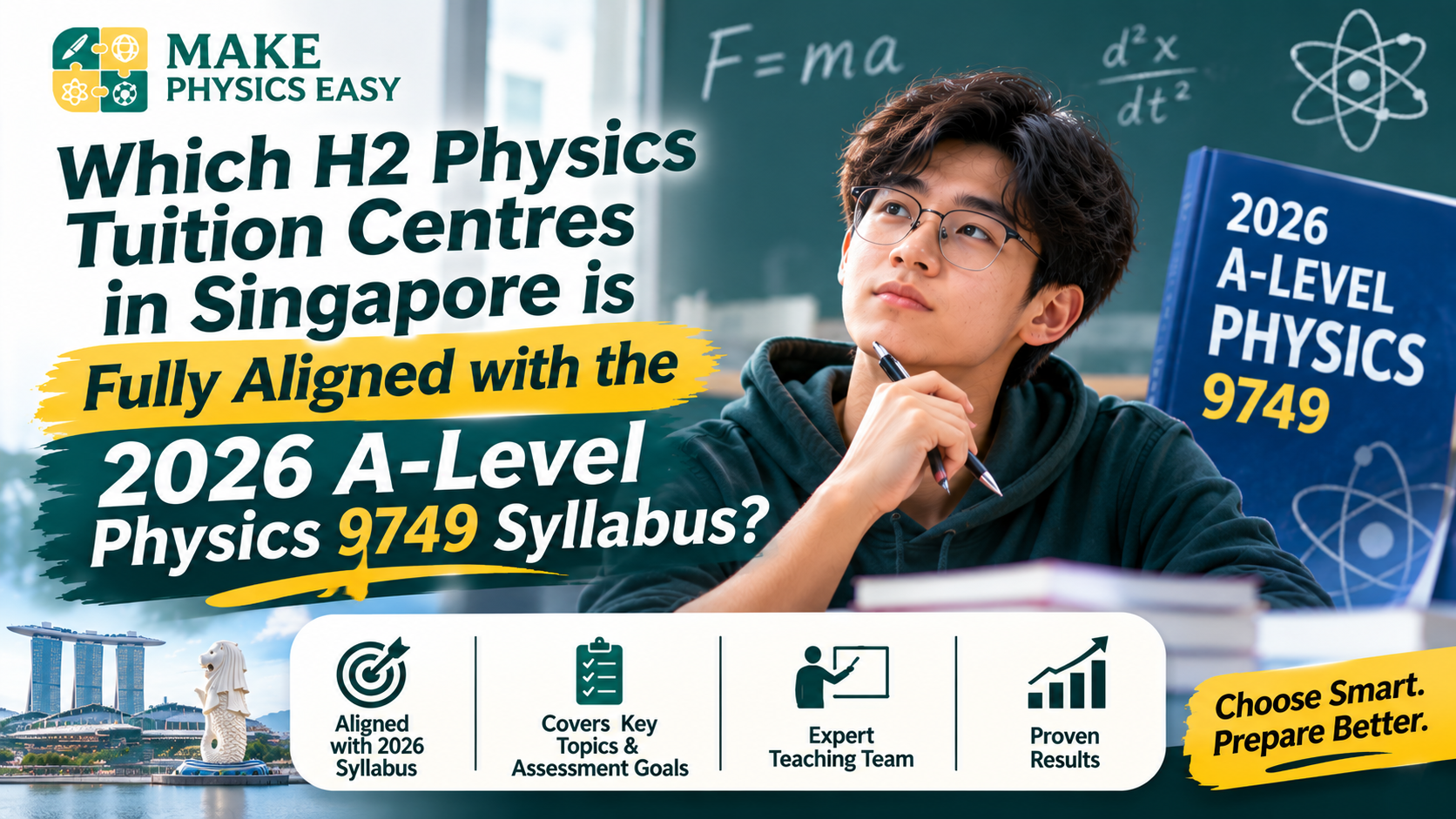
Which H2 Physics Tuition Centres in Singapore Are Aligned with the 2026 A-Level Physics Syllabus (9478)?
Every year around this time, a JC student or parent asks me the same question: "Is this H2 physics tuition centre updated for the new syllabus?" Usually the question comes with a code attached, and the code is often 9749.
Here is the first thing worth knowing. The H2 Physics syllabus examined from 2026 is 9478, not 9749. The code 9749 belongs to the previous syllabus. If a tuition centre's website still talks about "9749" as the current syllabus, that is already a small warning sign.
I have taught physics for over 20 years, and I currently teach first-year undergraduate physics at NTU. This guide explains what changed in the new H2 Physics syllabus, whether any H2 physics tuition centre in Singapore can honestly claim to be "fully aligned", and how to check for yourself before you commit.
9749 vs 9478: Which H2 Physics Syllabus Applies in 2026?
The Ministry of Education's revised A-Level physics syllabus covers H1 (8867), H2 (9478) and H3 (9814). It was introduced from the 2025 Pre-University 1 cohort, which means students who began JC1 in 2025 were the first to be examined on it, in 2026.
So, for current JC students, 9478 is the H2 Physics syllabus you are studying. The older 9749 syllabus is the one that past-year papers up to 2025 were based on. Those papers are still useful, but not everything in them matches what you now need to know.
If you are in JC1 or JC2 now, always check the official syllabus document on the SEAB website, because that is the only authority on what can be examined.
What Changed in the 2026 H2 Physics Syllabus
The new H2 Physics syllabus is organised into six sections and 20 topics: Foundations of Physics, Mechanics, Waves, Thermal Physics, Electricity and Magnetism, and Modern Physics. Mechanics now includes Gravitational Fields and Oscillations as separate topics. Electricity and Magnetism includes Electric Fields, Currents, Circuits, Electromagnetic Forces and Electromagnetic Induction.
Based on the syllabus and the sample papers, these are the changes students and tutors notice most:
- Capacitance is now part of the H2 course. The syllabus describes charge storage in capacitors as an H2 topic, and it links to exponential behaviour in circuits.
- Quantum physics goes further. The sample papers include a data sheet with energy states for a quantum particle in a box, so students should expect wavefunction-style ideas, not just photons and the photoelectric effect.
- The practical now uses spreadsheets. The syllabus states a requirement for spreadsheet software in the practical assessment, and it talks about analysing larger sets of real data. Students are no longer expected to plot graphs by hand on graph paper.
- The practical is smaller and weighted differently. Several JC guides report that it is now out of 50 marks instead of 55, still worth 20% of the subject, with less weight on planning and more on measurement, data and analysis. Please check the exact numbers in the official document.
- Digital literacy and real-world contexts are built in. The syllabus pairs each section with a theme, such as Transport for Mechanics, Communication for Waves and Electronics for Electricity and Magnetism.
- Derivations still matter. Learning outcomes such as deriving the equations of uniformly accelerated motion, or deriving kinetic energy from work done, remain part of the course.
Some JC guides also report that certain older content, such as X-ray physics, has been removed. If a topic matters to you, confirm it against the syllabus rather than a tutor's notes.
Can Any H2 Physics Tuition Centre Be "Fully Aligned" with the 2026 Syllabus?
This is the honest part. To my knowledge, there is no official badge or certification that confirms a tuition centre is aligned with the syllabus. The syllabus is public, so any centre can say it is aligned.
That means "fully aligned" is a claim, not a fact, until you see evidence. I cannot tell you which centres meet that bar, and I would be wary of any list that claims to rank them without checking. What I can do is show you how to test a centre yourself, and what to look for.
Seven Questions to Ask Before You Choose H2 Physics Tuition
You do not need to be a physics expert to ask these. A good tutor will answer them clearly and without hesitation.
- "Which syllabus code do you teach to?" The answer should be 9478. If the tutor hesitates or mixes it up with 9749, ask why.
- "How do you teach capacitance?" Look for an answer that goes beyond formulas. A strong answer explains how a capacitor charges and discharges, what the time constant means and how it compares with other exponential decays.
- "How far do you go with quantum physics?" The tutor should be comfortable with wave-particle ideas and with why energy levels become quantised, not just with recalling definitions.
- "How do students practise the spreadsheet practical?" Ask whether students actually import data, calculate columns, plot graphs and extract gradients in a spreadsheet during lessons.
- "Can I see your topic list mapped to the 20 topics?" A centre that has truly updated its materials can show you how its lessons match the syllabus.
- "How do you use old 9749 papers?" The best answer is that older papers are useful for topics that have not changed, but new content needs the 9478 sample papers and fresh questions.
- "What do you do when a student understands the formula but still gets the question wrong?" This reveals whether the tutor teaches understanding or only content.
If a centre cannot answer at least five of these with specifics, treat "fully aligned" as marketing.
What 9478-Aligned Teaching Looks Like: Three Examples
Alignment is not just a list of topics. It shows up in how a concept is taught. Here are three examples from the new syllabus.
Capacitors and exponential decay
When a charged capacitor discharges through a resistor, its charge falls according to Q = Q₀e^(−t/RC). The product RC is called the time constant.
Many students memorise this as a separate formula. I show them that it is the same pattern as radioactive decay, x = x₀e^(−λt). In both cases, the rate of change is proportional to what is left. Once students see one idea behind two topics, one in Electricity and Magnetism and one in Modern Physics, they remember both better and they can handle unfamiliar questions.
Why a particle in a box has quantised energy
The sample data sheet includes the energy levels for a particle in a box: Eₙ = n²h²/8mL². Rather than memorise it, students can build it.
A particle confined in a box behaves like a standing wave, so the wavelength must fit the box: λ = 2L/n. The de Broglie relation gives p = h/λ, which is nh/2L. Kinetic energy is p²/2m, so E = n²h²/8mL².
In a few lines, students see why confinement produces discrete energy levels. That is real alignment with the way the new syllabus presents quantum physics. If you are curious about where this physics leads, our article on what quantum computing is and why everyone is talking about it connects it to technology.
Using a spreadsheet to find a gradient
Suppose students measure the period T of a pendulum for different lengths L. Theory says T² is proportional to L. In the old practical, students plotted this by hand. In the new practical, they import the data, create a T² column, plot the graph in a spreadsheet and add a trendline.
The skill that earns marks is not clicking buttons. It is knowing why T² against L is the right graph to plot, what the gradient means physically, and how to judge the uncertainty. This is why practising the practical only in a lab, or only on paper, is not enough now.
Concept Mistakes the New Syllabus Still Targets
The syllabus itself warns about a classic error. In the Circular Motion narrative, it notes that centripetal force is often mistaken for a separate physical force, or confused with the "centrifugal force" that appears only when you analyse motion from a rotating frame.
I see this every year. Students draw centripetal force as an extra arrow on a free-body diagram, then get the equation wrong. The fix is to draw only real forces, such as tension, gravity or the normal reaction, and ask which combination points to the centre. The centripetal force is the name for that net inward force.
This kind of understanding is what a good H2 physics tutor builds, and it is the reason I wrote about why students know the right answer but still fail physics. Electricity and magnetism is another area where gaps appear early, as I explain in this article on the topic that makes or breaks O-Level physics. The same weak foundations carry into H2.
How I Teach H2 Physics for the 9478 Syllabus at Physics Made Easy
At Physics Made Easy, our H2 Physics tuition is taught in an advanced small-group format, with sessions of two hours for JC1 and JC2 students. Custom one-to-one tracks and live online lessons are available on request.
The method is the same one I use in every level: conceptual mastery first, then logical deconstruction of problems, then exam technique. You can read how this works on our methodology page, and why we use different ways of explaining the same idea on our Multiple Intelligences page.
I teach first-year undergraduate physics at NTU, so I see directly what the university expects from students who arrive from JC. That is why I put so much weight on derivations and on connecting topics, rather than treating each chapter as a separate list of facts. Students who want to see how university physics differs can read why university physics students struggle to see the big picture.
You can see the full H2 programme on the A-Level H2 Physics course page, and what former students say on our results page. I would rather you judge us by those questions above than by any claim on our website. If you want to see how we teach before you decide, the free physics resources and video masterclasses are open to everyone.
Who Needs to Pay Most Attention to the Syllabus Change?
JC1 students are studying 9478 from day one, so they need notes and tutors that match it. Be careful with older notes and guidebooks written for 9749.
JC2 students sitting H2 Physics in 2027 will take 9478 only. If your school notes follow the new syllabus but your tuition materials do not, you may have gaps in capacitance, quantum physics or the practical.
Students who are strong in content but lose marks in the practical should check that their tuition includes spreadsheet-based data analysis, not just paper-based practice.
Parents comparing centres will get the most from the seven questions above. A good centre welcomes them.
Frequently Asked Questions
Q1: What is the 2026 H2 Physics syllabus code in Singapore?
It is 9478. The older code, 9749, belongs to the previous syllabus. The revised H2 Physics syllabus applied to the cohort that began JC1 in 2025, so the 2026 A-Level was the first one examined on it.
Q2: Is there a tuition centre that is fully aligned with the 2026 H2 Physics syllabus?
Several centres may teach to it well, but there is no official certification for alignment, so the claim has to be checked. Ask which syllabus code the centre uses, how it teaches new topics such as capacitance and quantum physics, and how students practise the spreadsheet-based practical.
Q3: What are the biggest changes in the new H2 Physics syllabus?
The most noticeable are the addition of capacitance, a deeper treatment of quantum physics, and a practical assessment that uses spreadsheets for data analysis. The syllabus is also organised into six sections with real-world themes.
Q4: Can I still use old 9749 past-year papers for H2 Physics revision?
Yes, for topics that have not changed, such as much of Mechanics, Waves and Thermal Physics. For new content and the practical, use the 9478 sample papers and updated questions. Check each question against the current syllabus before relying on it.
Q5: Do I need H2 physics tuition if my school already teaches the new syllabus?
Not everyone does. Tuition helps most when a student has conceptual gaps, struggles to apply formulas to new questions, or needs extra practice with the practical. A tutor should be able to identify the specific gaps, not just repeat the lesson.
Q6: How do I know if my tutor understands the 9478 syllabus?
Ask them to explain a new topic, such as why energy levels are quantised for a particle in a box. A tutor who knows the syllabus will explain the reasoning clearly and link it to other topics.
Q7: How much does H2 physics tuition cost in Singapore?
Fees depend on the format and the tutor. Please contact us for current rates, and when you compare, look at what is included and how closely lessons follow the current syllabus, not only the hourly price.
Choosing H2 Physics Tuition That Truly Matches the 2026 Syllabus
The honest answer to "which H2 physics tuition centres in Singapore are fully aligned with the 2026 A-Level physics syllabus?" is that you should not take any centre's word for it, including mine. The current syllabus is 9478, and the best way to find aligned tuition is to ask specific questions and listen for specific answers.
If you would like me to look at where your child's marks are going, message Make Physics Easy with their level and a recent test result. I will point out the likely gaps against the 9478 syllabus and tell you honestly whether tuition is the right next step.
Where We Teach
Main Centre (Toa Payoh): Blk 185 Toa Payoh Central, Lift E, #02-342, Singapore 310185
Toa Payoh Central (Wednesdays only): Blk 186 Toa Payoh Central, Lobby H, #02-430, Singapore 310186
West Branch (Beauty World): Beauty World Shopping Centre, Upper Bukit Timah Road, Singapore. We run Physics and Chess classes in the West.