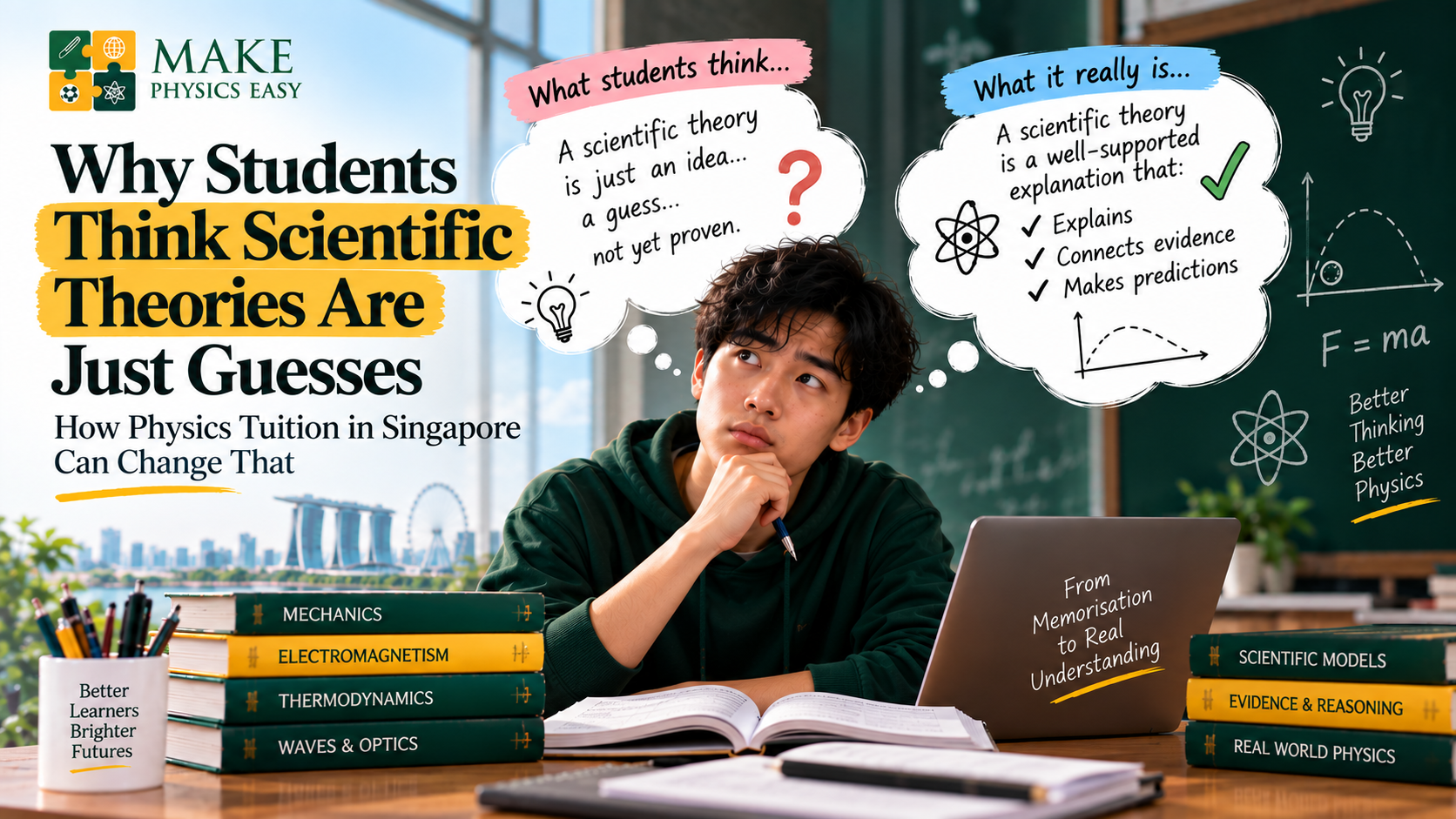
Why Students Think Scientific Theories Are Just Guesses: How Physics Tuition in Singapore Can Change That
Ask a bright Secondary 3 student, "What is a scientific theory?" and you will often hear the same answer: "It's an idea. Something people think but haven't proven yet." That answer sounds reasonable, but it is one of the biggest hidden reasons why O-Level physics students lose marks on explanation questions, and why many H2 Physics and IB Physics students struggle with the "big picture" of their subject.
A large study in Greater London looked at this exact problem.
It followed 859 students in Grade 6 and Grade 8 and asked how they judge evidence, how they see scientific theories, and how their thinking compares with how real science works. The results are useful for every parent, student, and teacher who cares about good physics tuition in Singapore. Here is what the research found, and what it means for your physics exam preparation.
What Is the Epistemology of Science? (In Plain English)
Epistemology simply means "how we know what we know." In science education, it covers questions like: Is scientific knowledge certain? Where does it come from? How do we decide if a claim is true?
The researchers split this into two ideas that matter for any physics student in Singapore:
- Formal epistemology of science: what students believe about how science works, such as the role of theories, facts, and evidence.
- Personal (practical) epistemology: how students judge claims in real situations, such as choosing between two competing explanations.
Students who think well in both areas tend to become stronger scientific thinkers, and that is exactly the skill behind top marks in physics application questions.
The Good News: Students Can Already Reason With Evidence
Before we look at the problem, let's celebrate what students do well. The researchers used a well-known test from psychologist Deanna Kuhn to sort students into three types of thinkers:
- Absolutist: knowledge is certain, and claims are simply right or wrong.
- Multiplist: every view is just an opinion, so nobody can say which is better.
- Evaluativist: claims should be judged using evidence and good reasons.
About 39% of Grade 6 and 42% of Grade 8 students were clear evaluativists, and roughly another 37–40% were close to it. Only a tiny number were absolutists. In interviews, 99% of student pairs picked the correct scientific theory, and 94% brought in their own examples as extra evidence. One pair even used a falling avocado to argue about floating and sinking!
This is encouraging for secondary school physics tuition. Students arrive with real evidence-based reasoning skills. A good physics tutor's job is to build on them, not to replace them with memorised formulas.
The Problem: 89% of Students See Theories as "Educated Guesses"
Here is where things went wrong. When the same students were asked what a scientific theory actually is, the answers were surprisingly weak:
- 96% of student pairs believed that facts are theories that have been proven.
- 89% mostly described theories as ideas, opinions, or guesses.
- Only 13% said theories explain why things happen.
- Only 41% said theories can make predictions.
This is a big gap. In real science, a theory is not a weak guess waiting to become a fact. It is a powerful explanatory framework that ties many observations together, like Newton's laws of motion, the wave model of light, or plate tectonics.
Why This Matters for O-Level, A-Level and IB Physics Marks
You may wonder why a study about Grade 6 and Grade 8 students matters for O-Level physics tuition. The answer is simple: command words in physics exams reward explanation, not recall.
When a question says "explain why the bulb dims" or "suggest why the measured value is higher than the theoretical value," the examiner wants a cause-and-effect explanation built on a physics model. Students who see theories as "just ideas" tend to write lists of facts instead. If this sounds familiar, read our related article on why students know the right answer but still fail physics, and our guide on why physics students know terms but cannot use them.
The same pattern shows up later in life. Our piece on why university physics students struggle to see the big picture shows how gaps in conceptual understanding can follow a student all the way to university.
Knowing More Facts Does Not Fix the Problem
One of the most interesting findings is that students' content knowledge and their understanding of how science works were not linked. The researchers compared national exam results with students' views of theories and found no clear connection. The link between the two types of thinking was also very weak, with correlations of only about 0.16 to 0.30.
In simple terms: a student can score well in a physics topic test and still not understand what a theory is for. This is why memorising formulas for physics exams is never enough, and why concept-based physics tuition matters so much.
The "Facts vs Theories" Trap in Everyday Physics Learning
Most students believe a "fact" is the top prize of science and a "theory" is the lower rung on the ladder. Real scientists see it the other way round: facts are the building blocks, and theories are the big explanations they support.

The researchers noted that school science often presents knowledge as something delivered and fixed, like a parcel handed to students. They call this "knowledge as propagated stuff." Better classrooms treat knowledge as something students help build, test, and criticise, which is called "knowledge as fabricated stuff."
How Students React When Evidence Disagrees With Their Theory
The study also tested how students handle conflicting evidence, a skill that matters in every physics practical and data analysis question. About 72% of students noticed the conflict. Their responses were varied:
- Around 36% adjusted or qualified their theory.
- Around 35% changed their theory.
- Around 33% tried to fit the new evidence into their idea.
- About 14% kept their theory unchanged.
- About 15% rejected all the theories and suggested a new one.
None of these responses is automatically wrong. What matters is that students notice the conflict and explain their choice using evidence. This is exactly the habit we train in IB Physics IA and A-Level H2 Physics practical work, where students must comment on errors, anomalies, and limits of a model.
How Our Physics Tuition in Singapore Builds Real Scientific Thinking
At Physics Made Easy, Mr. Chew is an ex-MOE scholar and NIE-trained educator with over 20 years of experience teaching physics and mathematics. His physics tuition in Singapore is built around one idea: students learn better when they understand why a model works, not just how to plug numbers into a formula.
Here is how that connects to the research above:
- Explain first, calculate second. In every lesson, students explain a concept in words before they solve problems, so they treat theories as explanatory models and not as random rules.
- Compare rival explanations. Just like the London study tasks, students weigh two ideas against the evidence and decide which fits better. It is a great way to prepare for O-Level physics explanation questions.
- Learn from wrong answers. Instead of hiding mistakes, we study them. Our guide to the top 5 mistakes students make in O-Level physics shows how this works.
- Use hands-on models. Simple physical models make abstract ideas real, as we explain in why foam balls and bedsheets teach physics better than textbooks.
- Train strategic thinking. Our Multiple Intelligences approach and optional chess strategy coaching help students practise planning, evidence-checking, and decision-making. You can read more in why limited instructional time should be devoted to chess.
You can see the full approach on our methodology page and our page on science understanding.
Which Physics Course Is Right for Your Child?
Every level needs a slightly different focus, so choose the programme that matches your child's stage:
- O-Level Physics Tuition: for Sec 3 and Sec 4 students who need clear explanations, exam technique, and strong topic foundations, especially in tricky areas like electricity and magnetism.
- A-Level H2 Physics Tuition: for JC1 and JC2 students tackling quantum and field theory, complex problem solving, and long-answer questions.
- IB Physics HL/SL Tutor: for IB students who need Paper 1, 2, and 3 strategies plus IA mentorship and data analysis skills.
Prefer to learn from anywhere? Online lessons are also available, and you can always start with our free physics resources before you book.
Who Is This Research Most Useful For?
- Parents searching for the best physics tutor in Singapore who teaches understanding, not just answer-copying.
- Secondary and JC students who "know the content" but lose marks on explanation and application questions.
- IB and IP students who need to link theory, evidence, and data in their physics internal assessment.
- Teachers and tutors who want classroom ideas that build critical thinking in science.
Frequently Asked Questions
Q1: What is the difference between a scientific fact and a scientific theory?
A fact is a reliable statement about the world, such as a measurement. A theory is a tested explanation that connects many facts and predicts new results. Good physics tuition in Singapore helps students see that theories are not "unproven facts" but the main goal of science.
Q2: Why do so many students think theories are just guesses?
Everyday language uses "theory" to mean a hunch. School science can also reinforce the idea by focusing on facts and formulas. The London study found that 89% of students described theories this way, and the view barely changed between Grade 6 and Grade 8.
Q3: Can understanding scientific theories improve my O-Level physics grade?
Yes. Many O-Level physics questions ask students to explain, suggest, or predict, and these need model-based thinking. Students who understand the purpose of a theory write clearer, more complete answers.
Q4: Is it enough to memorise formulas for H2 Physics?
No. Formulas help with calculations, but H2 Physics rewards students who can explain assumptions, limits, and evidence. This is why our A-Level physics tuition focuses on concepts before calculations.
Q5: How does physics tuition help with the IB Physics internal assessment?
The IA needs students to judge data, comment on errors, and connect results to a theoretical model. A skilled IB physics tutor in Singapore guides students to justify conclusions with evidence, which is the same evaluative thinking studied in this research.
Q6: Does chess really help with physics?
Chess builds planning, foresight, and habits of checking your reasoning, which support problem solving in physics. It works best as a complement to strong physics teaching, not a replacement for it. Learn more on our chess coaching page.
Q7: How can I try a lesson before enrolling?
You can book a free trial lesson or message Mr. Chew on WhatsApp at +65 9727 7419. Classes are based in Toa Payoh, and online lessons are also available.
Final Thoughts: Turn Physics From Memorising Into Understanding
The London study delivers a clear message: students are more capable of evidence-based reasoning than their views of science suggest, but school science often leaves them with a weak idea of what scientific theories really do. When students learn to see theories as powerful explanations that are tested, refined, and used to predict, their physics understanding and exam results both grow.
If you want physics tuition in Singapore that builds this kind of thinking for O-Level, A-Level, or IB Physics, learn more about Mr. Chew, read real student results, or book a free trial lesson today. Your child does not need more memorised facts. They need to understand why physics works.